Does an NC Straightener Feeder Change Material Properties?
- Share
- publisher
- David Park - Senior Stamping Engineer, FANTY Machinery
- Issue Time
- Sep 7,2026
Summary
How straightening affects strip material: work hardening, yield strength changes, residual stress relief, and when the effect matters for the stamped part.
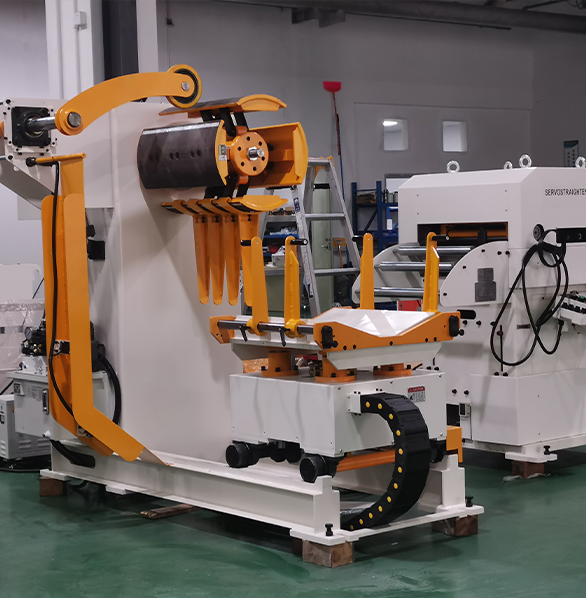
Straightening is a forming operation, and every forming operation changes the material it touches. When an NC straightener feeder bends strip over its work rolls to remove coil set, it work-hardens the outer fibers of the material, shifts the yield strength slightly, and relaxes some of the residual stress locked in the coil. For most stamping work these changes are small and harmless, but for critical parts, thin materials, and applications with tight mechanical requirements, the change can matter. This guide explains what straightening actually does to the material, when the effect is significant enough to care about, and how to control the process so the material properties stay within your specification.
Understanding this subject separates a shop that treats the straightener as a black box from one that can explain why a batch of parts behaves differently, which is the level of control that quality-sensitive customers expect.
There is also a practical quality-control angle worth adding. When a customer requirement includes a mechanical test on the finished part, such as a hardness check or a bend test, the straightener setting is one of the process variables that can influence the result. Documenting the straightener recipe alongside the coil number and the press settings gives your quality team the complete process picture when a result needs investigation. It also demonstrates to auditors that the straightening step is controlled rather than left to operator judgment, which is exactly the kind of process discipline that quality certifications look for.
What Happens to the Metal at the Rolls
When strip bends over a work roll, the material on the outside of the bend stretches and the material on the inside compresses. If the bend is severe enough, both exceed the yield point and the material deforms plastically, which is exactly what removes the coil set. That plastic deformation has two side effects: it work-hardens the deformed zones, and it rearranges the internal stress pattern of the strip.
Work hardening means the deformed material becomes slightly stronger and less ductile than it was before. The effect is concentrated in the surface layers of the strip, where the bending strain is highest, and it is generally small when the straightener is set correctly, because the penetration is just enough to flatten the strip rather than to bend it severely.
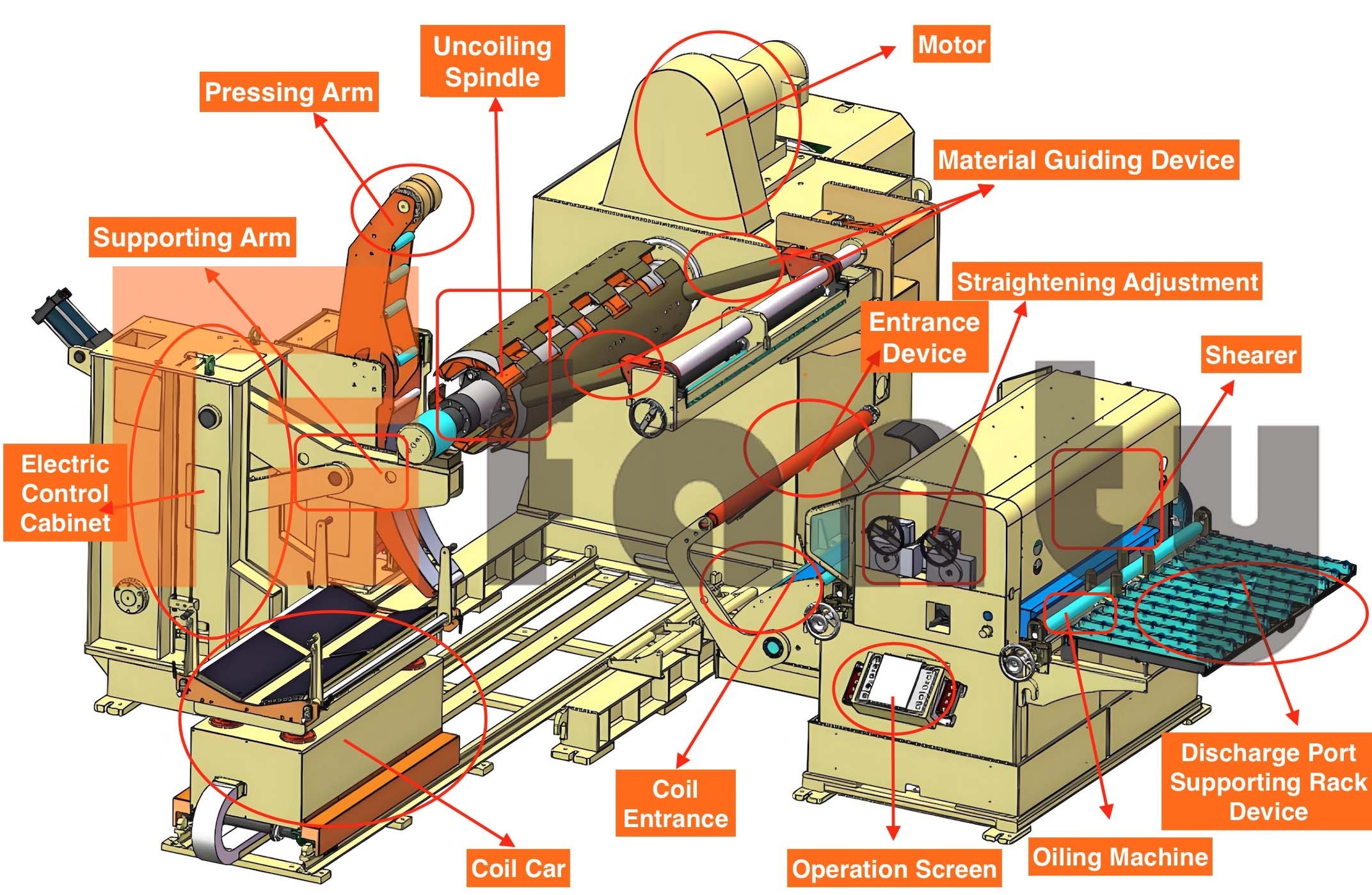 Structurer of nc straightener feeder.
Work Hardening: How Much Is Too Much?
The critical question is whether the straightener changes the material enough to matter. The answer depends mainly on the penetration setting and the number of bends the strip receives.
| Situation | Material effect | Does it matter? |
|---|---|---|
| Correct penetration on mild steel | Minimal surface work hardening | No; within normal material variation |
| Heavy penetration on soft aluminum | Noticeable hardening and possible surface marking | Yes, for ductility-sensitive parts |
| Many small bends on thin strip | Accumulated hardening across the surface | Can matter for subsequent forming |
| High-strength steel at correct setting | Small change relative to the base strength | Usually no; the material is already strong |
A straightener that is set to just remove the coil set, with the minimum penetration needed for flatness, produces a change that is typically within the normal variation of the material as delivered by the mill. Problems appear when the machine is over-driven: excessive penetration or repeated passes on a material that is already work-hardening-sensitive, such as soft aluminum or fully annealed strip, can shift the properties enough to affect a subsequent bending or deep-drawing operation.
Residual Stress: The Quiet Benefit
While work hardening is a side effect to manage, the relaxation of residual stress is often a genuine benefit. Coiled strip carries locked-in stress from the coiling process, and when a part is cut from the strip, that stress can cause the part to distort, curl, or move after forming. Straightening reduces the coil-related residual stress, which is why parts stamped from well-straightened strip hold their shape better through downstream processes.
This is the reason that demanding applications, such as precision blanks, laser-cut parts, and components that are welded or plated afterward, benefit from a straightener even when the strip appears flat enough to feed. The visible flatness and the invisible stress relief come from the same correct setting, and the stress relief is often the more valuable of the two for the finished product.
When the Material Change Actually Matters
For most stamping parts, the straightener's effect on material properties is a non-issue. It matters in four specific situations, and knowing them helps you decide when to verify the material after straightening.
- Deep drawing. A drawn part needs ductility, and over-hardened strip can crack at the draw radius.
- Subsequent bending. A part that is stamped then bent needs the bend zone to remain ductile.
- Certified mechanical properties. If the customer certifies yield or hardness, verify that straightening did not shift the value out of spec.
- Soft or annealed materials. These harden fastest and are the most sensitive to over-driving.
If your application falls into one of these categories, run a simple verification: compare the hardness or a bend test on a straightener-processed sample with an unprocessed sample of the same coil. The comparison tells you whether the process is within the material's normal variation or whether the straightener needs a gentler setting.
Controlling the Effect with the Right Settings
The material effect of straightening is controlled by the same settings that control flatness, which means a correctly set machine produces both flat strip and minimal material change. The principles are simple: use the minimum penetration that achieves the required flatness, avoid unnecessary extra passes, match the roll set to the material so the bend is distributed rather than concentrated, and keep a record of the settings that worked for each material grade.
On the modern NC Straightener Feeder, the recipe system makes this discipline automatic: each grade stores its proven penetration and speed, so the operator does not re-tune the machine every shift. The recipes also document what worked, which becomes valuable evidence if a material question ever arises about a batch of parts.
Frequently Asked Questions
Does straightening make the strip harder?
It work-hardens the surface layers slightly, which can raise the measured hardness by a small amount. With a correctly set straightener the change is typically within the material's normal variation and does not affect the stamped part.
Can straightening make a material too hard to form?
In extreme cases, yes. Over-driving a soft or annealed material with excessive penetration or repeated passes can harden it enough to affect deep drawing or subsequent bending. The prevention is minimal correct penetration and appropriate roll geometry.
Does straightening relieve stress or add stress?
Both, in different senses. It relaxes the coil-related residual stress that causes parts to distort, which is beneficial. It also adds a small amount of surface work hardening, which is the trade-off of the process.
How do I know if my straightener is over-working the material?
Compare a processed sample with an unprocessed sample from the same coil using a hardness test or a bend test. If the processed material is measurably harder or cracks in a bend where the unprocessed material survives, reduce the penetration or the number of passes.
Is the material effect worse at high line speed?
Speed itself has little effect on the metallurgical change, which is driven by the bending strain rather than the rate. High speed mainly adds heating, which is a different effect. The setting that matters is the penetration, not the speed.
Straighten with Control, Not Guesswork
FANTY NC Straightener Feeders are specified with the roll geometry and penetration range matched to your material, and the recipe system stores the gentle, proven settings that protect material properties. Send us your grades and forming requirements for a machine recommendation.
Discuss Your Material Requirements