How Does Die Protection Work on an NC Servo Feeder Line?
- Share
- publisher
- David Park - Senior Stamping Engineer, FANTY Machinery
- Issue Time
- Sep 6,2026
Summary
How die protection systems monitor sensors, feed pitch, and press load on an NC servo feeder line, and how they stop the press before a crash damages the tool.
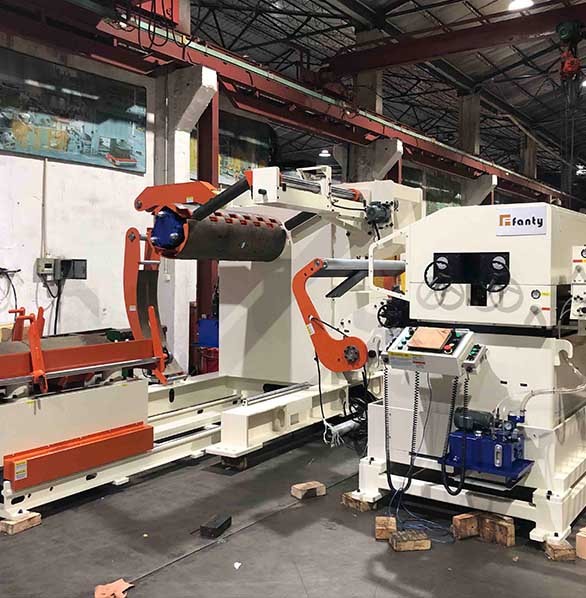
A progressive die is the most expensive single component on a stamping line, and it can be destroyed in a single stroke. A slug that fails to eject, a strip that double-feeds, a pilot that misses its hole, or a sensor wire that breaks can all turn a running die into a pile of scrap tooling in less than a second. Die protection is the system that watches for these faults and stops the press fast enough to save the tool. On a modern line the NC servo straightener feeder plays a central role in that protection, because it knows exactly where the strip is and whether it arrived correctly. This guide explains how die protection systems work, which sensors matter, and how the feeder and the protection controller cooperate to guard the die.
Understanding die protection is not just for automation engineers. Operators, setup staff, and maintenance teams all make decisions that depend on what the system can and cannot detect, and knowing the logic behind the alarms turns a confusing shutdown into a clear diagnosis.
What Die Protection Is Trying to Prevent
Die protection exists to catch faults while they are still cheap. A fault that is caught in the same stroke costs a stopped line and a quick cleanup. The same fault caught one stroke later costs a damaged punch. Two strokes later it can cost the whole die set. The protection system's job is to detect the fault and command a stop within the same cycle, which at 200 strokes per minute leaves only a few hundred milliseconds to sense, decide, and stop.
The faults die protection watches for fall into three families: material faults such as a misfeed or a strip buckle, part faults such as a slug that stayed in the die or a part that did not eject, and process faults such as a sensor failure or an overload. Each family needs a different sensing strategy, and a complete protection system covers all three.
How the Feeder Protects the Die
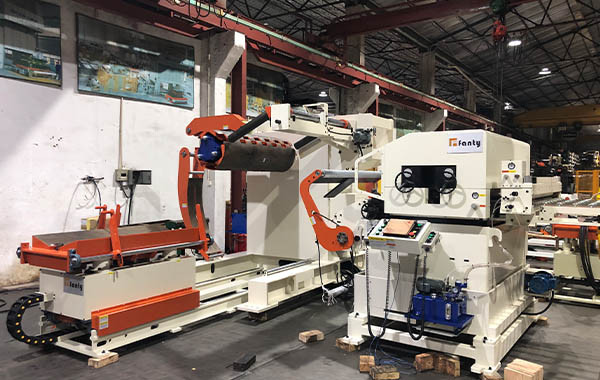
The NC servo feeder is a die protection device in its own right, because it is the only component that knows the true position of the strip. Three feeder functions protect the tool directly.
- Feed pitch verification. After every feed, the feeder confirms the strip reached the programmed position; a short feed stops the line before the die closes on the wrong spot.
- Double-feed detection. If the strip slips and over-feeds, the servo detects the position error and stops before the pilots hit the wrong holes.
- Material-end and buckle alarms. The feeder senses the strip end and strip buckling, stopping the line instead of feeding air or crumpled material into the die.
These feeder functions are fast because they are electronic. The servo controller compares the measured position with the target every cycle and can raise a stop command within milliseconds, far faster than any mechanical detector.
The Sensors That Watch the Die Itself
Beyond the feeder, sensors around the die watch for faults that the feeder cannot see. The table below lists the common sensor types and what each one detects.
| Sensor type | What it detects | Where it is mounted |
|---|---|---|
| Slug / part presence sensor | A slug or part that stayed in the die after the stroke | In the die, at the ejector or the part drop |
| Strip edge sensor | The strip wandering out of its correct path | At the die entry or between stations |
| Pilot / hole sensor | The pilot missing the pilot hole | Under the strip at the pilot station |
| Buckling sensor | Strip compression before the die | On the strip between feeder and die |
| Load monitor | Overload or a stuck part increasing press tonnage | On the press frame or connection rod |
Each sensor connects to the die protection controller, which compares the signal with the expected pattern for that part of the cycle. If a sensor that should be clear at bottom dead center is still blocked, the controller commands an immediate stop. The key to reliable protection is mounting and timing: a sensor that sees the wrong part of the cycle produces either false stops or missed faults.
Load Monitoring: Watching the Press's Effort
Load monitoring adds a layer of protection that does not depend on sensors inside the die. Strain gauges on the press frame measure the actual tonnage of every stroke, and the controller compares it with a reference curve for the job. A missing pilot hole or a double blank raises the load; a broken punch lowers it. Both changes are visible on the load curve within a stroke.
Load monitoring is especially valuable for protecting dies from faults that produce no sensor signal, such as a punch that breaks silently or a strip that feeds at the wrong angle. The load curve is also a diagnostic treasure: after a stop, the recorded curve shows exactly which station was affected, turning a blind shutdown into a targeted repair.
How the Stop Is Executed
Detecting a fault is only half the job; stopping the press fast enough is the other half. The protection controller does not simply cut power to the motor, because a large flywheel press takes time to stop and can coast through several strokes. Instead, the stop sequence uses the fastest available mechanism for the situation.
On a clutch press, the protection system trips the clutch and applies the brake, stopping the slide at the top of the stroke. On a servo press, the controller commands a controlled deceleration that stops the slide in a programmed position. The die protection controller also sends the stop command to the NC servo feeder so the strip stops feeding at the same instant, preventing a half-fed strip from sitting in the die while the operator investigates.
After the stop, the system requires a deliberate reset. The operator clears the fault, confirms the die is clear, and restarts the line through the normal sequence. This manual reset requirement is a safety feature: the line must never restart itself after a protection stop, because the cause has not yet been addressed.
Frequently Asked Questions
Is die protection the same as a light curtain?
No. A light curtain protects the operator from the machine's moving parts, while die protection guards the tool and the process from material and part faults. A complete line usually has both: the light curtain for people and the die protection system for the die.
Can the NC servo feeder alone protect the die without extra sensors?
The feeder protects against feed-related faults such as short feeds, double feeds, and strip buckling, which are a large share of die crashes. It cannot see faults inside the die such as a retained slug, so a complete protection strategy combines feeder monitoring with die sensors and load monitoring.
Why does the line stop for a sensor I think is not important?
Every sensor is wired into the protection logic for a reason, and stopping on a sensor signal is cheaper than repairing the die that the sensor is watching. If a sensor causes repeated false stops, the correct response is to adjust its position or timing, not to bypass it.
How fast can die protection stop a high-speed press?
On a clutch press the stop is typically completed within one stroke, because the clutch is tripped and the brake applied at the top of the cycle. On a servo press the controlled stop can be even faster and more precise, which is one reason servo presses are favored for high-value dies.
Can die protection be added to an existing line?
Yes. Adding a die protection controller, sensors, and a load monitor to an existing press and feeder is a standard retrofit. The feeder's fault outputs connect to the protection controller, and the controller's stop output connects to the press clutch circuit, giving an old line the same protection as a new one.
Protect Your Die Investment with a Complete System
FANTY integrates die protection into the coil-feeding packages we supply, coordinating the NC servo feeder's fault signals with die sensors and load monitoring. Tell us about your press and die, and we will specify the protection level your tooling deserves.
Discuss Die Protection for Your Line