How Does an NC Straightener Feeder Boost Stamping Line Productivity?
- Share
- publisher
- David Park - Senior Stamping Engineer, FANTY Machinery
- Issue Time
- Aug 7,2026
Summary
Learn how an NC Straightener Feeder boosts stamping line productivity. Setup time, scrap, accuracy, and throughput improvements with real numbers.
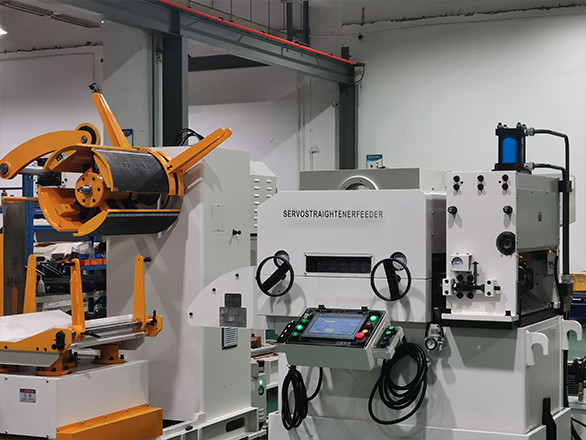
Every stamping plant wants the same thing: more good parts per hour, less scrap, and fewer unplanned stops. The NC Straightener Feeder — an integrated system that combines coil unwinding, precision straightening, and servo feeding — attacks all three at once.
This guide explains how an NC Straightener Feeder boosts stamping line productivity, with real numbers you can measure on your own floor.
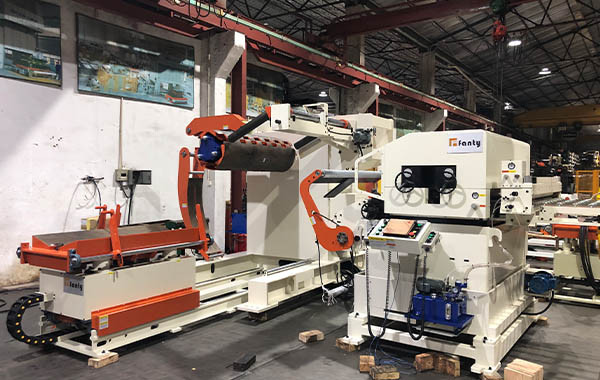
Where Productivity Is Lost in a Stamping Line
Before you can improve productivity, you need to see where it leaks. In a typical coil-fed stamping line, production losses concentrate in four areas:
- Changeover time: 45-90 minutes per job change with separate machines
- Scrap from misfeeds: threading errors and feed drift waste material and cycle time
- Rejects from flatness issues: coil set and wavy strip cause inconsistent parts
- Unscheduled downtime: alignment drift and mechanical wear on separate units
An NC Straightener Feeder addresses every one of these directly — which is why plants that switch from separate decoiler + straightener + feeder layouts consistently report double-digit productivity gains.
Measurable Productivity Gains
| Productivity Metric | Before (Separate Units) | After (NC Straightener Feeder) |
|---|---|---|
| Setup time per job change | 45 - 90 minutes | 5 - 15 minutes |
| Feeding accuracy | ±0.15 - 0.3 mm | ±0.05 - 0.1 mm |
| Scrap rate | 4 - 6% typical | 1 - 2.5% typical |
| Floor space required | 6 - 8 meters | 3 - 4 meters |
| Operator requirement | 2 per line often | 1 per line, sometimes 2 lines |
| Maximum speed | 80 - 120 SPM | 150 - 200+ SPM |
These numbers come from real installations. For example, a mid-sized automotive supplier running 12 press lines switched to integrated NC Straightener Feeder systems and cut setup time per job from 22 minutes to under 2 minutes — a 91% improvement that freed 18 hours of production time per week across their plant.
How Each Function Contributes
Precision Straightening Reduces Rejects
The straightener section removes coil set and internal stress so the strip arrives at the die perfectly flat. Flat material means consistent die filling, fewer edge cracks, and less pilot pin stress — all of which translate directly into fewer rejected parts and longer die life.
Servo Feeding Eliminates Misfeeds
The servo-driven feed section holds ±0.05 mm accuracy at high speeds, synchronized to the press angle encoder. Misfeeds that used to scrap coils and damage expensive progressive dies are virtually eliminated, protecting both material and tooling.
Integrated Control Cuts Changeover Time
One touchscreen controls straightener gap, feed length, and speed profile. Operators store job recipes and recall them in seconds — no more walking between three machines to set up each stage manually.
Quick Wins for Your Line
- Start with job recipes: program your 10 most common parts once, and changeover becomes a single selection
- Track scrap by shift: measure your scrap rate for a month before and after, and quantify the improvement
- Use the loop sensor correctly: proper loop control between decoiler and straightener keeps tension stable at speed
- Maintain rollers on schedule: worn feed rollers silently degrade accuracy — stick to the maintenance calendar
Frequently Asked Questions
How fast is the ROI for upgrading to an NC Straightener Feeder?
Most plants see full payback within 12-18 months through scrap reduction (15-25%), faster changeovers (60-80%), and lower labor requirements. High-mix plants recover the investment even faster.
Can an NC Straightener Feeder handle multiple material types?
Yes. Modern units store multiple job profiles with optimized straightener gap, roller pressure, and feed settings for each material. Switching between steel and aluminum is a single touchscreen selection.
Does the machine need special training to operate?
Basic operation is intuitive via the touchscreen. FANTY includes operator training (on-site or remote), video tutorials, and a printed manual with every machine.
What maintenance does it require?
Daily: clean rollers and check lubrication. Weekly: inspect belt tension and sensor alignment. Monthly: check roller wear and bearings. FANTY provides a detailed schedule and remote diagnostics.
Related reading
Part of the the coil line guide library — the full library of coil handling, straightening and feeding guides from FANTY.
Want to see how an NC Straightener Feeder can boost your line's productivity? Talk to FANTY's engineering team for a free consultation and productivity assessment.
Fanty · 3-in-1 Compact Line
Decoiler, Straightener and Feeder on a Single Frame
Fewer foundations, one control cabinet, faster commissioning. Share your strip spec and target output and our engineers size the combined unit against your cycle.
Get a Free QuoteFANTY Machinery · 13 years on stamping automation · 2,000+ coil lines installed · engineers reply within 24 hours