How Does an NC Straightener Feeder Extend Die Life?
- Share
- publisher
- David Park - Senior Stamping Engineer, FANTY Machinery
- Issue Time
- Aug 14,2026
Summary
Understand how strip flatness and stress relief from an NC Straightener Feeder protect progressive dies from uneven wear, shock loads, and misfeeds, and how to spot the warning signs.
In progressive stamping, the die is both the most valuable tool in the line and the component most sensitive to the condition of the incoming strip.
Strip that carries residual curvature, camber, or internal stress from the coil wreaks havoc on a progressive die: uneven loads, premature wear, cracked punches, and sudden breakdowns. The NC Straightener Feeder sits directly upstream of the die and is the last line of defense before the strip enters the tool.
This guide explains the mechanical link between straightening quality and die life, why an NC servo feeder with a precision straightening head protects your tooling investment, and the practical signs that your straightening setup is costing you die life, based on the field experience of FANTY Machinery with more than 200 installed stamping lines.
The Hidden Cost of Poor Strip Flatness
Coil steel never arrives at the press perfectly flat. The coiling process itself introduces residual stresses: the outer wraps are stretched, the inner wraps are compressed, and the strip remembers this curvature even after it is uncoiled.
The first effect is uneven loading. A bowed strip makes contact with only part of the die surface, so the stamping load concentrates on a few punches and die sections instead of distributing evenly. That concentration accelerates wear on those specific tool areas, causing them to dull faster than the rest of the die.
Eventually the die wears unevenly, and the parts coming off the press become inconsistent in ways that are difficult to trace back to the strip.
The second effect is vibration and shock. When a curved strip is flattened by the die on every stroke, the impact is much harder than a flat strip would produce. The press and the die experience repeated shock loads that fatigue the tool steel and the die components.
Over time, this shock can cause cracks in hardened tool sections, loosened die fasteners, and accelerated wear on guide posts and bushings, all of which shorten die life and increase the frequency of die maintenance.
The third effect is mis-feeding and misalignment. Strip that is not flat tends to shift sideways or lift between the feeder and the die, so the feed length and the lateral position vary from stroke to stroke.
A progressive die is designed around a precise pitch and strip position; when the strip drifts, the tool hits material where it should not, which can break punches or damage die sections. This is why shops with poor strip flatness see a pattern of unexplained die damage that no amount of die redesign seems to fix.
How Straightening Removes Stress from the Strip
A straightening head works by bending the strip alternately over a series of rolls, with each successive bend reversing the previous one. The number of rolls, their diameter, and the depth of penetration determine how thoroughly the strip is worked.
The number of straightening rolls matters directly. A head with more rolls, typically nine or eleven in a quality NC Straightener Feeder, applies more alternating bends and achieves a flatter, more stress-relieved strip in a single pass.
A head with fewer rolls may visually flatten the strip but leave internal stresses that resurface during stamping, causing the material to spring, warp, or shift inside the die. For progressive dies, where consistency over thousands of strokes is everything, the extra rolls are a direct investment in die protection.
Equally important is the precision of the straightening adjustment. The depth of the bend is set by the roll gap, and the correct gap depends on the material thickness, grade, and hardness.
An NC servo feeder system that stores straightening parameters in the controller, alongside the feed parameters, ensures the same straightening setup is applied every time a job runs.
Manual straighteners rely on operator memory and judgment, and a slightly wrong gap on one setup can cause the strip to enter the die with just enough residual stress to create problems.
Die Life Impact: The Numbers That Matter
Quantifying the die-life benefit of good straightening is difficult in a controlled way, because die life depends on dozens of variables, but the field data from FANTY's installations points consistently in one direction: shops that upgrade from a basic straightener to a precision NC Straightener Feeder system typically report longer intervals between die regrinds and fewer unexpected die breakdowns.
Consider the economics. A progressive die for a medium-complexity part can cost tens of thousands of dollars, and a regrind cycle involves removal, reconditioning, and re-installation, plus the lost production while the die is out.
Every additional regrind cycle that can be avoided, or every extension of the interval between regrinds, returns real money. When the strip entering the die is flat and consistent, the die wears slowly and predictably, and the plant can plan tool maintenance instead of reacting to failures.
There is also a less visible benefit: consistency of the parts themselves. A die that wears slowly and evenly produces parts that stay within tolerance for longer, which means fewer rejected batches, less rework, and more stable quality for the customer.
In competitive stamping markets, part consistency is often the difference between keeping and losing a contract. The NC Straightener Feeder contributes to that consistency at the very front of the process, where all the downstream quality begins.
Five Signs Your Straightening Setup Is Hurting Your Die
- Unexplained punch breakage: if punches break at random intervals with no die design change, suspect strip flatness and mis-feeding rather than the die itself.
- Uneven die wear: if one section of the die wears much faster than the rest, the strip is likely entering with localized high spots that concentrate the load.
- Frequent die maintenance: a die that needs regrinding or repair far more often than its history suggests is being damaged by inconsistent input material.
- Strip marks and scratches: marks on the strip between the straightener and the die indicate the strip is rubbing or shifting, which also loads the die unevenly.
- Dimensional drift in parts: if part dimensions drift during a run even though the die is new, the incoming strip condition is the prime suspect.
If any of these signs appear, the first diagnostic step is to check the strip entering the die. Lay a length of strip on a flat surface and see whether it lies flat; measure its flatness across the width and along the length. If the strip shows curvature or waves, the straightening head needs adjustment or the machine needs an upgrade. The die is rarely the first thing to blame; the strip condition is where the evidence usually points.
Why the Integrated 3-in-1 Design Protects Dies Better
In a traditional separate-unit line, the strip travels from the decoiler through a standalone straightener into a standalone feeder, with open spans of strip between the units.
The integrated design also keeps the strip in a controlled state from the moment it leaves the coil until it enters the die. The strip passes from the decoiler into the straightener, then directly into the feeding rollers, with no uncontrolled sagging or drifting in between.
The straightening and feeding parameters are set and stored together, so the strip that reaches the die is flat, correctly positioned, and fed at exactly the right length every stroke. For die protection, this controlled pass-through is worth more than the sum of its parts.
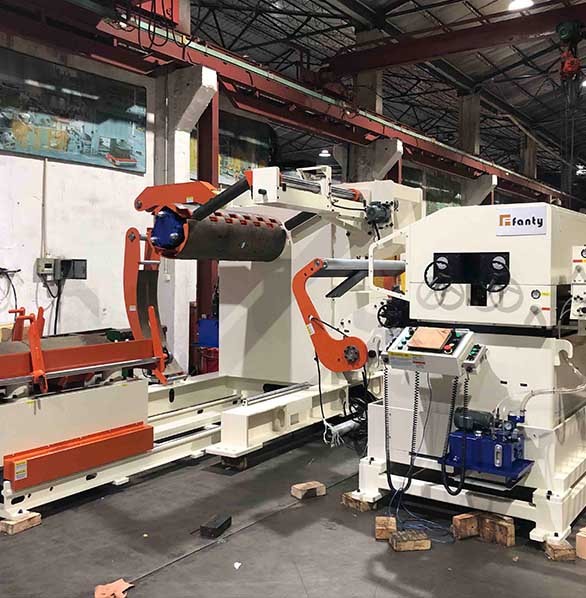
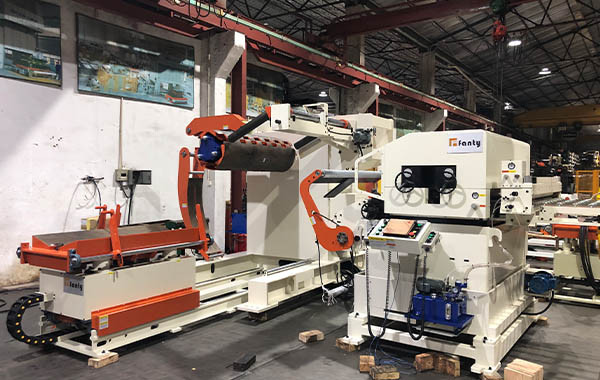
FANTY's NC Straightener Feeder integrated machines are engineered around this principle, with the straightening head and feeding unit sharing a precision-machined base so that the strip path is straight and stable.
The machines hold feeding accuracy to plus or minus 0.05 mm at speeds up to 200 strokes per minute, and they are CE-certified and built in a 45,000 square meter factory by a team of 370 people including more than 80 R&D engineers.
The result is a machine whose every design decision supports the die that runs downstream of it.
Comparing Straightening Configurations for Die Protection
| Configuration | Roll Count (Typical) | Strip Flatness | Die Protection | Best Application |
|---|---|---|---|---|
| Basic Straightener Only | 5-7 rolls | Visual flatness only | Limited; residual stress remains | Simple stamping, generous tolerances |
| Standalone Precision Straightener + Feeder | 9-11 rolls | Good flatness | Good, but open spans add variability | Medium-precision progressive stamping |
| 3-in-1 Decoiler Straightener Feeder | 9-11 rolls | Excellent, controlled pass-through | Excellent; consistent strip to the die | Progressive dies, high-speed precision lines |
| High-Precision Servo Straightening Feeder | 11+ rolls with servo adjustment | Excellent with precise gap control | Highest; repeatable setup every job | High-tensile, tight-tolerance stamping |
The table summarizes how the configuration choice maps to die protection. The key insight is that die protection is not a single feature; it is the combination of flatness, consistency, and repeatable setup that matters. A machine that flattens the strip well but cannot repeat the setup between jobs will still let residual stress reach the die on some runs. The best configuration for progressive dies combines precision straightening, servo-controlled feeding, and stored job recipes, which is exactly the design of a modern NC Straightener Feeder integrated machine.
Frequently Asked Questions About Straightening and Die Life
Can straightening really extend the life of a progressive die?
Yes. Flat, stress-free strip produces uniform die loading, less shock, and consistent feeding, all of which reduce die wear. Shops that improve strip condition typically see longer intervals between regrinds and fewer unexpected die breakdowns, even though die life depends on many factors.
How many straightening rolls do I need to protect my die?
For progressive stamping, nine or eleven rolls is the practical standard for thorough stress relief. Fewer rolls may leave internal stresses that resurface inside the die. The right number also depends on material thickness and grade, so confirm the recommendation with your supplier's engineers.
How do I know if my strip is flat enough for my die?
Check a length of strip on a flat surface for curvature and waves, measure flatness across width and length, and watch for the warning signs: punch breakage, uneven die wear, frequent maintenance, and dimensional drift. If any appear, the strip condition is the first place to investigate.
Does an integrated 3-in-1 machine protect dies better than separate units?
Generally yes, because the strip travels from coil to die through a controlled, closely coupled path with no open spans where it can drift or sag. The straightening and feeding parameters are also stored together, so the strip reaching the die is consistent from job to job.
Related reading
- how leveling improves strip flatness
- how to set roll pressure
- how to hit a flatness spec on a coil line
Part of the 3-in-1 decoiler straightener feeder — the full library of coil handling, straightening and feeding guides from FANTY.
Protect your die investment with the right straightening solution.
FANTY Machinery engineers will evaluate your strip material, die requirements, and production speeds, and recommend an NC Straightener Feeder configuration that delivers the flatness and consistency your progressive dies need, backed by 12 years of experience and CE-certified quality.
Discuss Your Die Protection Needs