How to Automate Stamping Lines with an NC Servo Feeder?
- Share
- publisher
- David Park - Senior Stamping Engineer, FANTY Machinery
- Issue Time
- Aug 31,2026
Summary
How to automate a stamping line with an NC servo feeder: what automation really means, the 5-step conversion plan, and the accuracy and labour gains to expect.
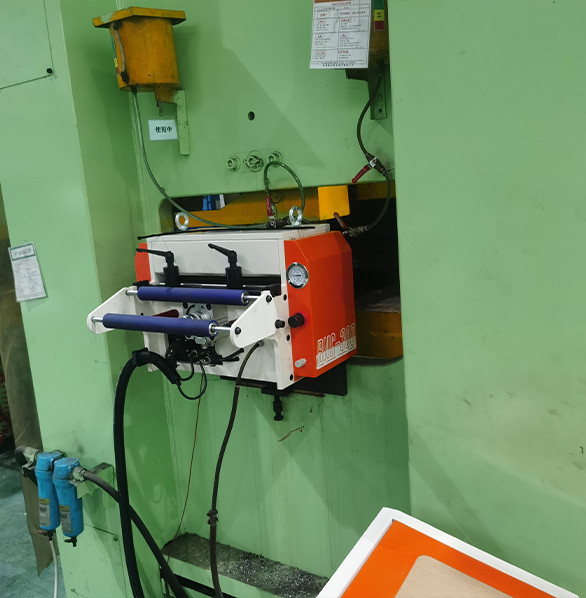
Stamping automation is no longer a luxury reserved for large automotive plants. Even a mid-size press shop can dramatically improve output, consistency, and labour efficiency by automating the coil feeding stage — and the NC servo feeder is the component that makes it possible.
This guide walks through what stamping automation really involves, how an NC servo feeder fits into an automated line, and the practical steps to convert your existing press line step by step.
Whether you run a single press or a full 3-in-1 decoiler straightener feeder arrangement, the principles are the same: remove manual feeding errors, lock in repeatable accuracy, and let the control system run the line. If you are evaluating automation for your shop, this article gives you the framework to plan it properly.
What Stamping Automation Really Means
Stamping automation is often misunderstood as full robotics. In reality, most successful automation projects start at the material handling stage, where the biggest gains are available with the least complexity.
Automation exists on a spectrum. At level one, an NC servo feeder replaces manual feeding and delivers precise feed lengths every stroke. At level two, the feeder is synchronised with the press, creating a continuous automatic cycle.
At level three, sensors, stackers, and a central controller manage the whole line, including coil change detection and quality monitoring. Most shops start at level one and progress as confidence and volume grow.
The key insight is that every level of automation depends on the same foundation: a feeding device with reliable, repeatable accuracy. Without it, no amount of robotics or software can make the line consistent. That is why the NC servo feeder sits at the centre of virtually every coil-fed stamping automation project.
The Role of the NC Servo Feeder in an Automated Line
An NC servo feeder performs three jobs in an automated line. First, it feeds an exact length of strip into the die for every press stroke, using a servo motor and encoder that can hold accuracy in the range of ±0.05 mm.
Second, it synchronises with the press through a cam or encoder signal, so the feed happens in the precise window when the press is at the top of its stroke. Third, it stores multiple feed recipes, so changing between products is a matter of calling up a program rather than re-setting mechanical stops.
Because the feeder is programmable, automation brings flexibility as well as speed. A single press line can run different feed pitches, different materials, and different stroke patterns across shifts without mechanical changeover. For high-volume production, the feeder can run at speeds that support presses operating at 200 SPM while keeping feed length stable.
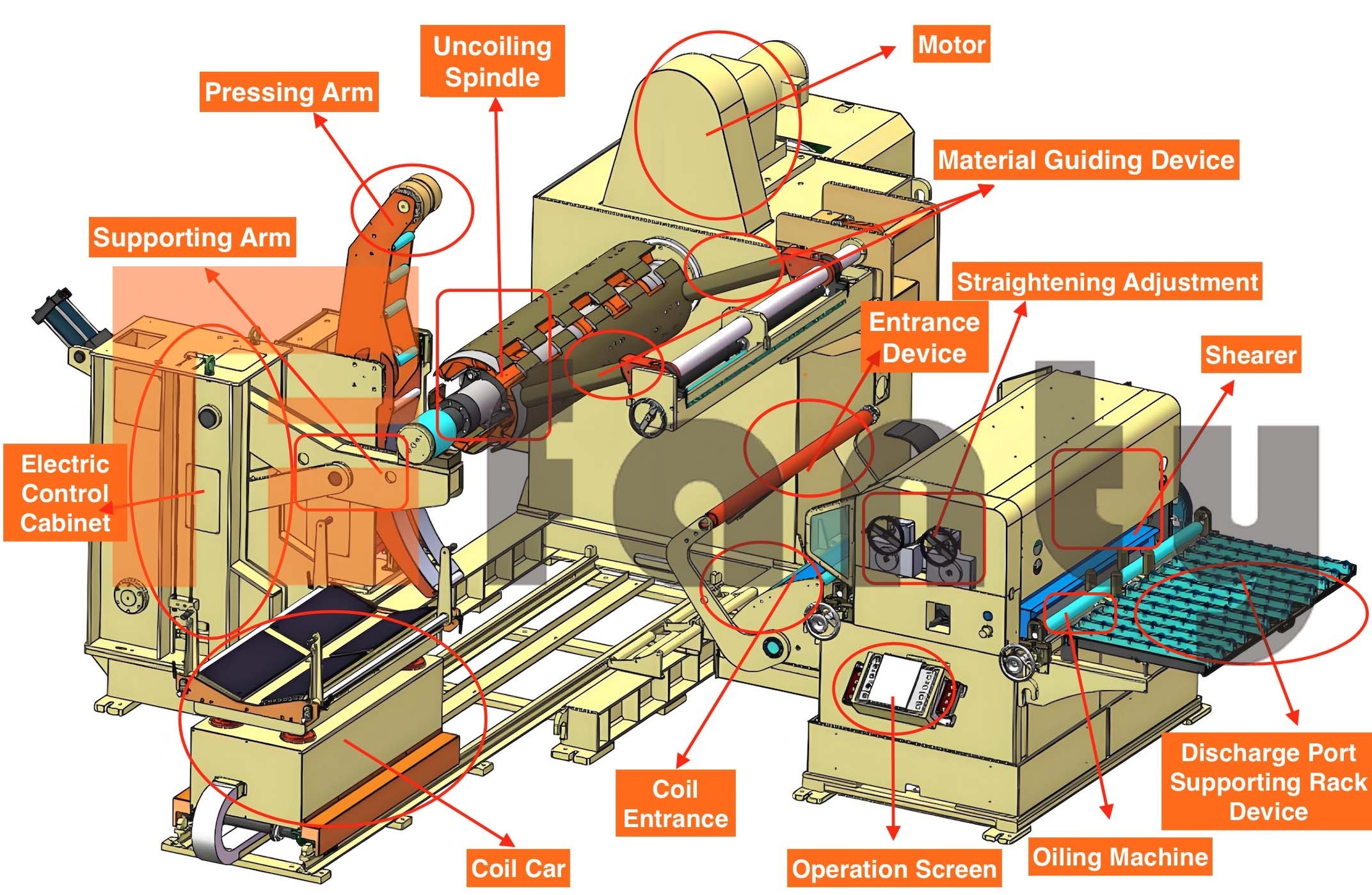
In a full 3-in-1 decoiler straightener feeder configuration, the decoiler controls coil tension, the straightener removes coil set, and the servo feeder drives the strip forward. The control system of the feeder can also coordinate the straightener speed, creating one smooth, continuous material flow from coil to die.
This integration is what separates an automated line from a collection of separate machines.
5 Steps to Automate Your Existing Stamping Line
Converting an existing line does not require replacing the press. In most cases the press is the most valuable asset and stays in place. The conversion follows five practical steps:
- Audit the current process: measure feed length variation, scrap rate, changeover time, and the number of operators involved.
- Select an NC servo feeder sized for your material width, thickness, and maximum feed length, with headroom for future products.
- Plan the line layout: decoiler to straightener to feeder to press, with adequate strip pass line and safety guarding.
- Wire the press signal interface and program the first feed recipes with the supplier's commissioning engineer.
- Train operators and run a controlled trial: verify feed accuracy, adjust straightening pressure, then ramp to full speed.
Each step is deliberately small.
Manual vs Automated: What Changes on the Shop Floor
| Area | Manual Feeding | With NC Servo Feeder |
|---|---|---|
| Feed accuracy | Operator dependent, visible part-to-part variation | ±0.05 mm repeatable across the whole shift |
| Speed | Limited by operator reaction time | Synchronised with press, up to 200 SPM support |
| Scrap rate | Higher due to mis-feeds and length drift | Minimised by locked-in program control |
| Changeover | Mechanical stops re-set manually | Recipe recall in seconds |
| Labour | One or more operators feeding continuously | One operator supervising multiple machines |
| Consistency | Depends on shift, fatigue, and skill | Identical feed behavior every stroke |
The table shows why automation pays back quickly. The most visible gain is labour: a single operator can supervise several automated lines, and the reduction in scrap and rework compounds every shift. Less visible but equally important is consistency — an automated line produces the same part quality at 8 a.m. and at 11 p.m., which makes downstream processes predictable.
Common Automation Pitfalls and How to Avoid Them
The most common pitfall is underestimating the straightening requirement. A brand-new NC servo feeder cannot hold accuracy if the strip arrives with coil set, camber, or waves.
The second pitfall is poor press signal wiring. The feeder must receive a reliable signal at the correct point of the press cycle. Work with the feeder supplier during commissioning rather than leaving the interface to local electricians who may not understand cam timing. A mis-wired signal causes intermittent mis-feeds that are extremely hard to diagnose.
The third pitfall is skipping operator training. Automation changes the operator's job from physical work to supervision, which requires a different skill set. A short structured training session on the feeder control panel, recipe programming, and alarm handling pays for itself in the first week.
Finally, do not automate a process that is not stable yet: fix material quality and die condition first, then automate.
FANTY's Track Record in Stamping Automation
FANTY has spent 12 years helping stamping shops automate, with more than 200 active line installations in over 60 countries.
The result is a proven automation path: FANTY's NC servo feeder delivers ±0.05 mm feeding accuracy and supports press speeds up to 200 SPM, while the integrated 3-in-1 decoiler straightener feeder combines the whole front end into one controlled unit.
When you automate with FANTY, you get a partner who has seen the pitfalls across hundreds of installations and can steer your project around them.
Frequently Asked Questions
Can I automate a line without replacing my existing press?
Yes. Automation of the feeding stage is independent of the press itself. The NC servo feeder connects to the press through the existing signal interface, so most presses can be automated without modification to the main frame or drive.
How long does it take to commission an automated feeding line?
A typical installation, including mechanical alignment, wiring, programming, and trial runs, takes a few days with the supplier's engineer on site. Simple single-press lines can be commissioned in as little as two to three days.
What accuracy can I expect from an automated NC servo feeder line?
FANTY's NC servo feeder holds ±0.05 mm feeding accuracy under stable conditions. Achievable accuracy depends on strip quality, straightening effectiveness, and press condition, which is why straightening quality is part of the automation project.
Do I need a 3-in-1 machine for automation, or separate units?
Both work. A 3-in-1 decoiler straightener feeder integrates the front end into one unit with shared control, which simplifies commissioning and saves floor space. Separate units give more flexibility for extreme coil weights and widths.
How do operators learn to run the automated feeder?
FANTY includes operator training during commissioning, covering the control panel, recipe programming, daily checks, and alarm handling. Most operators are confident within the first week of supervised production.
Related reading
Part of the the coil line guide library — the full library of coil handling, straightening and feeding guides from FANTY.
Automate Your Stamping Line with a Precision NC Servo Feeder
Tell us your press tonnage, material, and feed length — we will propose the right automation package and send the full specification.
Send Inquiry to FANTY