How to Automate a Sheet Metal Stamping Line?
- Share
- publisher
- David Park - Senior Stamping Engineer, FANTY Machinery
- Issue Time
- Jul 31,2026
Summary
Complete guide to automating a sheet metal stamping line with decoilers, NC servo feeders, straighteners, and control systems from FANTY.
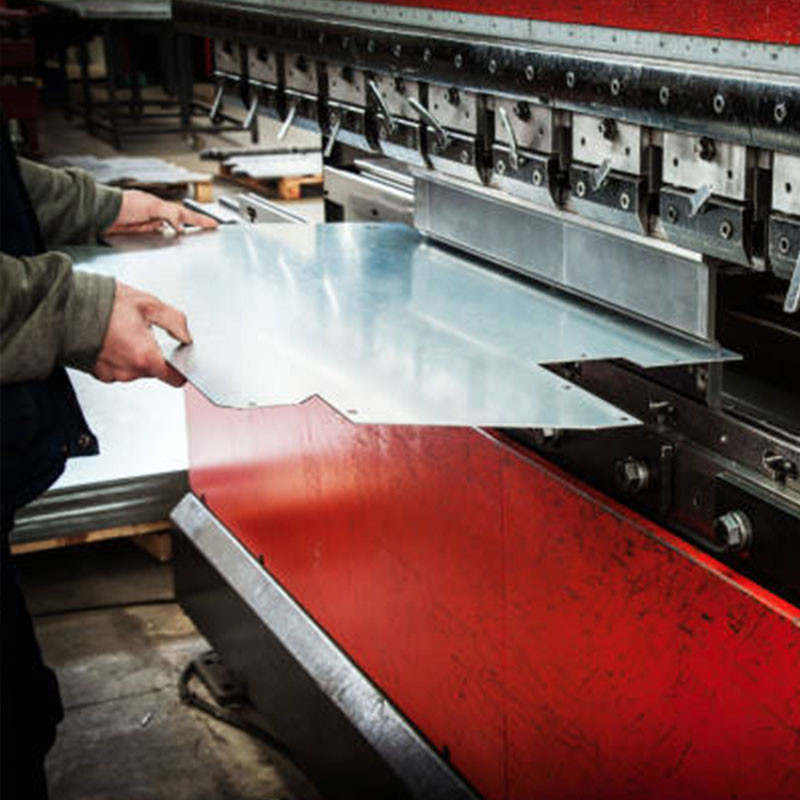
Automating a sheet metal stamping line is one of the most impactful investments a manufacturing facility can make. Manual feeding and handling of coil stock is slow, inconsistent, and increasingly difficult to sustain in today's labor-constrained environment.
A fully automated stamping line transforms raw coil steel into finished stamped parts with minimal human intervention, dramatically improving throughput, quality, and safety.
In this comprehensive guide, FANTY Machinery explains exactly how to automate your sheet metal stamping line step by step, covering equipment selection, integration, and optimization.
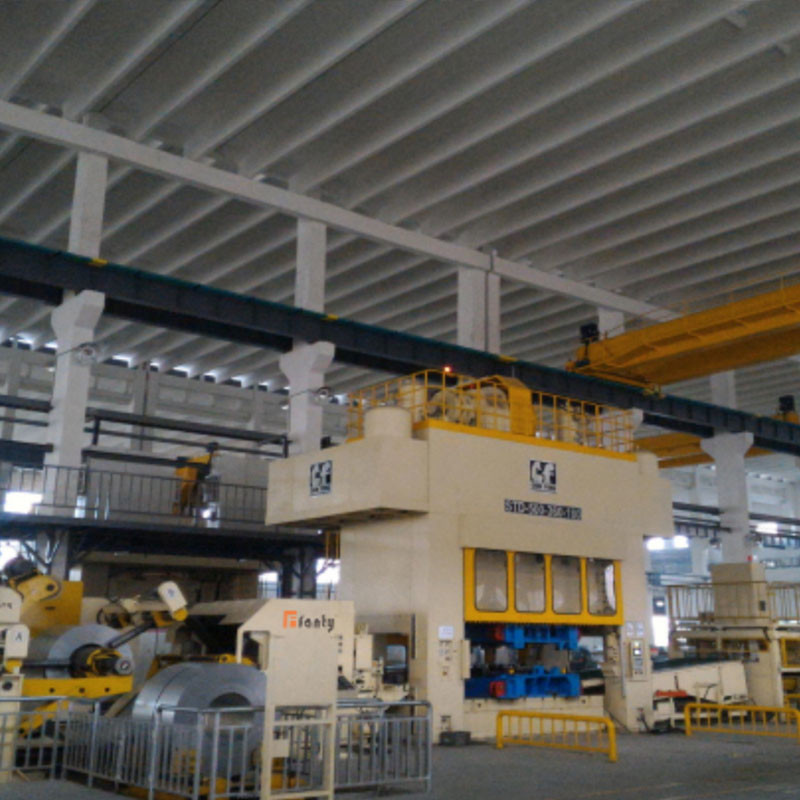
A fully automated stamping line maximizes throughput and minimizes labor costs.
Why Automate Your Stamping Line?
The benefits of stamping line automation go far beyond labor reduction. Here are the key drivers that push manufacturers toward full automation:
- Consistent quality: Automated feeding eliminates human error in material positioning. NC servo feeders maintain ±0.05 mm feed accuracy stroke after stroke, ensuring every stamped part meets specification
- Higher production speed: Automated lines can operate at 200 SPM or more, limited only by the press capacity and die design. Manual feeding typically caps out at 40–60 SPM
- Reduced material waste: Precise pitch control and automatic scrap ejection minimize material loss. Combined with an NC servo straightener, coil set and curvature are eliminated before feeding, saving 2–5% in raw material
- Improved operator safety: Automated coil loading, feeding, and part ejection keep operators away from the press danger zone. This dramatically reduces the risk of hand and finger injuries
- Data collection and traceability: Modern automation systems track stroke count, feed length, speed, and fault events, enabling data-driven process optimization and quality traceability
Core Components of an Automated Stamping Line
An automated sheet metal stamping line consists of several integrated subsystems that work in sequence:
| Component | Function | Automation Level | FANTY Recommendation |
|---|---|---|---|
| Coil Loading Car | Transports coil from storage to decoiler mandrel | Motorized, remote-controlled | Hydraulic lifting car with photo-eye positioning |
| Decoiler (Coil Cradle) | Holds and uncoils the coil, releasing material steadily | Auto-expanding mandrel, hydraulic arm control | Motorized decoiler with variable speed control |
| Straightener | Removes coil curvature and residual stress from the strip | NC servo controlled, roller gap adjustment | NC Servo Straightener with 7–11 rollers |
| NC Servo Feeder | Advances precise strip length into the press each stroke | Fully programmable, ±0.05 mm accuracy | High-torque AC servo motor feeder |
| Press (Punch Press) | Stamps the part using dedicated tooling and die | PLC-controlled clutch, SPM programming | High-speed press with safety light curtain |
| Scrap Chopper / Rewinder | Disposes of scrap skeleton or rewinds remaining strip | Automatic activation on press signal | Motorized scrap winder with tension control |
| Control System | Coordinates all line components via PLC/HMI | Touchscreen control, recipe storage | FANTY integrated control cabinet with remote access |
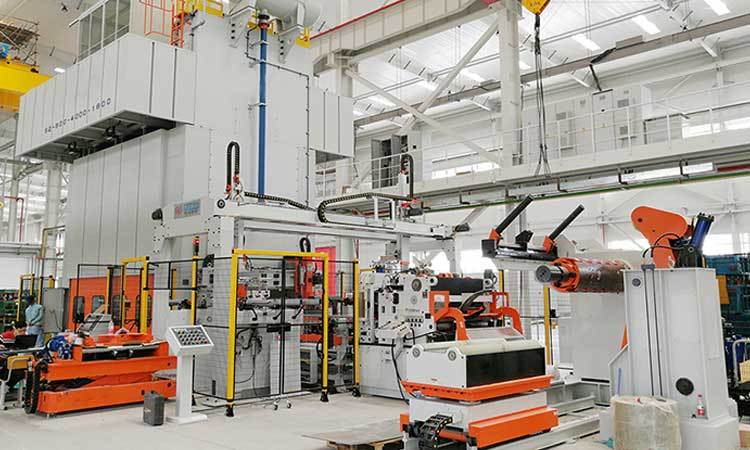
Step-by-Step Automation Process
Here is the sequence of operations in a fully automated sheet metal stamping line:
- Coil Loading: The coil is placed on the loading car by overhead crane or forklift. The car moves the coil onto the decoiler mandrel. The mandrel expands hydraulically to secure the coil, and the hold-down roller prevents uncoiling.
- Strip Feeding into Straightener: The coil end is guided into the straightener rollers. An operator performs initial threading; subsequent coil changes use auto-threading guides. The straightener flattens the strip by passing it through alternating rollers with precise gap adjustment.
- Strip Feeding into NC Feeder: From the straightener, the strip enters the NC servo feeder. Upper and lower pinch rollers clamp the strip. The servo motor advances the strip by the programmed pitch length (typically 50–1,000 mm) at the exact moment the press opens after each stroke.
- Press Stamping Cycle: When the feeder completes the pitch advance and signals ready, the press executes one stroke. The feeder controller and press controller are synchronized via encoder feedback or PLC handshake signals to ensure perfect timing.
- Part Ejection and Scrap Handling: The stamped part is ejected via chute or conveyor. The scrap strip passes through a scrap chopper that cuts it into manageable pieces, or is wound onto a scrap rewinder.
- Process Monitoring: Sensors monitor material tracking, feeding accuracy, press tonnage, and lubrication status. Any deviation triggers an alarm or automatic line stop, preventing damage to the die or press.
Key Considerations for Automation Success
- Material variability: Real-world coils vary in thickness, width, curvature, and surface condition. FANTY's NC servo feeder uses adaptive control algorithms that compensate for material variations in real time, maintaining ±0.05 mm accuracy regardless of strip condition
- Line speed matching: All components must be sized for the maximum required SPM. A bottleneck at any stage limits the entire line. FANTY's engineering team performs speed analysis for your specific press and material parameters
- Space planning: An automated line requires 8–15 meters from coil loading to press feed height. Floor space should include coil storage, the automation line itself, and part collection areas. Our 45,000 m² factory builds systems optimized for compact footprints
- Power and utility requirements: Servo-driven lines typically require 380V/480V three-phase power, compressed air for clutches and scrap choppers, and cooling for control cabinets. FANTY provides a detailed utility requirements document for every installation
- Operator training: Even automated lines need skilled operators for setup, die changeovers, and troubleshooting. FANTY includes comprehensive training programs for your team, covering HMI operation, recipe management, and preventive maintenance
FANTY's Integrated Automation Solutions
End-to-End Integration
FANTY supplies all line components — decoiler, straightener, feeder, control system — as a matched set. This eliminates compatibility issues and single-source responsibility for performance.
CE-Certified Safety
Every component is designed and manufactured to CE standards, with safety guards, light curtains, emergency stops, and interlocks integrated into the control logic.
Global Installation Support
Our team has commissioned over 200 automated lines across 60+ countries. We provide on-site installation supervision, commissioning, and remote monitoring after handover.
Proven Track Record
From automotive tier-1 suppliers to appliance manufacturers, FANTY's automated stamping lines are trusted by leading manufacturers worldwide. Our 370-person team, including 80+ R&D engineers, ensures continuous innovation and reliability.
Frequently Asked Questions About Stamping Line Automation
How much does it cost to automate a sheet metal stamping line?
The cost depends on coil size, press tonnage, automation level, and existing equipment compatibility. A basic retrofit with NC feeder and straightener may cost $20,000–$50,000, while a complete greenfield line with decoiler, straightener, feeder, and control system ranges from $50,000 to over $200,000. FANTY provides detailed quotes based on your specific production requirements.
Can existing presses be retrofitted with automation?
Yes. Most existing C-frame and gap-frame presses can be retrofitted with an NC servo feeder and straightener. The key requirements are that the press has a consistent stroke timing signal (cam switch or encoder) and sufficient bolster area for feeder mounting. FANTY has retrofitted hundreds of existing presses across various makes and models.
How long does it take to commission an automated stamping line?
A typical installation and commissioning takes 3–7 days on-site, depending on line complexity. This includes mechanical installation, electrical connection, control system programming, and operator training. FANTY's pre-configured control cabinets and recipe-based programming significantly reduce setup time.
What maintenance is required for an automated stamping line?
Daily: check lubricant levels, inspect feed rollers for wear, verify sensor alignment. Weekly: clean straightener rollers, check belt tension on servo drives. Monthly: inspect electrical connections, calibrate feed length using a test strip. FANTY provides a detailed maintenance schedule and spare parts list with every installation.
Can I integrate multiple presses into one automated line?
Yes. Progressive die lines and transfer press systems can be integrated with synchronized feeders and conveyors. FANTY has implemented multi-press automation for complex parts requiring multiple forming operations, with centralized control and coordinated feeding between stations.
Automate Your Stamping Line with FANTY
Ready to transform your press shop into a highly efficient production line? FANTY Machinery offers complete automation solutions for sheet metal stamping lines, from individual NC servo feeders to fully integrated turnkey systems.
Related reading
- which part limits feeding accuracy
- what feeding accuracy to expect
- how to hold feed accuracy on a coil line
Part of the the coil line guide library — the full library of coil handling, straightening and feeding guides from FANTY.