How to Fix Center Buckle with an NC Straightener Feeder?
- Share
- publisher
- David Park - Senior Stamping Engineer, FANTY Machinery
- Issue Time
- Sep 3,2026
Summary
Why center buckle forms in coiled strip and how an NC Straightener Feeder removes it: diagnosis steps, roll pattern adjustment, prevention checklist, and die protection advice.
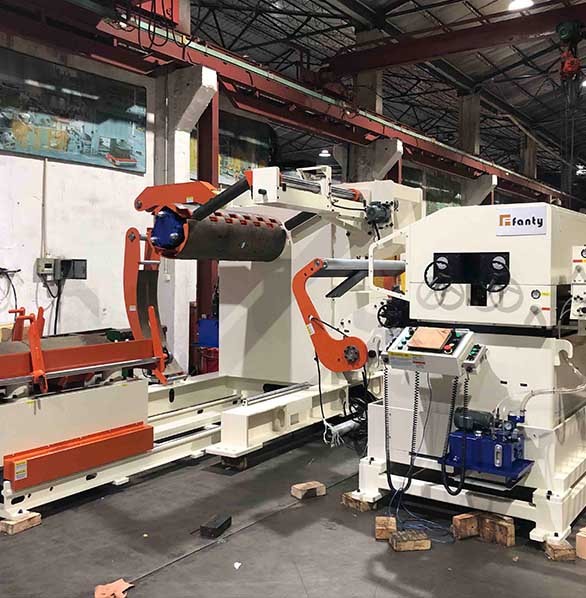
Center buckle, sometimes called center wave or oil-canning, appears when the center fibers of the strip are longer than the edge fibers. The strip looks flat at the edges while the middle lifts or ripples, and once it reaches the die, the buckle causes unstable feeding, poor flatness on the finished part, and scrap.
Understanding the cause and the straightening response turns a mysterious quality problem into a routine setup adjustment on your NC Straightener Feeder.
This guide explains the root causes of center buckle, how a straightening head removes it with the correct roll bite pattern, and the measurement and setup routine our engineers use on more than two hundred installed coil lines. Follow the diagnosis steps and you will correct center buckle at the source instead of fighting its symptoms downstream.
What Center Buckle Looks Like and Why It Forms
Run a strip through a light pass and watch its profile from the end. With center buckle, the middle of the strip rises in a gentle dome or a series of shallow ripples while both edges lie flat on the table.
Coil history explains most cases. A coil wound under uneven tension, a slitting line with dull knives, or a rolling mill with asymmetric work-roll profile all produce strip whose center is longer than its edges.
The defect can also change along a single coil, so operators see good strip at the outer laps and buckle deeper into the coil.
The good news is that an NC Straightener Feeder bends the strip over a series of work rolls, and that bending can redistribute the stress and equalize the fiber lengths, provided the straightening head is set correctly for the defect direction.
How Straightening Removes Center Buckle
Straightening works by bending the strip alternately over and under successive work rolls, which stretches the shorter fibers and relaxes the longer ones until the whole width reaches the same length.
This is where operator knowledge matters. If the strip has edge wave instead, the correct response is the opposite, a concave pattern that works the center harder.
Using the edge-wave adjustment on a center-buckle strip makes the defect worse, which is why it is important to identify the defect direction before turning any adjustment screw.
The roll arrangement of a modern NC Straightener Feeder, with independently adjustable banks and a readable scale, makes it possible to set the pattern deliberately and repeatably for each coil family.
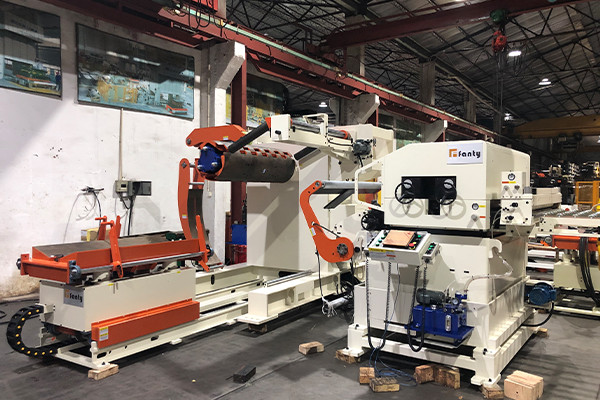
Step-by-Step Center Buckle Correction Procedure
Start by confirming the defect. Uncoil a few meters, lay it on a flat table, and check both the crosswise profile and the lengthwise ripple; compare the center against the edges with a straightedge.
When the diagnosis is confirmed, increase the bite at the edges of the roll set relative to the center in small steps, running a fresh sample after each adjustment, until the strip sits flat across its full width.
Then gradually increase the feed speed to the production value and recheck, because straightening response changes slightly with speed and tension. Record the final settings against the coil specification so the next coil from the same supplier starts with the proven setup instead of a fresh guess.
Defect Diagnosis Reference Table
| Strip Defect | Visible Profile | Root Cause | Straightening Response |
|---|---|---|---|
| Center buckle (center wave) | Middle lifts or ripples; edges flat | Center fibers longer than edges | Work the edges harder; slightly convex pass pattern |
| Edge wave (wavy edge) | Edges ripple; center flat | Edge fibers longer than center | Work the center harder; slightly concave pass pattern |
| Crossbow (transverse curl) | Strip curled across its width | Coil set from winding radius | Increase overall roll bite and reduce to relax residual curl |
| Coil camber (longitudinal curve) | Strip curves left or right along length | Asymmetric edge elongation | Check roll parallelism and side guides before straightening |
Center Buckle Prevention Checklist
- Confirm the defect direction on a flat table before adjusting the straightener, since edge wave and center buckle need opposite settings.
- Change the roll bite in small steps and sample after every adjustment instead of making large corrections blindly.
- Record the final straightener settings for each coil ID, width, and material grade, and reuse them for repeat coils from the same mill.
- Verify roll parallelism monthly; a tapered roll gap creates one-sided defects that no pattern adjustment can fully remove.
- Inspect incoming coils at the slitting or receiving stage and flag suppliers whose coils arrive with consistent center buckle.
- Keep straightening rolls clean and correctly lubricated so the strip does not skid and create secondary surface defects.
Why Center Buckle Is Dangerous for the Die
A buckled strip rarely reaches the die as a flat sheet, and the consequences are expensive. In a progressive die, the pilot enters the strip expecting a controlled hole position; a center buckle lifts the strip away from the die face so the pilot punches through misaligned material, producing scrap and sometimes breaking the pilot. In a forming operation, the buckle is pressed flat by the die and reappears as springback or distortion in the finished part, so the part is out of tolerance even though the die is perfect.
There is also a safety dimension. A strip with a strong center buckle can flutter as it exits the straightener, catching on guards or feeding unevenly into the die area, which is exactly the kind of unpredictable condition that causes unexpected stops or tool damage at high stroke rates.
Removing the buckle at the NC Straightener Feeder, before the strip reaches the die, protects the tool, the part quality, and the operator in one adjustment.
How FANTY Builds Straighteners That Fix Flatness
FANTY Machinery has engineered coil straightening and feeding equipment for twelve years in a 45,000 m² factory with 370 employees, more than 80 of them in R&D.
Can an NC Straightener Feeder fully remove center buckle?
In most cases yes, when the defect is within the capacity of the straightening head and the roll pattern is set correctly for the defect direction. Severe or work-hardened strip may need a second pass or a larger straightener.
How can I tell center buckle from edge wave without a gauge?
Place the strip on a flat table. If the middle lifts or ripples while both edges touch, it is center buckle. If the edges rise while the center touches, it is edge wave. The two need opposite roll patterns.
Will more roll bite always make the strip flatter?
No. Excessive bite can reverse the defect, work-harden the strip, or create new ripples. Increase the bite in small steps and sample after each change until the profile is flat, then stop.
Why does the same coil show buckle only on some parts of its length?
Mill and slitting conditions vary along a coil, especially in tension and roll temperature. If buckle appears only in a band of laps, note the position and adjust the straightener for the worst section so the whole coil is acceptable.
Does feeding speed change the straightener setting I need?
Yes, slightly. Straightening response depends on strip tension and speed, so set the pattern at a moderate speed and verify at your production speed, then lock the proven value into your setup record.
Related reading
- how to set roll pressure
- how back tension affects straightening
- how to hit a flatness spec on a coil line
Part of the 3-in-1 decoiler straightener feeder — the full library of coil handling, straightening and feeding guides from FANTY.
Need a Straightening Setup for Your Strip Profile?
Describe your strip material, width, thickness, and the defect you are seeing, and FANTY's engineers will recommend the work-roll configuration and setup procedure for your NC Straightener Feeder. We can also supply the gauge and setup chart that turns flatness control into a repeatable process.
Ask a Straightening Engineer