How to Fix Springback in High-Strength Strip Straightening?
- Share
- publisher
- David Park - Senior Stamping Engineer, FANTY Machinery
- Issue Time
- Sep 4,2026
Summary
Why high-strength strip springs back after straightening and how to compensate with an NC Straightener Feeder: penetration depth, roll count, and multi-pass strategy.
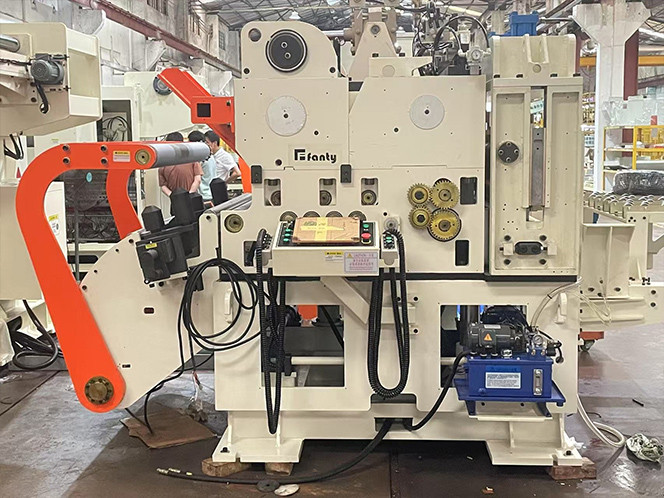
Straightening high-strength steel is a battle against memory. The strip comes off the coil with a tight radius that the steel wants to keep, and when the straightener bends it flat, the material tries to spring back toward its original shape the moment it leaves the last work roll.
An NC Straightener Feeder that flattens mild steel perfectly can leave a visible residual arc in high-tensile material, and the difference shows up downstream as feeding problems, die wear, and parts that do not sit flat.
This guide explains why springback happens, how to compensate for it on the straightener, and the machine features that make high-strength work predictable instead of experimental.
The physics applies to any material with a high yield strength: advanced high-strength steels used in automotive, spring steel, stainless grades, and hardened strip.
The approach described here is the same one FANTY application engineers use when they set up a straightener for a customer running 590 to 1180 MPa material, and it will help you either set up your existing machine correctly or specify the right machine for the job.
Why Springback Happens
When a straightener bends strip over a work roll, the outer fibers of the material yield in tension and the inner fibers yield in compression. Below the yield point, the bend is elastic and disappears when the load is removed. Above it, the material takes a permanent set.
The practical result is that the amount of curvature the rolls must create is larger than the flatness you want at the exit. If you simply set the rolls to make the strip flat, high-strength material will spring back to a visible arc. The straightener must over-bend the strip enough that the elastic recovery lands exactly at flat.
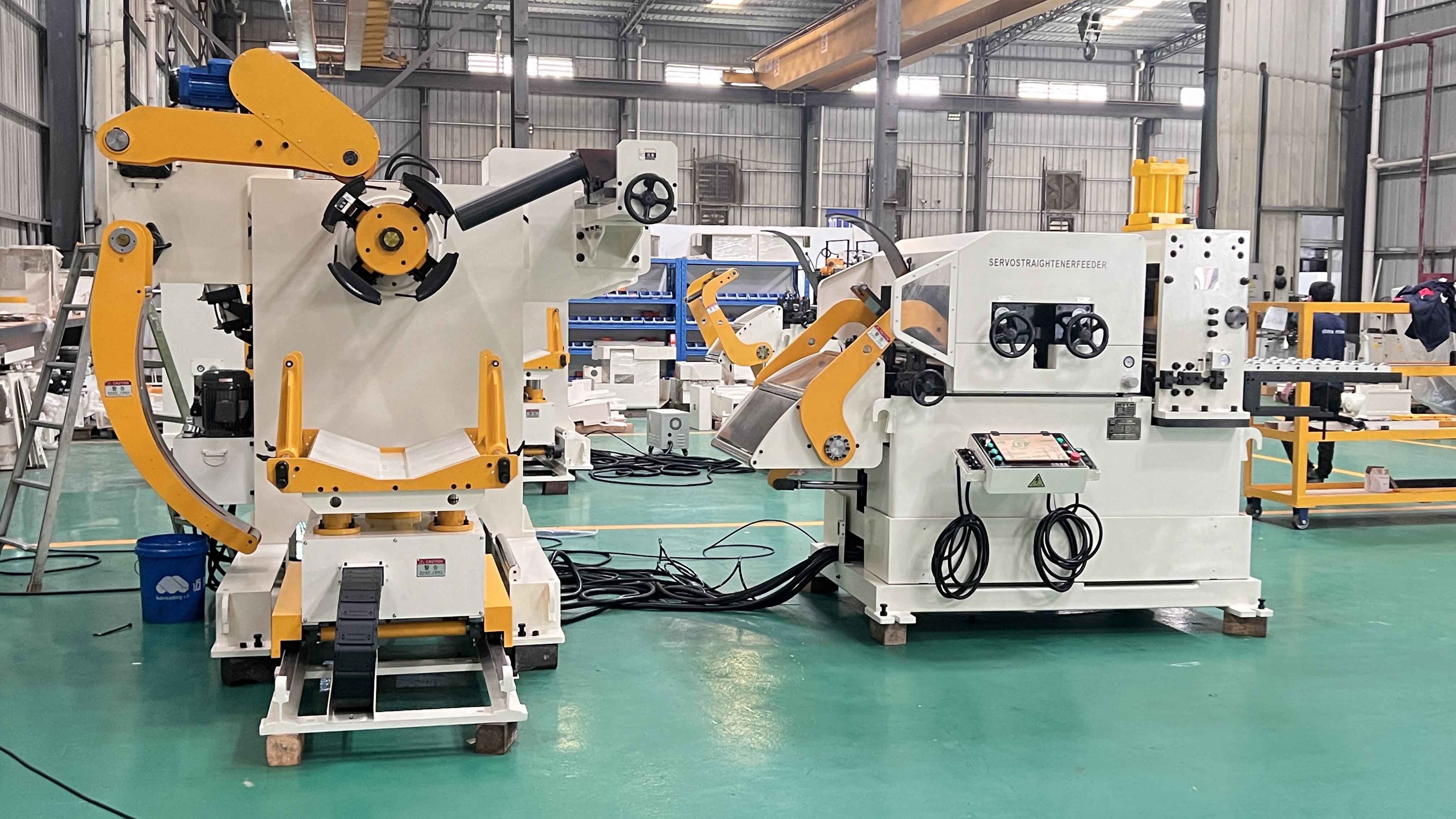 Straightening high-strength strip requires controlled over-bending.
The Compensations That Actually Work
Four adjustments control springback compensation, and they work together rather than alone.
- Increase roll penetration. Push the work rolls deeper so the strip is bent past flat, leaving room for the elastic recovery to return it to level.
- Add straightening passes. Multiple passes at increasing penetration flatten progressively instead of fighting the material in one heavy pass.
- Use smaller work rolls. Smaller diameters bend a tighter radius and push more of the section past yield for a given penetration.
- Set entry and exit rolls independently. The exit roll nearest the feeder controls the final residual curvature, so it deserves its own adjustment.
Experienced setup engineers describe the process as tuning: change one variable, run a short sample, measure the residual arc, and adjust again.
Roll Count and Diameter: What the Numbers Mean
Not every straightener can handle high-strength work. The geometry of the roll set decides how much over-bend the machine can create. The table below shows how roll count and diameter influence springback control.
| Straightener geometry | Effect on high-strength strip | Typical use |
|---|---|---|
| Few rolls, large diameter (e.g. 5 rolls, 80-100 mm) | Gentle bending, low penetration capability | Soft aluminum and annealed mild steel |
| Medium set (7-9 rolls, 50-70 mm) | Balanced flattening with moderate over-bend | General cold-rolled carbon steel |
| Many rolls, small diameter (11+ rolls, 30-45 mm) | Deep bending, strong springback control | High-strength and stainless strip |
| Backup roll support | Prevents small rolls deflecting under load | Wide or high-tensile strip |
Small work rolls bend a tighter radius, which pushes a greater share of the strip thickness past the yield point for a given penetration. That is exactly what high-strength material needs.
But small rolls deflect under heavy load, so a straightener built for high-strength work carries backup rolls behind the work rolls to hold them rigid. When you specify a machine for 590 MPa and above, ask specifically about work-roll diameter, roll count, and backup-roll arrangement, not just the thickness range.
How to Set Up the Straightener for a New High-Strength Grade
Setting up a straightener for a new high-strength grade is a procedure, not a guess. Follow this sequence and you will reach a stable setting in a fraction of the time it takes to experiment blindly.
- Record the coil data. Grade, nominal yield strength, thickness, and width. If the mill certificate lists actual yield, use that number.
- Set the baseline penetration. Start with the penetration used for a mild steel of the same thickness, then increase it by roughly twenty to thirty percent as a first guess.
- Run a short sample and stop. Cut a piece, lay it on a flat table, and measure the residual arc at both ends and the middle.
- Adjust and repeat. If the strip still curves up, increase penetration; if it cups down, decrease it. Change one variable per sample.
- Check the width direction. High-strength strip can also show edge wave or center buckle; adjust the roll crown or individual roll pressure if the flatness varies across the width.
- Save the recipe. Once flatness is stable across a full coil, store the settings in the NC Straightener Feeder HMI with the grade name.
The first setup of a new grade can take an hour of careful iteration. The second coil of the same grade takes minutes, because the recipe is already stored and the operator simply recalls it.
Watchpoints That Ruin High-Strength Flatness
Even with the right machine and settings, three practical issues defeat springback compensation on the floor.
The first is roll wear. High-strength steel wears work rolls faster than mild steel, and a worn roll changes the effective penetration across the strip width. If flatness starts drifting on a grade that was previously stable, measure the rolls before changing any settings. The second is strip tension.
High-strength strip under heavy pull from the feeder stretches slightly and masks the true residual flatness; release the tension or measure with the line stopped to get an honest reading. The third is temperature.
A line that runs fast heats the strip and the rolls, and the yield behavior changes with temperature, so settings made on a cold line can drift once the line is warm.
None of these is a machine fault. They are process variables, and a good setup routine includes them: measure rolls on a schedule, check flatness with tension released, and record the line temperature when you save a recipe.
Frequently Asked Questions
Can any NC Straightener Feeder handle springback in high-strength steel?
Not all. The machine needs enough work rolls, small enough roll diameters, and backup-roll support to create the required over-bend without deflecting. If the straightener was sized for mild steel, it may not reach the penetration needed for 590 MPa and above. Check the geometry before buying.
How much penetration should I add for high-strength strip?
There is no universal number because it depends on thickness, yield strength, and roll diameter. A practical starting point is twenty to thirty percent more penetration than the same thickness of mild steel, then iterate with samples until the residual arc disappears.
Why does the strip still curve even at maximum penetration?
If the rolls are at maximum penetration and the strip still springs back, the machine does not have enough bending capacity for that material, or the work rolls are too large for the required radius. This is a machine-specification limit, not a setting problem.
Does springback affect feeding accuracy too?
Indirectly, yes. A strip with residual curvature feeds unevenly: the leading edge lifts, the strip skips on the feed rolls, and the measured feed pitch drifts. Flat strip feeds consistently, which is why straightening quality shows up in the feeder's accuracy numbers.
Is a two-pass straightening better for high-strength strip?
Often yes. A first pass with moderate penetration removes the bulk coil set, and a second pass with fine adjustment controls the final flatness. Multi-pass work is gentler on the material and gives finer control than forcing everything through one heavy pass.
Related reading
- how to set roll pressure
- how back tension affects straightening
- how to hit a flatness spec on a coil line
Part of the 3-in-1 decoiler straightener feeder — the full library of coil handling, straightening and feeding guides from FANTY.
Specify a Straightener That Controls High-Strength Springback
Send FANTY your material grades, thickness range, and yield strength, and our engineers will confirm the roll geometry and penetration capacity you need. We build NC Straightener Feeders that hold flat strip through 590 to 1180 MPa grades, with recipe storage for every coil you run.
Request a High-Strength Application Review