How to Improve Feed Accuracy on Your Press Line?
- Share
- publisher
- David Park - Senior Stamping Engineer, FANTY Machinery
- Issue Time
- Jul 31,2026
Summary
Learn how to improve feeding accuracy on your press line. Expert guide covering NC servo feeder precision, calibration, and maintenance from FANTY.
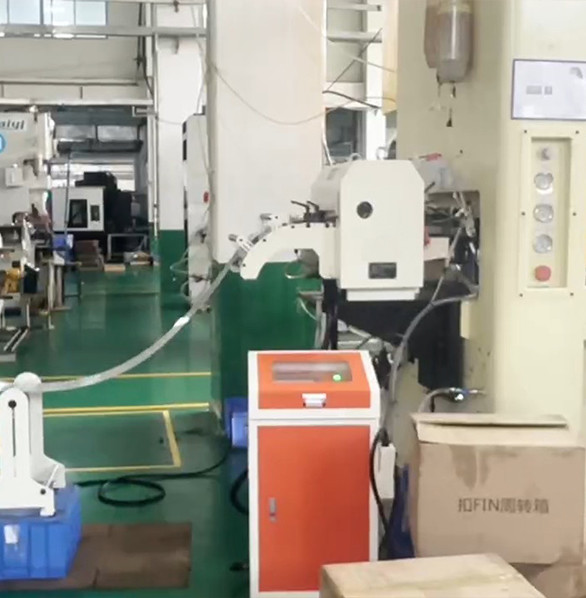
Feed accuracy is the single most important performance metric on any automated stamping press line. Inconsistent feeding leads to mis-stamped parts, die damage, excessive scrap, and costly downtime.
Whether you are running a progressive die at 200 SPM or a simple blanking operation, improving your press line's feed accuracy directly improves part quality, reduces material waste, and extends tool life.
In this comprehensive guide, FANTY Machinery explains the factors that affect feeding accuracy and provides actionable steps to achieve and maintain the highest possible precision.
NC servo feeders deliver the highest feed accuracy for high-speed stamping operations.
Understanding Feed Accuracy: What Does ±0.05 mm Mean?
Before we dive into improvement strategies, it is essential to understand what feed accuracy means in practical terms. Feed accuracy is the deviation between the programmed feed pitch length and the actual strip length advanced into the press.
For context, here is how different accuracy levels affect part quality:
- ±0.15 mm or worse: Acceptable for simple blanking operations where tolerances are generous. Scrap rates typically 3–5%
- ±0.10 mm: Suitable for general stamping. Common with mechanical roller feeders. Scrap rates around 1–3%
- ±0.05 mm: Required for progressive die stamping, complex forming, and high-precision electronics and connector parts. Scrap rates below 0.5%
- ±0.02 mm or better: Ultra-precision applications such as lead frames, IC sockets, and fine-blanking. Requires specialized servo systems with encoder feedback compensation
FANTY's NC servo feeders consistently deliver ±0.05 mm accuracy in production environments, backed by our proprietary control algorithms and precision-machined mechanical components.
Factors Affecting Feed Accuracy
| Factor | Impact on Accuracy | Mitigation Strategy |
|---|---|---|
| Servo motor resolution | Higher encoder resolution enables finer positional control. A 17-bit encoder provides 131,072 pulses per revolution | Use high-resolution servo systems. FANTY uses 23-bit absolute encoders for maximum precision |
| Pinch roller condition | Worn or contaminated rollers cause strip slippage, directly degrading feed accuracy | Replace rollers at regular intervals. Use hardened steel rollers for high-volume production |
| Pinch roller pressure | Insufficient pressure allows slippage; excessive pressure deforms the strip surface | Use pneumatic or hydraulic pressure systems with pressure gauges for consistent clamping force |
| Material thickness variation | Real-world coils have thickness tolerances of ±0.03–0.08 mm. This changes the effective feed pitch | FANTY's adaptive control algorithm measures actual thickness and compensates in real time |
| Material curvature and camber | Coil set and cross-bow cause the strip to lift or twist, altering the effective feed path length | Pre-straightening with an NC servo straightener before feeding eliminates curvature effects |
| Back tension variation | Inconsistent decoiler braking changes strip tension, affecting feed consistency | Use a loop control system with photoelectric sensor to maintain constant low tension at the feeder inlet |
| Vibration and mechanical play | Loose mounting, worn bearings, or frame flex introduces positional errors | Rigid mounting, precision-ground guide rails, and regular mechanical inspection |
| Control system timing | The feeder and press must be perfectly synchronized. Timing drift causes cumulative errors | Use encoder-based synchronization with the press cam signal. FANTY's PLC achieves sub-millisecond timing |
Step-by-Step Plan to Improve Feed Accuracy
- Audit your current feed system: Measure the actual feed length over 100 consecutive strokes using a precision ruler or digital caliper. Calculate the mean deviation and standard deviation. This baseline tells you whether the issue is systematic (calibration) or random (slippage, vibration, or mechanical wear)
- Upgrade to an NC servo feeder: If you are using a pneumatic air feeder or mechanical roller feeder, the single most impactful improvement is switching to an NC servo feeder. Servo feeders eliminate the variability of compressed air pressure and mechanical linkage wear. FANTY NC servo feeders deliver ±0.05 mm accuracy from day one
- Add an NC servo straightener: Material curvature is one of the most overlooked sources of feed inaccuracy. An NC servo straightener removes coil set and cross-bow before the strip enters the feeder, ensuring a flat, consistent strip. The combined straightener-feeder solution from FANTY dramatically improves overall line accuracy
- Optimize the decoiler-straightener-feeder path: The strip path between decoiler and feeder should be as short and straight as possible. Every change in direction introduces friction and potential measurement error. A properly designed loop control system maintains a consistent strip loop height, keeping tension constant
- Implement regular calibration: Feed accuracy drifts over time as rollers wear, bearings loosen, and control parameters shift. Establish a weekly calibration check: run 20 feed cycles at your standard pitch, measure total length, divide by 20 to get average pitch, and compare to the programmed value. Adjust the feeder's compensation parameter if deviation exceeds ±0.03 mm
- Maintain optimal roller condition: Feed rollers should be inspected daily. Look for grooves, scoring, or rubber debris on urethane-coated rollers. Replace rollers when surface wear exceeds 0.1 mm depth. Keep rollers clean using a dry cloth — never use lubricants on feed rollers as they cause slippage
- Monitor and record data: Modern NC servo feeders from FANTY include data logging capability that records actual feed length for every stroke. Review this data weekly to identify trends: gradual degradation indicates wear; sudden changes indicate a mechanical issue or material change
Advanced Techniques for Maximum Feed Accuracy
- Closed-loop feedback: FANTY's premium feeder models incorporate a linear scale encoder that measures actual strip position in real time, independent of motor encoder feedback. This closed-loop system compensates for any residual slip or thermal expansion, achieving accuracy as high as ±0.02 mm
- Material thickness compensation: Different materials have different compressibility under roller pressure. FANTY's control system stores material-specific compensation profiles. When you switch from mild steel to stainless steel or aluminum, simply select the material recipe on the HMI and the feeder automatically adjusts parameters
- Speed-dependent compensation: At very high speeds (over 150 SPM), inertia effects can cause slight overshoot in feeding. FANTY's servo drives incorporate dynamic braking and deceleration curves that are automatically adjusted based on the programmed speed, maintaining ±0.05 mm accuracy across the entire speed range
- Temperature compensation: In continuous high-speed operation, roller surfaces heat up and expand slightly, changing the effective roller diameter. FANTY's advanced models include temperature sensors that feed into the control algorithm for real-time compensation
Why Choose FANTY for Precision Feeding?
Proven Accuracy
FANTY NC servo feeders achieve ±0.05 mm accuracy in thousands of production lines across automotive, appliance, electronics, and aerospace industries. Our accuracy is verified by third-party measurement on every machine before shipment.
Robust Construction
Built in our 45,000 m² factory with precision-ground roller shafts, heavy-duty roller bearings, and rigid C-frame construction. FANTY feeders maintain accuracy year after year in 24/7 production environments.
Intelligent Control
FANTY's custom-designed control system features adaptive algorithms, material recipe storage, remote monitoring, and predictive maintenance alerts. Our 80+ R&D engineers continuously improve the control software.
Global Support
With equipment in over 60 countries and CE certification, FANTY provides local technical support, spare parts, and on-site service. Our 370-person team ensures your production never stops.
Frequently Asked Questions About Feed Accuracy
What is the best type of feeder for high accuracy?
NC servo feeders are the gold standard for high feed accuracy. Unlike pneumatic or mechanical feeders, servo feeders use a precision servo motor with encoder feedback and programmable control. FANTY NC servo feeders achieve ±0.05 mm accuracy — the industry benchmark for precision stamping.
How often should feed accuracy be checked?
For critical applications, check feed accuracy daily using a simple test: run the feeder for 10–20 cycles at the standard pitch without the press running, measure the total strip advanced, and calculate the average pitch. Compare to the programmed value. For general applications, weekly checks are sufficient.
Can feed accuracy be improved without buying a new feeder?
Yes, to some extent. Ensure the feeder is rigidly mounted, verify pinch roller pressure is within specification, clean rollers daily, and check that the decoiler provides consistent back tension. However, if your current feeder cannot hold the required tolerance after these measures, upgrading to an NC servo feeder is the most cost-effective long-term solution.
Does material type affect feed accuracy?
Yes, significantly. Soft materials like aluminum and copper are more prone to roller marking and stretching. High-strength steels require higher roller pressure to prevent slippage but are less compressible. Springy materials like stainless steel require effective straightening before feeding. FANTY's material-specific recipes optimize parameters for each material type.
What accuracy can I expect at 200 SPM?
With FANTY's high-performance NC servo feeder, ±0.05 mm accuracy is maintained up to 200 SPM for typical pitch lengths up to 300 mm. For longer pitches or ultra-high-speed applications, FANTY offers specialized high-torque servo systems with enhanced regenerative braking to maintain accuracy at maximum speed.
Upgrade Your Feed Accuracy with FANTY
Stop losing money to scrap and rework caused by inconsistent feeding. FANTY Machinery's NC servo feeders deliver guaranteed ±0.05 mm accuracy, backed by 12 years of engineering expertise, CE certification, and installations in over 60 countries.
Related reading
Part of the the coil line guide library — the full library of coil handling, straightening and feeding guides from FANTY.