How to Remove Coil Crossbow with an NC Straightener Feeder?
- Share
- publisher
- David Park - Senior Stamping Engineer, FANTY Machinery
- Issue Time
- Sep 2,2026
Summary
What is coil crossbow and how do you remove it? Learn how an NC straightener feeder levels cross curvature with correct roll intermesh and backup-supported work rolls.
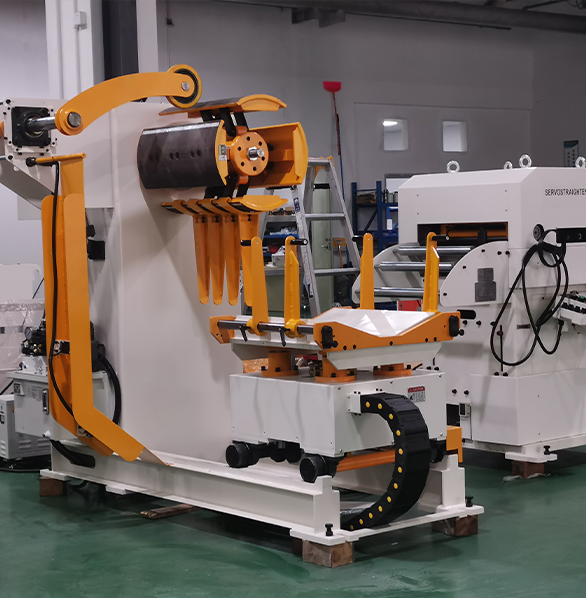
Coil crossbow, also called cross curvature or coil set across the width, is one of the quieter strip defects on a stamping line.
Unlike a visible edge wave, a crossbow strip looks almost flat until it reaches the die, where it refuses to lie down: the edges curl up into a shallow trough, the blank springs out of position, and the parts come out twisted.
The fix starts with understanding what the defect is and ends with an NC straightener feeder set up to remove it.
In this guide we explain what crossbow looks like, why coils develop it, and how the roll arrangement and settings on a straightener feeder take it out of the strip before it ever reaches your die. FANTY straightening engineers work on these problems daily across 200+ installed lines.
What Does Coil Crossbow Look Like?
Lay a short piece of strip on a flat surface, concave side down, and press the center. If the strip rocks on its edges like a child seesawing on a plank, it has crossbow.
The confusion matters because each defect needs a different correction. A strip with crossbow will not sit flat in a die no matter how many times you feed it, and parts punched from a crossbow strip often carry a subtle twist that only shows up at assembly. When operators describe a "curly coil" that springs up as it is cut, they are usually describing crossbow.
Why Coils Develop Crossbow
Crossbow comes from the way the strip was rolled and stored. During rolling, the fibers on the two surfaces of the strip are deformed unevenly: the surface that contacts the work rolls is stretched and displaced slightly relative to the opposite surface.
Slitting and leveling at the service center can also add crossbow, especially on narrow slit widths cut from wide coil, because the slitting process releases the original stress pattern unevenly. The practical result is that crossbow varies from coil to coil and even from one slit strand to the next, which is why the straightener must be adjustable rather than a fixed machine.
How Straightening Removes Cross Curvature
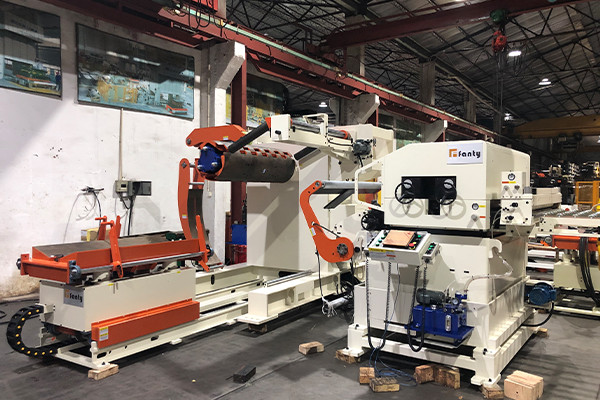
A straightener removes crossbow by repeatedly bending the strip in alternating directions as it passes between offset rolls.
The depth of the bend is controlled by the roll gap between the upper and lower roll banks. Deepening the intermesh increases the bending force on stiff or thick material; lightening it prevents over-working thin, soft strip.
The correct setting is the smallest intermesh that leaves the strip flat with no visible coil set when it exits, and it should be verified on a test piece before production starts.
Strip Shape Defects and Their Fixes
| Defect | Appearance | Straightener response |
|---|---|---|
| Coil crossbow (cross curvature) | Edges curl up across the width; strip rocks on a flat table | Increase roll intermesh evenly to bend and release locked-in stress |
| Edge wave | Rippled wavy edges, center flat | Adjust edge roll pressure or use corrective roll crowning |
| Center buckle | Wavy center, edges flat | Reduce center roll pressure so edges do more work |
| Camber | Strip bows sideways along its length | Check roll parallelism and coil tracking through the machine |
| Longitudinal coil set | Strip curls along its length like a tape measure | Add straightening passes or increase overall intermesh |
Choosing Rolls and Backup Support for Stubborn Crossbow
Stubborn crossbow on thick or high-tensile strip needs more than a deep gap; it needs the right roll geometry. Small-diameter work rolls bend the strip over a shorter arc, which creates the high local stress needed to permanently release coil set, while backup rolls behind each work roll stop them from deflecting in the middle. FANTY straighteners use this small-roll-plus-backup arrangement so that the intermesh you set at the center is the intermesh that actually reaches the edges.
The number of straightening rolls also matters. More rolls mean more alternating bends, which suits heavy-gauge or high-strength material with strong coil set.
For a 3-in-1 decoiler straightener feeder or an NC straightener feeder, the straightening section is matched to the material range you actually run, so tell your supplier the thickest and strongest strip you plan to feed. A machine that just barely levels the easy jobs will struggle when a hard coil arrives.
Verify the Result on the Line
The final test is always the part, not the strip. Even when the strip lies flat on the inspection table, the die clearance, lubrication, and press stiffness influence whether the blank stays flat through the forming process.
Feed a short pilot run, measure the first parts for flatness and twist, and only then accept the setup. If the parts still twist with a perfectly flat strip, check whether the die is gripping the blank unevenly rather than blaming the straightener.
Keep a simple record of the crossbow level of each incoming coil. A note on the coil tag, or a quick visual check when the coil is loaded, tells the operator whether to expect a difficult coil and how deep to set the roll intermesh.
Coils from the same mill often behave similarly, so over a few months the line builds a practical map of which suppliers and which batches need extra straightening attention.
Setting Up the Machine for a Crossbow Coil
- Check the strip direction of the coil and feed the top surface consistently through the rolls.
- Set the roll gap for the material thickness, then deepen intermesh in small steps.
- Run a test length and lay it on a flat table to confirm the edges lie down flat.
- Adjust the entry and exit roll banks separately if crossbow differs between coil ends.
- Re-check flatness after every coil change, because crossbow varies coil to coil.
- Record the winning settings in the job sheet so the next run starts from a known point.
Frequently Asked Questions
What is the difference between crossbow and camber?
Crossbow (cross curvature) is a curve across the strip width, so the cross-section is a shallow arc. Camber is a lateral bow along the strip length. They look different, and they need different corrections on the straightener.
Can an NC straightener feeder really remove coil crossbow?
Yes. By bending the strip in alternating directions between offset rolls, the straightener balances the internal stresses that cause crossbow and delivers flat strip to the feeder and die. The intermesh must be set correctly for the material.
Why does crossbow come back on some coils even with the same settings?
Crossbow varies with each coil because it depends on the mill rolling process and how the coil was stored. Always verify flatness on a test piece after every coil change and adjust the intermesh if the strip rocks on a flat table.
Do I need more straightening rolls for high-strength material?
Higher strength and thicker strip generally need more alternating bends to release stress, so a straightener with more work rolls and backup support is recommended. Match the machine to your hardest material, not your easiest job.
Will the 3-in-1 decoiler straightener feeder handle crossbow on thin strip?
Yes, if the roll pressure is adjusted carefully. Thin soft strip needs only light intermesh, and the small-diameter roll set on a FANTY 3-in-1 decoiler straightener feeder can be set precisely to level thin material without over-working it.
Do soft metals like aluminum need special straightening rolls?
Soft metals benefit from polished work rolls and light intermesh so the surface is not marked or over-worked. The roll geometry itself is the same as for steel, but the pressure settings are lower than for steel of equal thickness.
Related reading
- how to set roll pressure
- how back tension affects straightening
- how to hit a flatness spec on a coil line
Part of the 3-in-1 decoiler straightener feeder — the full library of coil handling, straightening and feeding guides from FANTY.
Get strip flatness advice from FANTY engineers
Send us your material grades, thickness range, and a sample of the defect. FANTY will recommend the straightening roll configuration that removes crossbow and keeps your dies cutting flat parts.
Send Inquiry to FANTY