How to Run Progressive Stamping with an NC Servo Feeder?
- Share
- publisher
- David Park - Senior Stamping Engineer, FANTY Machinery
- Issue Time
- Sep 1,2026
Summary
How to run a progressive die line with an NC servo feeder: setup steps, key feed parameters, high-speed tuning, and troubleshooting fixes.
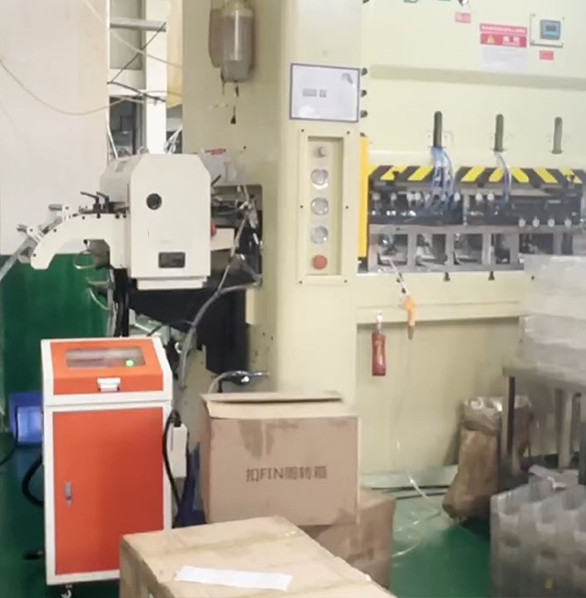
Progressive stamping is the fastest way to turn coil stock into finished parts, but only when the strip arrives at the die at the right length, at the right speed, every single cycle.
That job belongs to the feeder, and an NC servo feeder is the machine most progressive die lines rely on for the ±0.05 mm repeatability that keeps a multi-stage die cutting, forming, and punching in register.
This guide walks through how to set up an NC servo feeder for a progressive die, which feeding parameters to lock down, how to keep the line running at high speed, and how to fix the faults that stop a progressive stamping line.
FANTY has engineered NC servo feeders and complete 3-in-1 decoiler straightener feeder lines for twelve years, supports more than 200 active installations in 60+ countries from a 45,000 m² factory with 370 staff and 80+ R&D engineers, and every recommendation here comes from real press floors.
Why Does Progressive Stamping Need a Servo-Driven Feeder?
In a progressive die, each stroke performs one or more operations, and the strip must advance by exactly the pitch between stations before the press descends.
Beyond accuracy, a servo feeder adds three capabilities a progressive line cannot do without: adjustable feed length without changing cams, programmable acceleration profiles that protect thin strip from buckling, and recipe storage that lets an operator switch parts in under a minute.
When you are running twenty different progressive dies in one month, those three capabilities are worth more than the price difference between a servo feeder and a mechanical unit.
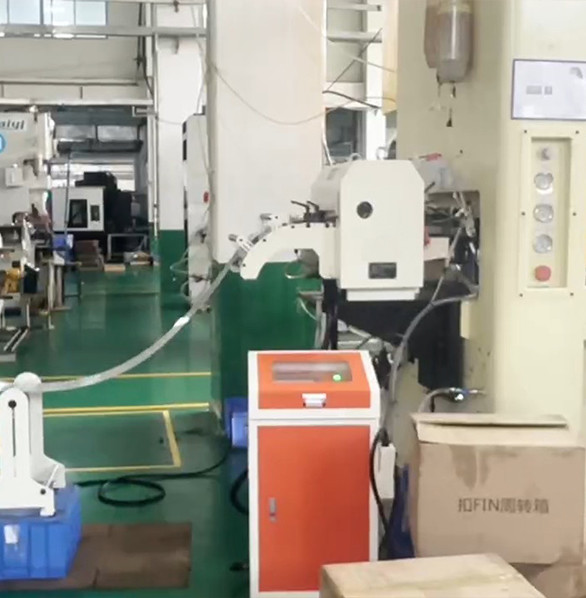 A progressive stamping press line running with an NC servo feeder delivering coil strip at high speed.
How Do You Set Up an NC Servo Feeder for a Progressive Die?
Setup is where a progressive line is won or lost. Follow these steps in order the first time and every time you change a die, and the first-piece approval will take minutes instead of hours.
- Record the die data first. Read the die layout for pitch, strip width, feed direction, and pilot positions before touching the feeder.
- Enter the feed length on the HMI. Type the pitch in millimetres with the correct decimal places; the servo controller converts it into motor pulses.
- Set the feed speed and acceleration. Start at 60% of target speed, confirm the strip tracks straight, then raise speed in steps.
- Align the strip with the die entry. Use the feeder side guides and the die entry guide; a 1 mm misalignment becomes a crash at speed.
- Jog one full cycle by hand. Confirm the pilots engage before the punch descends, then run the press on inch mode.
- Save the recipe. Store the die number, feed length, speed, and material data so the next changeover recalls everything.
- Check the first part. Measure pitch, hole position, and form dimensions against the drawing before running full speed.
Which Feeding Parameters Matter Most in Progressive Stamping?
Not every number on the HMI matters equally. The table below ranks the feeding parameters by their impact on a progressive die line and gives the typical setting logic.
| Parameter | Why It Matters | Setting Logic |
|---|---|---|
| Feed length (pitch) | Must match the die pitch exactly or pilots miss and the die crashes. | Read from die layout; verify with a marked strip on first run. |
| Feed speed | Determines line SPM together with the press stroke. | Match press speed; raise only after strip tracking is confirmed. |
| Acceleration profile | Too aggressive acceleration buckles thin strip; too soft wastes time. | Start with the material default, tune on the actual coil. |
| Feeding accuracy | ±0.05 mm repeatability keeps all stations in register. | Confirm at operating speed; accuracy drifts at the extremes. |
| Strip tracking | Side-to-side drift scratches dies and misaligns pilots. | Set side guides tight, check straightener roll parallelism. |
| Back-gauge / loop control | Keeps tension constant between decoiler and feeder. | Set sensor range to mid-travel for stable tension. |
| Press signal timing | Feeder must deliver "in position" before the press strokes. | Use the hard-wired ready signal, not a software timer. |
| Roll pressure | Too high marks the strip; too low lets the strip slip. | Set for the material thickness and yield strength. |
How Do You Keep a Progressive Line Running at High Speed?
Getting the line up to 150 or 200 SPM is only half the battle; keeping it there without micro-stops is what separates good plants from great ones. Three habits have the biggest effect.
Material handling matters just as much as the feeder. The decoiler must pay out strip with stable tension and no snaking, the loop sensor must keep the strip from touching the floor, and the strip must enter the feeder straight.
FANTY's complete lines integrate the decoiler, straightener, and NC servo feeder into one tuned system, which removes most of the alignment problems that appear when units from different suppliers are bolted together.
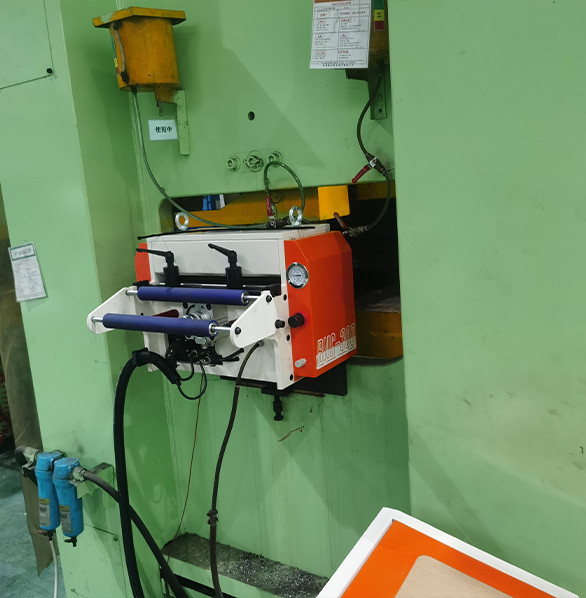 Operator monitoring a high-speed progressive stamping line with an NC servo feeder and HMI control panel.
Common Progressive Stamping Faults and How the Feeder Fixes Them
Even a well-tuned progressive line develops faults. Most of them share one root cause: the strip is not arriving at the die in the exact condition the die expects. Here is how to read the symptoms.
- Pilot holes tear. The strip is slightly out of register; check feed length and slow the acceleration profile.
- Burrs on one side only. The strip is tracking to one side; realign the feeder side guides with the die entry.
- Strip buckling between stations. Feed acceleration is too aggressive or the loop tension is too high; soften the profile.
- Scratches on the strip surface. Feed roll pressure is too high or a roll has picked up debris; clean and reset.
- Micro-stops at speed. The press ready signal is late or the encoder is picking up noise; check wiring and shielding.
- Dimension drift over a shift. Servo temperature rise changes torque; check cooling and the drive ventilation.
Frequently Asked Questions About Running Progressive Stamping
What feed accuracy does progressive stamping need?
Most progressive dies are designed around pilots that need the strip within roughly ±0.05 mm of the pitch position. An NC servo feeder with an encoder-based closed loop delivers this at speed; a pneumatic feeder cannot guarantee it above about 60 SPM.
Can one NC servo feeder run different progressive dies?
Yes. Recipe storage on the HMI lets operators recall the feed length, speed, and acceleration for each die in seconds. This is the main reason servo feeders replaced cam feeders in job-shop progressive stamping.
How do I stop the strip from buckling in the die?
Reduce the acceleration ramp, lower the loop tension from the decoiler, and check that the straightener rolls are parallel. Buckling is almost always a timing or tension problem, not a die problem.
What SPM can a progressive line reach with an NC servo feeder?
FANTY NC servo feeders support stamping lines up to 200 SPM depending on feed length and material. Longer strokes and heavier strip reduce the practical maximum, so size the feeder to your worst case.
Do I need a straightener for progressive stamping?
For most coil-fed progressive work, yes. A 3-in-1 decoiler straightener feeder flattens the coil memory before the strip reaches the die, which protects pilots and keeps the strip flat inside the die stations.
How long does a die changeover take on a modern line?
With a servo feeder and recipe storage, a well-organized changeover runs in 10 to 20 minutes for the feeding side: recall the recipe, thread the new strip, verify the first part. The die change itself usually takes longer than the feeder setup.
Your Progressive Stamping Action Plan
Whether you are installing your first servo feeder or optimizing a line that has run for years, the path is the same: standardize the setup, lock the parameters, monitor the alarms, and maintain the consumables.
Related reading
- which part limits feeding accuracy
- what feeding accuracy to expect
- how to hold feed accuracy on a coil line
Part of the the coil line guide library — the full library of coil handling, straightening and feeding guides from FANTY.
Ready to run your progressive dies at full speed?
Send your die pitch, coil width and thickness, and target SPM. FANTY will recommend the right NC servo feeder configuration and commissioning plan.
Get a Feeder Recommendation