How to Select the Right Decoiler Mandrel Size for Coils?
- Share
- publisher
- David Park - Senior Stamping Engineer, FANTY Machinery
- Issue Time
- Sep 3,2026
Summary
How to select the right decoiler mandrel expansion range: coil inner diameter, coil OD and weight, mechanical versus hydraulic expansion, and the common sizing mistakes to avoid.
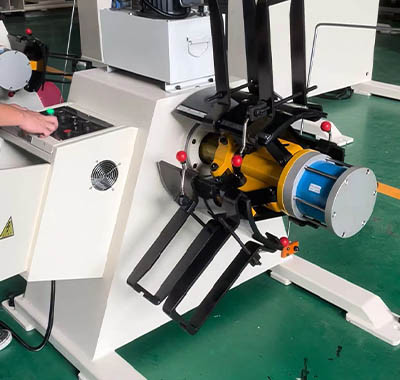
The mandrel expansion range is one of the most under-rated specifications on a coil line quotation, yet it decides whether a coil sits dead-center during unwinding or vibrates, telescopes, and damages both the strip edges and the feeding equipment downstream.
Choosing the correct motorized decoiler mandrel is not complicated once you understand coil inner diameters, expansion mechanics, and how mandrel fit interacts with strip quality in a stamping line.
This guide explains the four coil dimensions that determine mandrel selection, the difference between mechanical and hydraulic expansion, and the consequences of running a coil on the wrong mandrel.
Use the tables below to build your own specification before you talk to a supplier, and you will avoid the most common field problems we see across more than two hundred installed coil lines.
Why Mandrel Size Is a Quality Issue, Not Just a Fit Issue
Think about what happens when a coil inner diameter is much larger than the collapsed mandrel. The coil drops onto the mandrel off-center, and when the segments expand they may grip only part of the coil eye.
The opposite problem is equally real: a coil whose inner diameter is at the very bottom of the expansion range can bind on the segments, making loading and unloading slow and dangerous. The goal is not the tightest possible grip but a uniform, centered grip over the full coil width.
That is why manufacturers publish an expansion range rather than a single diameter, and why your job is to make sure every coil you buy falls comfortably inside that range with margin for steel tolerances.
The Four Coil Dimensions That Decide Mandrel Selection
Collect four numbers from your coil specification before you choose anything: the coil inner diameter (ID), the coil outer diameter (OD), the coil width, and the coil weight.
The coil width determines the mandrel length and the decoiler arm width; the coil OD and weight determine the motor power and the structural rating of the arms. A heavy, large-OD coil needs a decoiler with enough torque to start the mass moving smoothly and enough braking to stop it without over-run.
Width also matters for the coil guide: if your strip is narrow, an extra-wide coil eye can create edge pressure on the mandrel segments, so match the decoiler to the narrowest common coil width as well as the widest.
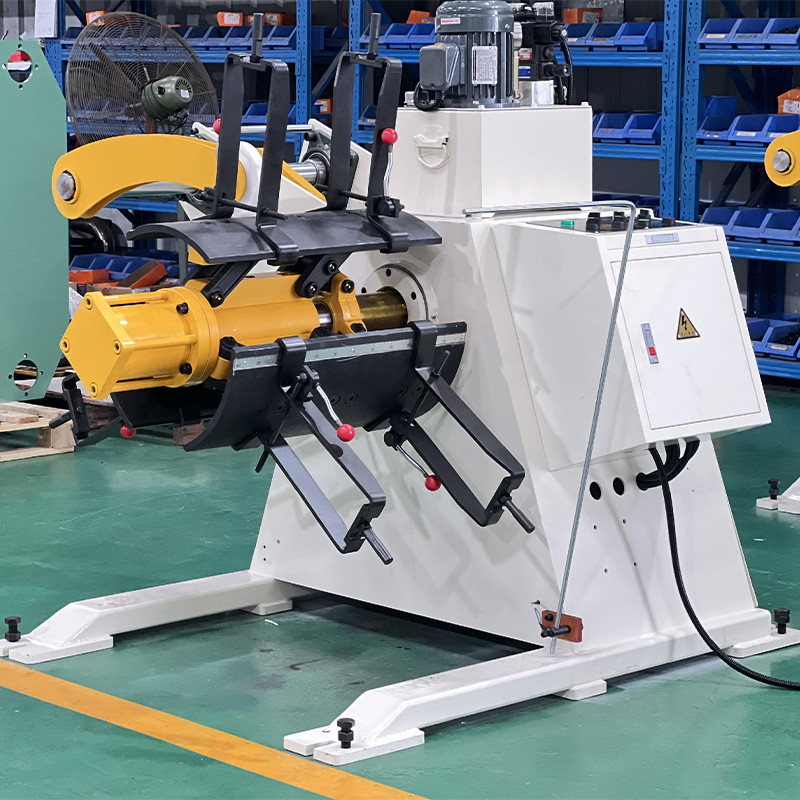
Mechanical or Hydraulic Expansion: Which Decoiler Do You Need?
Mechanical expansion decoilers use a hand wheel and a screw or wedge mechanism to push the segments outward. They are simple, inexpensive, and perfectly adequate when coil sizes change only a few times per shift.
Hydraulic expansion adds speed, force, and repeatability. With a hydraulic cylinder and a control valve, the operator expands the mandrel with a lever or a button, the segments move out together with high and uniform force, and the gripping pressure is consistent from coil to coil.
Hydraulic expansion is the right choice when coils change frequently, when coils are heavy and need a very firm grip to start and stop without slippage, or when you want to integrate mandrel control into an automated coil loading sequence with a coil car.
The trade-off is higher cost and the need to maintain the hydraulic power unit.
Coil ID and Mandrel Range Reference Table
| Nominal Coil ID (mm) | Typical Mandrel Expansion Range (mm) | Best Use |
|---|---|---|
| 300 | 280 - 330 | Light gauge, narrow strip, small progressive dies |
| 400 | 380 - 450 | General stamping and fastener production |
| 450 | 420 - 480 | Mid-size press lines, medium coil weights |
| 500 | 480 - 530 | Continuous high-speed stamping with large coils |
| 508 | 490 - 540 | Common export coil standard, multi-purpose lines |
Always confirm the expansion range with the supplier for your exact coil ID and weight; the table shows typical values for planning only.
Decoiler Mandrel Selection Checklist
- List every coil ID your plant actually receives, including suppliers' tolerances, and keep the whole range inside the mandrel expansion range.
- Choose mechanical expansion for stable, infrequent coil changes and hydraulic expansion for frequent changeovers or heavy coils.
- Confirm the decoiler width and arm rating suit your narrowest and widest coil, and the motor torque suits your heaviest coil OD.
- Check that the mandrel segments are hardened and the expansion mechanism is protected from scale and dirt on the workshop floor.
- If you plan a coil car or automatic loading, confirm the decoiler can be supplied with synchronized hydraulic expansion control.
- Ask the supplier how the decoiler behaves on a partially used coil, since an out-of-balance half coil stresses the mandrel differently.
Common Mandrel Mistakes and How to Avoid Them
The most common mistake is buying a decoiler for today's coil and ignoring next year's. Stamping plants change part families, and part families change coil sizes. If your range of coil IDs is wider than one decoiler can cover, buy a decoiler for the largest common coil and keep the smallest coils on a second, smaller unit, rather than forcing one machine to run at the extreme edges of its range where grip quality suffers.
The second mistake is ignoring coil ID tolerance from steel mills. A nominal 508 mm coil can arrive at 505 mm or 511 mm depending on the mill and the batch. If your decoiler expansion range ends at 510 mm, that 511 mm coil binds and the 505 mm coil may not grip firmly. Keep ten percent margin on both ends of the range and you absorb mill variance without drama.
How FANTY Matches the Mandrel to the Line
FANTY Machinery has built coil handling equipment for twelve years in a 45,000 m² factory with 370 employees, more than 80 of them in R&D.
What happens if my coil ID is smaller than the mandrel expansion range?
Loading becomes difficult or impossible without forcing the coil, and forcing it can damage the coil eye or the mandrel segments. Choose a decoiler whose collapsed mandrel passes freely through your smallest coil ID with a few millimeters of clearance.
Can one decoiler handle several coil inner diameters?
Yes, within its published expansion range. Keep every coil ID you buy inside the range with about ten percent margin on each end, and verify the grip on the smallest and largest coils during the factory test.
Is hydraulic expansion worth the extra cost?
If your line changes coils more than a few times per shift or handles coils above roughly two tons, hydraulic expansion pays for itself in faster changeovers, consistent grip, and easier automation with a coil car.
Why does a partially used coil wobble even on the correct mandrel?
A partial coil has an unbalanced mass, and its inner laps may have relaxed away from the mandrel. Slow the payoff speed during the last part of the coil and use a hold-down or peeler arm if edge quality matters.
Does the motorized decoiler speed affect mandrel selection?
Not directly, but coil OD and weight affect the torque and braking needed, and larger coils need a stronger decoiler. Confirm motor power and brake torque against your heaviest, largest-diameter coil.
Related reading
- how much coil weight a decoiler handles
- how much floor space a coil line needs
- how to specify a decoiler for a coil line
Part of the the coil line guide library — the full library of coil handling, straightening and feeding guides from FANTY.
Not Sure Which Decoiler Mandrel Fits Your Coils?
Send FANTY your coil specification sheet, and we will confirm the mandrel expansion range, expansion type, motor rating, and width configuration that fit your stamping line. Every recommendation includes a factory test with your coil dimensions before delivery.
Send Your Coil Specification