What Causes Coil Slipping on a Decoiler Mandrel?
- Share
- publisher
- FANTY
- Issue Time
- Sep 10,2026
Summary
A slipping mandrel is easy to misdiagnose as a pressure problem. This field guide covers the five real causes - surface contamination, segment wear, coil ID tolerance, expansion linkage wear, and over-torqued brakes - and the order in which to check them.
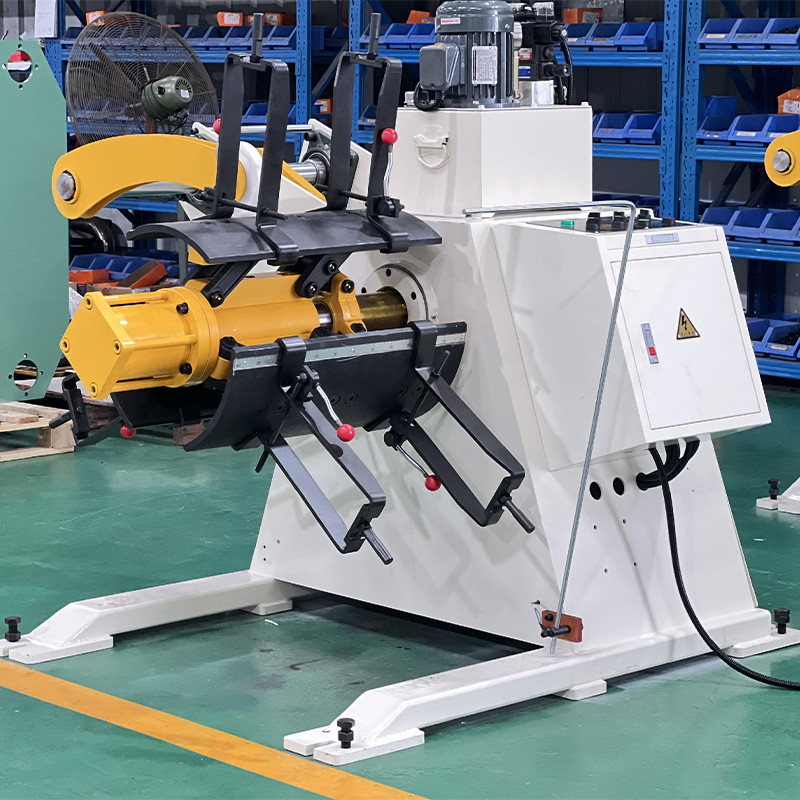
The first sign is usually a sound, not a fault code — a low groan from the mandrel as the coil starts to turn, followed by the strip tension going soft and the loop dancing. By the time the operator notices the payoff speed wandering, the coil has already rotated on the mandrel and marked the inner wraps. I have walked into more plants chasing this than any other decoiler fault, and in nearly every case the cause turned out to be one of five things. None of them are expensive to fix once you know which one you have.
What slipping actually looks like
Slipping is easy to confuse with three other conditions, so confirm the symptom before touching anything. True mandrel slip means the coil rotates relative to the mandrel body while the mandrel itself is stationary or turning more slowly. The tell-tale is a polished or scored band on the inside of the coil, and matching rub marks on the mandrel segments.
If the coil is turning with the mandrel but the strip tension is still unstable, you are looking at a tension control problem, not a grip problem. If the coil has shifted sideways along the mandrel, that is a centering or coil winding issue. And if the whole coil has collapsed inward onto the mandrel, you are dealing with an eye or telescope defect in the coil itself.
On a hydraulic decoiler the diagnosis takes about thirty seconds: mark the mandrel segment and the coil inner wrap with a paint pen, run the line for one coil, and check whether the marks have separated. That single test saves hours of speculative adjustment.
Expansion pressure and real contact area
A mandrel does not grip a coil around its full circumference. It grips at the segments — typically three, four or six — and the coil inner wrap bridges the gaps between them. The load is carried by those contact patches, and slip begins the moment the required torque exceeds what friction across those patches can transmit.
Two numbers set the limit: the clamping force the mandrel applies, and the coefficient of friction between segment and coil surface. Operators tend to focus only on the first, reaching for the hydraulic pressure regulator when a coil slips. Raising pressure helps, but it also deforms the inner wraps of thinner-gauge coils, and on a 1,200 mm wide aluminium coil it can oval the bore permanently.
The friction side is usually where the real problem sits. Oil, mill scale and rust inhibitor on the coil inner surface drop the coefficient of friction sharply. A coil that arrived with a heavy anti-rust coating will slip on a mandrel that grips a dry coil without complaint, at exactly the same hydraulic pressure. If slip started when you changed material supplier, look at the surface condition before you touch the regulator.
| What you see | Most likely cause | What to do |
|---|---|---|
| Polished band on coil inner wrap, mandrel rub marks | Genuine mandrel slip | Clean segments, check expansion pressure, verify coil ID |
| Slip only on coils from one supplier | Oil or coating on inner surface | Clean the inner wrap or specify a dry-lubricated coil |
| Slip that worsens as the coil empties | Falling weight reduces the normal force at the mandrel | Increase pressure slightly; check segment wear |
| Slip with heavy strip only | Torque demand exceeds mandrel capacity | Reduce braking torque or use a larger mandrel diameter |
| Slip accompanied by a rhythmic knock | Segment or expansion mechanism wear | Inspect and rebuild the expansion assembly |
| Slip on a coil that sat outdoors | Rust or scale on the inner surface | Reject or clean the coil; do not increase pressure |
Wear you cannot see from the aisle
Expansion segments wear in a way that hides itself. The segment face is ground flat when new; after a few thousand coils it develops a slight crown or a taper, and the contact patch that was a full-width band becomes a narrow strip along one edge. Grip drops even though the segment looks fine from three metres away.
Check it with a straight edge across the segment face and a feeler gauge. Anything more than about 0.15 mm of deviation across the segment width is enough to cost you meaningful grip. The expansion linkage is the second wear point — if the wedges or the toggle mechanism have taken a set, the mandrel reaches full hydraulic pressure without fully expanding, and the pressure gauge reads normal the whole time.
The field test for that is simple: expand the mandrel with no coil fitted and measure the outer diameter against the specification. If it is undersized, the linkage is worn and no amount of pressure will recover it.
Coil ID tolerance: the margin is thinner than you think
A decoiler mandrel is designed for a nominal coil inner diameter — 508 mm is the common standard, with 610 mm on heavier lines. Coils arrive within a tolerance band, and the mandrel has to grip across the whole band. The upper end of the tolerance is where slip appears, because the mandrel has to expand further to reach the coil, and expansion force falls off as the segments travel outward.
When a coil comes in at the top of the tolerance band and the strip is heavy, the combination is enough to produce slip on a mandrel that handles every other coil in the plant. The fix is not more pressure — it is checking the actual measured ID rather than the nominal one, and matching the mandrel expansion range to the coils you really receive.
If you regularly run coils from multiple mills, measure a sample from each. A 6 mm spread in inner diameter across suppliers is common, and it is enough to change mandrel behaviour noticeably.
When tension control is the real culprit
Braking torque is applied to hold the coil back so the strip feeds under controlled tension. If the brake applies more torque than the mandrel can transmit, the coil rotates on the mandrel — the brake wins, the grip loses, and you get slip on a mandrel that is mechanically perfect.
This is common on lines where the brake was set up for a different material. A coil line tuned for 1.5 mm mild steel, then switched to 3 mm high-tensile strip, needs more tension to keep the loop stable — and the extra torque can exceed the mandrel's grip limit. The symptom is slip that appears only on the heavier material and only during acceleration.
Diagnose it by reducing brake torque and observing whether the slip stops. If it does, the mandrel is fine and the tension setting is wrong. Fixing it properly usually means moving to closed-loop tension control rather than a fixed brake setting, so the torque tracks what the strip actually needs instead of a value set once at commissioning.
Fixing it in the right order
Work through the causes in cost order, cheapest first. Doing it in this sequence avoids the most common mistake in the field, which is raising pressure to compensate for a dirty or worn mandrel — that works for a week, then the inner wraps start deforming and you trade a slip problem for a coil damage problem.
- Clean the mandrel segments and the coil inner wrap. Remove oil, mill scale and rust inhibitor — this alone fixes a surprising share of reported slip.
- Measure the actual coil inner diameter with a tape, not the nominal figure from the mill certificate, and compare it with the mandrel's expansion range.
- Check segment flatness with a straight edge and feeler gauge. More than about 0.15 mm of deviation across the segment width costs grip.
- Expand the mandrel with no coil fitted and measure the outer diameter. Undersized means the expansion linkage is worn and pressure will not recover it.
- Only then review hydraulic pressure against the manufacturer's figure, and check brake torque against what the strip actually requires.
One downstream consequence is worth knowing about. A coil that has slipped is no longer round, and the deformed inner wraps can cause the loop to run unevenly into the straightener entry of a downstream NC Straightener Feeder. If the loop has been unstable, check the strip entry condition as well as the decoiler — a slip fault often leaves a second problem behind it.
If the machine itself is sound and the coils are within tolerance, the answer is usually a mandrel that was specified for a narrower ID range than the plant actually runs. FANTY builds decoilers in a 45,000 m² facility with a 370-strong workforce, and the specification conversation at order stage is where this gets settled — a mandrel matched to your real coil population costs nothing extra and removes an entire class of fault from your maintenance list.
How much hydraulic pressure should a decoiler mandrel run at?
Follow the manufacturer's figure for your mandrel size — typically 60 to 100 bar on industrial units. Higher pressure does not reliably improve grip and will deform the inner wraps of thinner-gauge coils, so treat the specified value as a ceiling rather than a starting point.
Can I run a 610 mm coil on a 508 mm mandrel?
No. The mandrel cannot expand far enough to grip a larger bore, and the coil will sit loose and slip immediately. You need either a sleeve adapter designed for the transition or a mandrel with the correct expansion range.
Why does the coil slip only when the line accelerates?
Acceleration is when torque demand peaks. A mandrel with marginal grip holds during steady running and loses it during the ramp. That pattern usually points to either brake torque set too high or segment wear that has reduced the contact patch.
Is it safe to keep running with a slipping mandrel?
No. Slip generates heat and scores both the mandrel segments and the coil inner wraps, and a coil that suddenly grips can whip the loop and damage the straightener entry. Stop the line, mark the mandrel and coil, and identify the cause.
How often should mandrel segments be inspected?
Check flatness with a straight edge at every scheduled decoiler service — monthly on a single-shift line. Also inspect immediately after any coil that slipped, since scoring accelerates wear on the affected segments.
Coil slipping and nobody can pin it down?
Send us your coil ID range, weight and strip thickness. FANTY's engineers will tell you whether the mandrel range is wrong, the brake is over-torqued, or the segments need rebuilding — and what it costs to fix.
Ask About Mandrel Grip