What Causes Coil Telescoping on a Decoiler?
- Share
- publisher
- David Park - Senior Stamping Engineer, FANTY Machinery
- Issue Time
- Sep 17,2026
Summary
When wraps step out into a cone, the decoiler is usually where the fault becomes visible rather than where it started. Four causes account for nearly every case, and two of them have nothing to do with the machine.
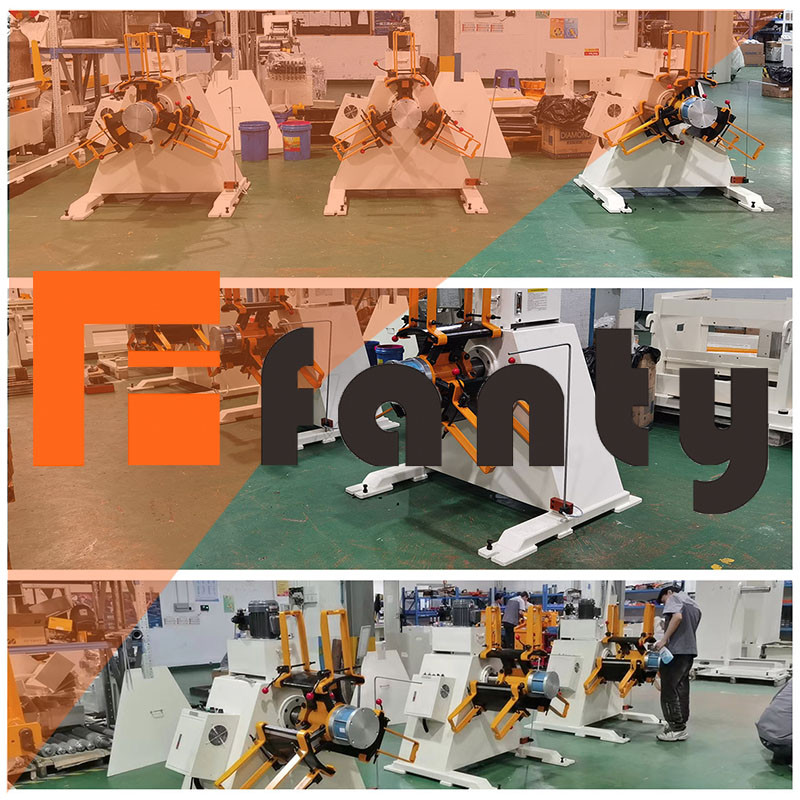
Coil telescoping looks like a decoiler fault. Most of the time it is not. When a coil walks sideways on the mandrel and the wraps step out into a cone, the damage usually started before the coil was ever loaded — in the slitter, in the warehouse, or in the crane operator's last pick. The uncoiler is simply where the fault becomes visible, because that is the first time the coil is asked to hold its own shape under tension.
This article covers what telescoping actually is, the four causes that account for nearly every case we see, how to test each one on a loaded coil without taking the line apart, and what permanently removes the risk. If the machine is still being chosen, start from the decoiler and uncoiler range first — mandrel range and brake sizing decide most of what follows.
What Telescoping Looks Like, and When It Starts
A telescoped coil is one whose wraps have shifted axially. Seen from the side, the end face is no longer a flat wall but a stepped or conical surface. Seen from above, the coil has grown wider than its nominal width, because the outer wraps have slid past the inner ones.
Three things distinguish telescoping from other coil defects, and the distinction matters because the fix is different.
- It is axial, not radial. The wraps have not unwound or loosened; they have slid sideways relative to each other. A loose coil is a different problem.
- It usually starts at the outer wraps. The outer wraps carry the least inter-wrap friction and the most freedom to move, so they step out first. By the time the inner wraps move, the coil is usually beyond recovery.
- It appears under tension, not at rest. A coil can sit in the rack looking square and telescope within the first 20 metres of running. That is why the fault gets blamed on the decoiler.
The timing tells you a lot. Telescoping that appears immediately on the first rotation points to handling or mandrel fit. Telescoping that develops gradually over a shift points to brake torque and back tension. Telescoping that appears only on one supplier's coils points to the coil itself.
Four Causes, and the Evidence Each One Leaves
When a coil telescopes on a decoiler machine, the cause is almost always one of four things. They can be separated by looking at where the step appears and when.
| Cause | What you see | How to confirm it |
|---|---|---|
| Mandrel not expanding to full contact | Step appears within the first few wraps, often with a shiny patch on the coil ID | Measure the gap between mandrel segments and the coil ID at three points |
| Brake releasing too abruptly | Telescoping develops over 20–60 minutes of running, worse at higher line speed | Watch the loop while the line accelerates and decelerates |
| Coil wound or stored out of square | Only certain suppliers' coils telescope; the step pattern follows the original winding | Square the coil on a flat plate before loading |
| Handling damage before loading | Step is one-sided, always on the same side, often with a visible dent or crease | Inspect the coil end faces before the crane lifts it |
Two of these four are the machine's responsibility and two are not. That split is the reason a decoiler that telescopes should never be judged from a single coil — and the reason a supplier cannot diagnose it from a photograph.
Testing Mandrel Fit Without Unloading the Coil
Mandrel fit is the first thing to check, because it is the most common cause and the easiest to measure. A segmented mandrel grips the coil ID through expanding segments. If it expands to 480 mm and the coil ID is 508 mm, the coil is not being held — it is being balanced.
Load a coil and expand the mandrel to normal working pressure. Then check the fit in three places, 120 degrees apart, using feeler gauges between the mandrel segment and the coil ID. On a properly matched pair the gauge should not enter beyond about 0.5 mm anywhere.
Look at the coil ID as well. A coil that has been run on an undersized mandrel leaves a set of bright, polished contact patches where the segments touched, and dull untouched areas between them. That pattern is proof of partial contact, and it survives on the coil after it comes off the machine.
Two mechanical faults produce the same symptom and both are cheap to fix. Segments worn below their original radius reduce the expanded diameter without showing any obvious damage; measure them against the drawing. And hydraulic pressure that has dropped — a tired pump, a leaking seal, a relief valve set low — leaves the segments short of full travel, which is why a pressure gauge on the mandrel circuit is worth fitting if the machine does not already have one.
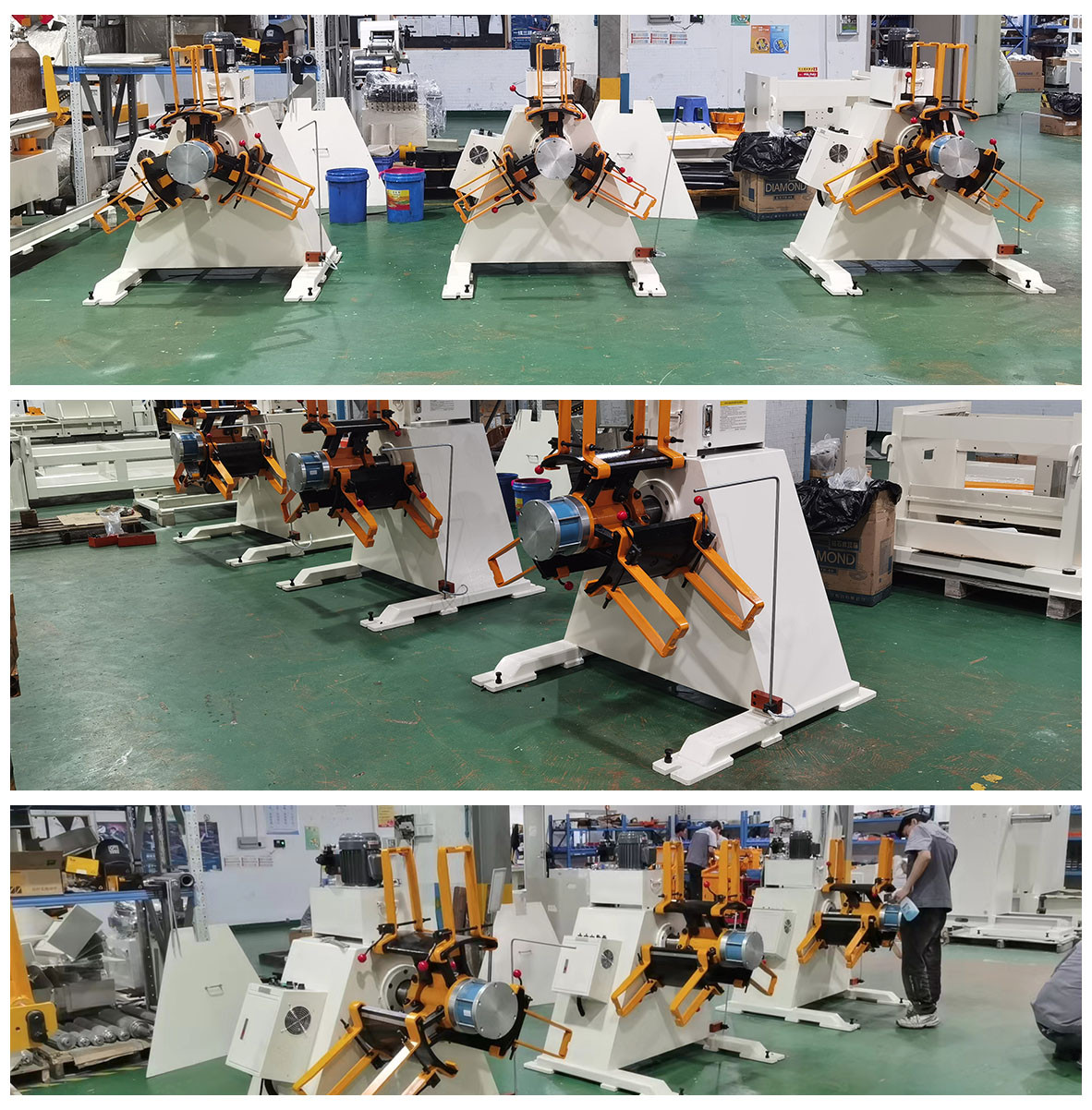
Brake and Back Tension: Letting the Coil Run On
The brake on a decoiler does two jobs. It holds the coil still when the line is stopped, and it provides back tension while the line runs so the strip leaves the coil under control. Get the second job wrong and the coil can telescope even with a perfect mandrel fit.
The mechanism is straightforward. If the brake releases too fast, the coil accelerates ahead of the line, the loop goes slack, and the strip stops pulling on the coil. For a moment the outer wraps are held by nothing except their own friction, and any coil with residual winding stress will start to step. If the brake holds too long, the loop tightens and jerks, which is hard on the strip but rarely causes telescoping.
So the failure direction to look for is a brake that is too free, not too tight. The check is to watch the loop through an acceleration. A well-set brake produces a loop that stays roughly constant in size. A brake that is too free produces a loop that grows during acceleration and then snaps back when the line reaches speed.
On a motorised or hydraulic unit, the fix is usually in the brake control rather than the brake itself: increase the release delay slightly, or add a small amount of continuous drag through a tension control valve. On a manual stand, the equivalent adjustment is on the brake band or the friction disc, and it should be set with a full coil on the mandrel rather than an empty one. A setting made on an empty mandrel is always too loose.
One more point about coil inertia. A 5 t coil has roughly four times the rotational inertia of a 1.2 t coil at the same outer diameter, and it needs a correspondingly larger braking effort to stay under control. A decoiler set up on light coils will telescope heavy ones until the brake is re-adjusted for the worst case.
Damage That Happened Before the Coil Reached the Mandrel
Roughly a third of the telescoping cases we are asked about turn out to have nothing to do with the machine. The coil arrived damaged, and the decoiler simply revealed it.
Slitting leaves the coil under internal stress. If the slitter's tension or the recoiler alignment is off, the coil comes off the line already carrying a built-in tendency to step sideways, and it will express that tendency the first time it is run under low tension. There is nothing the decoiler can do about it except hold the coil harder, which is a workaround rather than a fix.
Storage and handling do the rest. A coil stood on its side for weeks, lifted with a C-hook that contacts only part of the ID, or set down hard on a concrete floor, can be deformed enough to telescope. The signature is a one-sided step and a crease or dent on the coil face at the point where the crane contacted it.
These cases are worth identifying precisely, because the correct response is a conversation with the coil supplier, not a service call on the machine. Two checks settle it. Square the suspect coil on a flat plate before loading and measure the gap under the end faces. And compare the same material from a different supplier on the same decoiler. If the second coil runs clean, the machine is not the problem.
What Keeps It From Coming Back
Prevention on the machine side comes down to four things, none of them expensive.
Match the mandrel range to the coils you actually buy. A mandrel that covers 450 to 530 mm on paper is often only fully effective over the middle of that range. If most of your coils are 508 mm ID, specify a mandrel whose working range sits around 508 mm rather than at the edge of its travel.
Set the brake on the heaviest coil, at running temperature. Brake performance changes as the unit warms up. Setting it cold on a light coil produces a brake that is too free an hour into the shift.
Add a coil car or a proper loading method. Every manual coil load with a crane and a chain is a chance to deform the coil before it is even on the mandrel. A coil car that lifts the coil squarely to centre height removes that risk and cuts changeover time at the same time.
Inspect incoming coils against a written standard. Squareness, end-face condition and ID tolerance are three things a receiving inspection can check in under a minute. Coils that fail get rejected at the door, which is far cheaper than rejecting them after a shift of telescoped material.
For buyers specifying new equipment, the practical advice is to treat the decoiler, the mandrel and the loading method as one system. A 45,000 m² facility running 370 staff builds these as a matched set for a reason: a mandrel sized without reference to the coils it will hold, or a brake set without reference to coil weight, will produce exactly the fault this article describes.
Can a telescoped coil be re-wound and used?
Sometimes, if the wraps have stepped but not creased. Re-winding under tension on a recoiler can restore the shape, and the material is usually still usable. Once the strip has a crease or a fold line, that section should be cut out, because the deformation will show up as a defect in the finished part.
Does coil weight make telescoping more likely?
Indirectly, yes. A heavier coil carries more rotational inertia, so it needs more braking effort to stay under control, and the consequences of a slack loop are larger. The mechanism is the brake setting, not the weight itself. A 5 t coil with a correctly sized brake runs as cleanly as a 1 t coil.
Is a hydraulic mandrel better than a mechanical one for holding coil square?
For heavy coils and frequent changes, generally yes. Hydraulic expansion applies consistent force across all segments regardless of coil ID tolerance, while a mechanical screw or wedge mandrel depends on the operator tightening it consistently. On light coils at low speed, the difference is small.
What ID tolerance should I accept from my coil supplier?
A common specification is 508 mm +2/−0 mm for a standard coil eye. Anything looser than that starts to work against mandrel contact, and a coil that arrives at 514 mm ID will never be held properly no matter how far the mandrel expands.
Should the decoiler be level and anchored for this to be reliable?
Yes, and it is often overlooked. A decoiler that is not level across the mandrel axis will let the coil drift to the low side under its own weight, which looks exactly like telescoping and gets worse as the coil gets lighter. Check level on the mandrel, not on the base frame.
Specifying a decoiler or uncoiler for a new coil line? Send us your coil weight, ID and OD range, and we will size the mandrel, the brake and the loading method as one package.
Fanty · Coil Handling Equipment
Match a Decoiler to Your Coil, Not the Other Way Around
Send your coil inner diameter, outer diameter, weight and line speed. Our engineers reply with the mandrel size, motor power and expansion range that actually suits your coil — no guesswork, no overselling.
Get a Free QuoteFANTY Machinery · 13 years on stamping automation · 2,000+ coil lines installed · engineers reply within 24 hours