What Flatness Can an NC Straightener Feeder Achieve?
- Share
- publisher
- David Park - Senior Stamping Engineer, FANTY Machinery
- Issue Time
- Sep 6,2026
Summary
What flatness tolerance an NC Straightener Feeder should achieve, how flatness is measured, and how to specify the right bow and wave limits for your strip.

Every straightener promises flat strip, but flat means different things to different buyers. A motor-lamination maker needs the strip flat enough to feed a high-speed die without buckling, while a blanking shop may tolerate a gentle bow that disappears under the blank holder. The difference is expressed as a flatness tolerance, and specifying it correctly is the difference between a machine that meets your needs and a machine that meets the brochure. This guide explains how strip flatness is measured, what tolerances an NC straightener feeder can realistically achieve on common materials, and how to write a flatness requirement that suppliers can quote against and you can verify on the floor.
The numbers in this guide follow the industry's usual way of stating flatness: the maximum height of a bow or wave measured over a defined length of strip laid on a flat surface. Understanding the unit is the first step to specifying the requirement correctly.
It is also worth remembering that flatness is not the only quality the straightener controls. The same settings that produce flat strip also relax residual stress in the material, which affects how the part behaves after it is cut from the strip. A part stamped from well-straightened strip holds its shape better through downstream welding, plating, or assembly, because the internal stresses that cause distortion have been reduced. Buyers who measure only the flatness of the strip in the line often discover later that the real benefit of good straightening shows up in the dimensional stability of the finished part.
How Flatness Is Measured
Strip flatness is measured by cutting a sample, laying it on a flat table, and measuring the gap between the strip and the table. The result is expressed in two parts: the direction of the deviation and its magnitude over a standard length.
Length-direction curvature, called bow or coil set, appears as the strip arching along its length, like a banana. Cross-direction curvature appears as the strip edges curling up or down, called edge wave, or the center rising, called center buckle. The most complete flatness statement gives both: a maximum bow over a length and a maximum edge-wave height over a width. Most buyers specify only one number over a length, which is fine for simple parts but insufficient for high-speed feeding into a tight die.
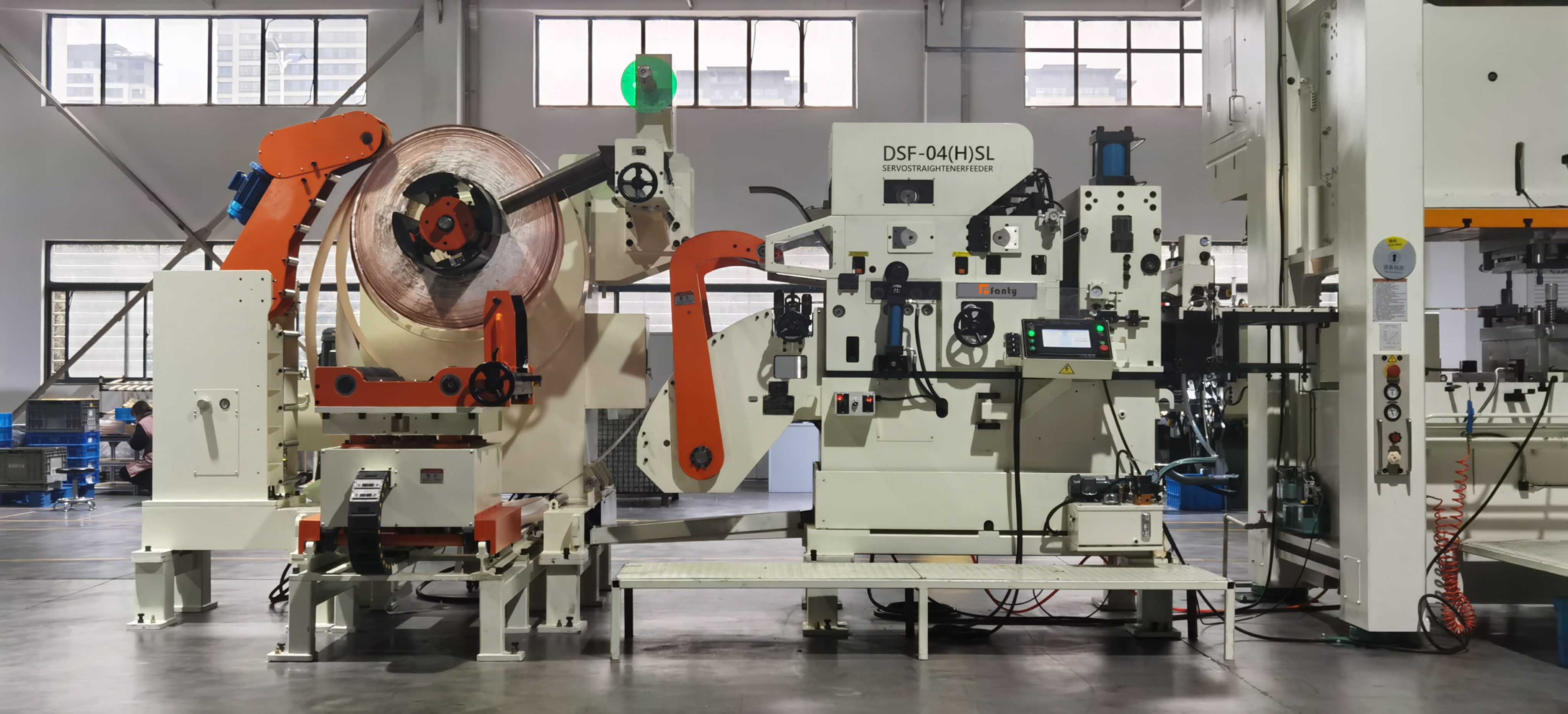 The nc straightener feeder line.
Typical Flatness Numbers by Application
The table below shows the flatness tolerances that different stamping applications typically require, expressed as the maximum deviation over a 1,000 mm length.
| Application | Typical tolerance over 1,000 mm | Why it is set this way |
|---|---|---|
| General blanking and piercing | 1.0 - 2.0 mm | The blank holder flattens the strip during the stroke |
| Progressive die feeding | 0.5 - 1.0 mm | Flat strip feeds consistently through pilots and stations |
| High-speed motor lamination | 0.3 - 0.5 mm | Thin strip must not buckle at 200+ SPM |
| Fine blanking | 0.2 - 0.5 mm | Surface and edge quality demand controlled flatness |
| Long strip fed into a leveler or roll former | 1.0 mm per meter or better | Downstream processes amplify any residual bow |
These are typical values, not guarantees. The achievable flatness depends on the material: thin soft strip straightens more easily than thick high-strength strip, and a machine with more rolls and finer adjustment reaches tighter tolerances. When you specify a requirement, match it to the application rather than asking for the tightest number on the sheet, because tighter tolerances cost more in machine capability and setup time.
What Affects Achievable Flatness
Five variables decide whether a straightener reaches a given flatness tolerance, and they are worth understanding before you specify.
- Material yield strength. Higher strength needs more bending force and is harder to flatten to a tight tolerance.
- Strip thickness and width. Thin wide strip is prone to edge wave; thick strip needs more roll power.
- Roll count and diameter. More small rolls bend the strip more progressively for finer control.
- Incoming coil condition. A coil with heavy coil set or edge damage is harder to flatten than clean material.
- Line speed and tension. Tension from the feeder changes the effective flatness at the measurement point.
When a supplier quotes a flatness figure, ask what material, thickness, and speed that figure applies to. A number quoted for 0.5 mm soft steel tells you nothing about the same machine on 3.0 mm high-strength strip, and the RFQ should tie the tolerance to the specific material range you run.
How to Write a Flatness Requirement
Writing a verifiable flatness requirement is a matter of being specific about the test. A complete statement includes the sample length, the measurement method, the material condition, and the acceptance point.
For example: the straightener shall deliver strip with a maximum bow of 1.0 mm measured over 1,000 mm, with the strip laid on a flat surface and measured without tension, on SPCC material 0.8 to 2.0 mm thick and 200 to 400 mm wide, at line speeds up to 40 m/min, tested at commissioning on the buyer's material. That single sentence removes every ambiguity and gives both sides a test they can run and sign.
Avoid the two most common specification errors: quoting a bow limit without a length, and quoting a flatness number without stating the material. Both errors make the requirement unverifiable, which turns a quality commitment into a dispute at commissioning.
Verifying Flatness on the Floor
At commissioning and during production, flatness should be verified with a simple repeatable test. Cut a sample at least 1,000 mm long, lay it on a certified flat surface, and measure the maximum gap under the strip with a feeler gauge or a dial indicator at several points along the length and across the width. Record the values and compare them with the specification.
For a production check, the same test on a sample at the start of each coil is enough to confirm the straightener settings are holding. If the flatness drifts during a coil, the cause is usually roll heating, roll wear, or a change in the incoming material, and the measurement catches it before the parts are made. Keep a log of the sample measurements with the coil number; the trend over coils tells you when the rolls need attention.
Frequently Asked Questions
What is the best flatness an NC Straightener Feeder can achieve?
On clean, thin, soft strip, a well-set straightener can reach 0.3 mm or better over a meter. On thick or high-strength strip, 1.0 to 1.5 mm over a meter is a more realistic expectation. The achievable value depends on the material and the machine geometry, so ask the builder for a figure tied to your material.
Is bow over a meter the same as edge wave?
No. Bow is curvature along the strip length, like a banana shape. Edge wave is waviness across the strip width, with the edges rising and falling. A straightener corrects both, but they are measured separately and require different roll adjustments.
Do I need the tightest flatness tolerance for every job?
No. Tighter tolerances cost more in machine capability, setup time, and sensitivity to material variation. Specify the tolerance your application actually needs, such as 1.0 mm per meter for general blanking or 0.5 mm for high-speed feeding, and save the cost.
Why does the flatness change between the start and end of a coil?
Incoming coil set varies along the coil, especially near the outer wraps where the material has been coiled the longest, and the rolls also warm up as the line runs. Both effects change the effective straightening result, which is why a sample check at the start of each coil is a useful routine.
How does flatness affect the feeder's accuracy?
Strip that is not flat feeds unevenly: the leading edge lifts, the strip skips or buckles at the feed rolls, and the measured pitch drifts. Flat strip feeds consistently, so the flatness tolerance you set for the straightener directly supports the feed accuracy you expect from the feeder.
Specify Flatness with Confidence
FANTY application engineers will confirm the flatness tolerance your NC Straightener Feeder can achieve on your specific material range, and include the measurement method in the proposal. Send us your strip grades, thickness, width, and the application, and we will quote against a verifiable number.
Request a Flatness Commitment