What Is a Decoiler Straightener Feeder? Complete Guide for Stamping Automation Lines

What Is a Decoiler Straightener Feeder? Complete Guide for Stamping Automation Lines

Summary

Learn what a Decoiler Straightener Feeder is, how it works, its main components, applications, advantages, selection tips, and how FANTY helps factories improve coil feeding efficiency.
What Is a Decoiler Straightener Feeder? Complete Guide for Stamping Automation Lines

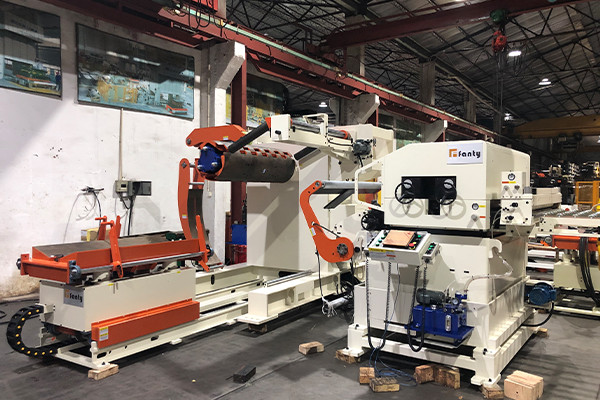
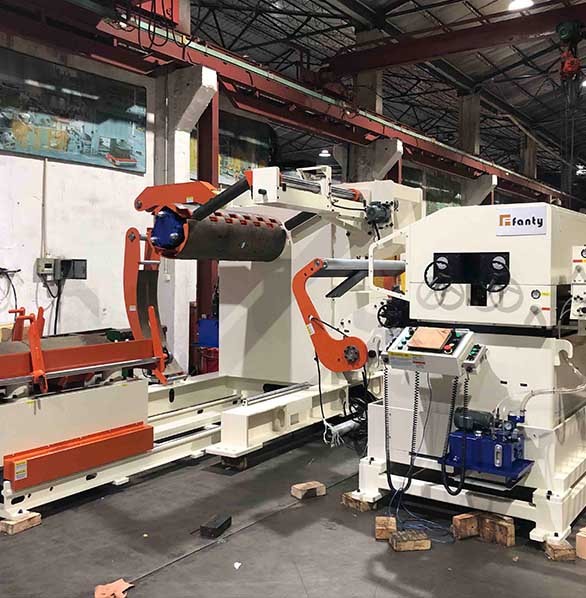
A Decoiler Straightener Feeder is an integrated coil feeding system used in metal stamping, punching, forming, cutting, and automated press production. Instead of using a separate decoiler, straightener, and feeder, this machine combines three important processes into one compact line: unwinding the coil, straightening the strip, and feeding the material into the press with accurate length control.

In modern stamping production, feeding accuracy and material stability directly affect part quality. If the coil is not released smoothly, if the strip is not flat, or if the feeder cannot send the material accurately into the die, the production line may suffer from material waste, press stoppage, poor part tolerance, die damage, and higher labor cost.

That is why more manufacturers are moving from traditional separate coil feeding systems to compact Decoiler Straightener Feeder solutions. For factories with limited workshop space, high production demand, frequent coil changes, or strict stamping accuracy requirements, an integrated system can improve both productivity and process reliability.

FANTY provides decoiler machines, straighteners, servo feeders, decoiler straightener feeders, punch presses, and complete stamping automation solutions. With experience in coil handling equipment, FANTY helps manufacturers design suitable feeding systems according to coil width, thickness, material type, press tonnage, feeding pitch, production speed, and factory layout.

What Is a Decoiler Straightener Feeder?

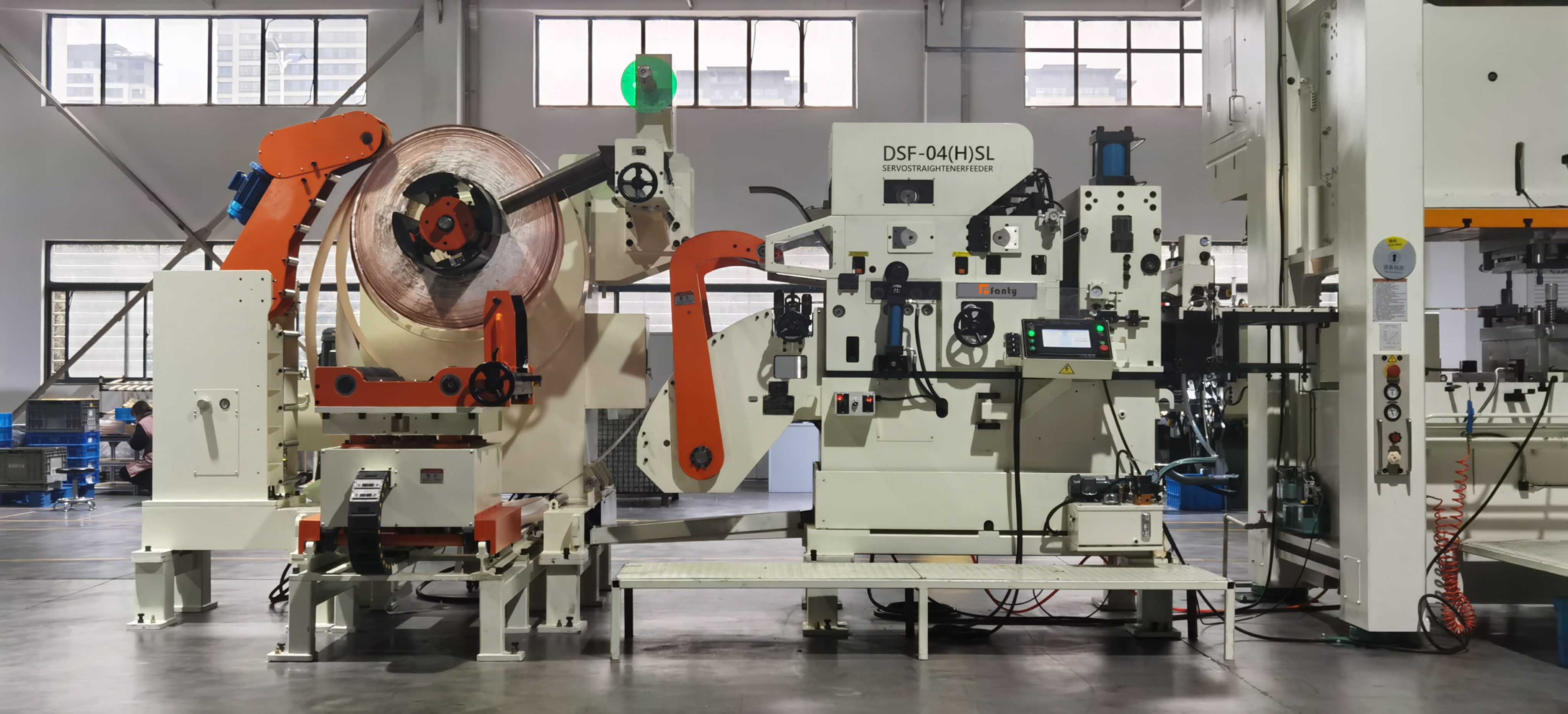
A Decoiler Straightener Feeder is a compact coil feeding machine that integrates three functions into one system. The decoiler holds and unwinds the coil. The straightener removes coil set, waves, and curvature from the strip. The servo feeder sends the material into the press or processing machine at a precise length and speed.

In simple terms, it turns a heavy metal coil into flat, accurately positioned strip material ready for stamping. This makes it especially useful for progressive die stamping, automotive parts, appliance parts, hardware components, electronic parts, brackets, hinges, washers, and many other metal forming applications.

Function Machine Section Purpose Production Value
Unwinding Decoiler Holds and releases metal coil Provides continuous material supply
Straightening Straightener Corrects coil curvature and waves Improves material flatness and stamping quality
Feeding Servo Feeder Feeds strip into press accurately Improves feeding precision and reduces waste
Control PLC / HMI / Servo System Coordinates speed, length, and timing Supports stable automatic production
A modern Decoiler Straightener Feeder machine connected to a press machine

Main Components of a Decoiler Straightener Feeder

A high-quality Decoiler Straightener Feeder is not just three machines placed together. It is an integrated system designed for stable material flow, accurate control, easy operation, and long-term reliability.

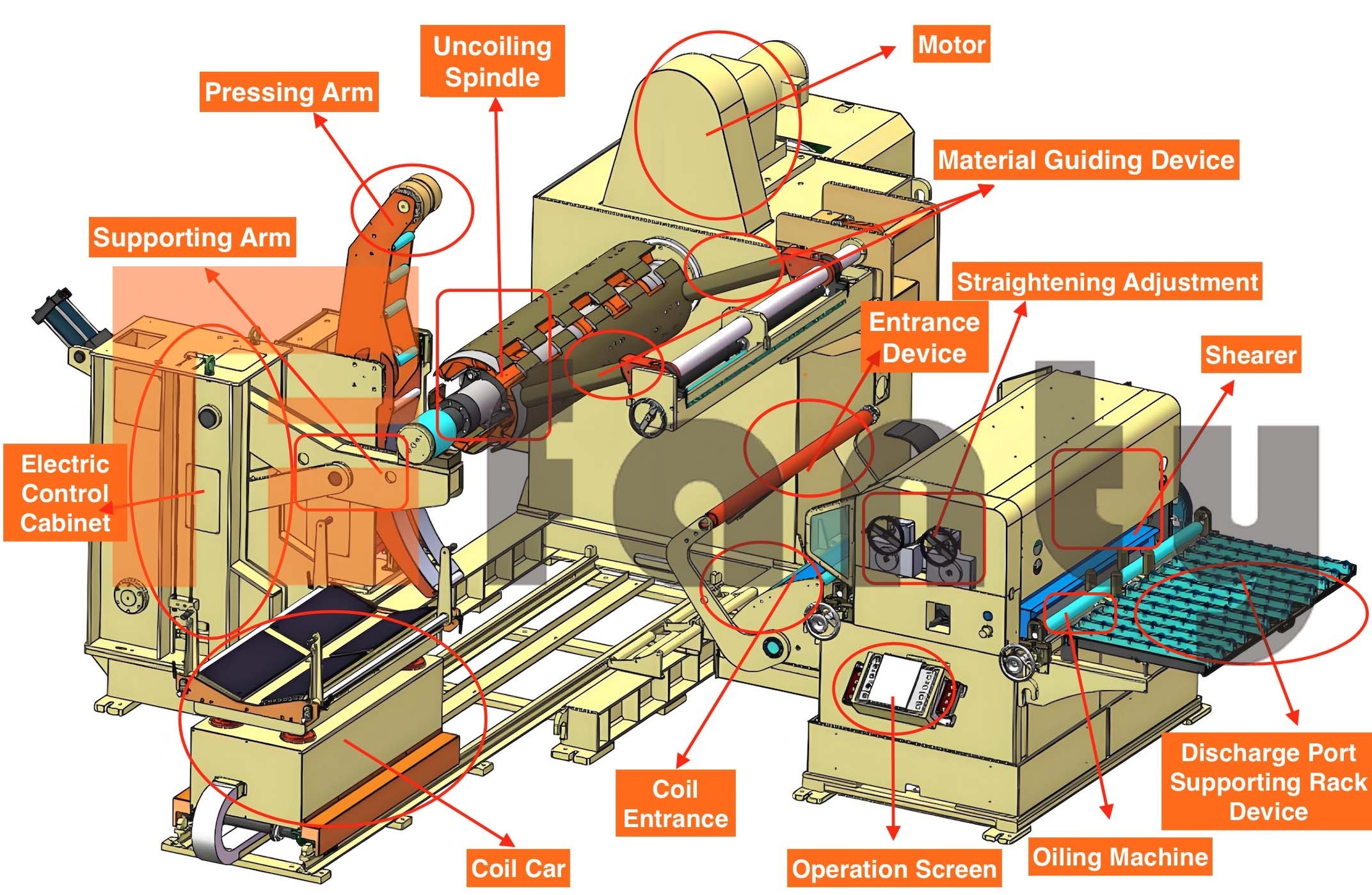
1. Decoiler Section

The decoiler section holds the coil and releases material smoothly. Depending on coil weight and production requirements, it may use manual expansion, hydraulic expansion, a pressing arm, a coil car, or side guide devices.

The decoiler must support the coil securely. If the coil slips, telescopes, or rotates unevenly, the entire feeding process becomes unstable. For heavy coils or frequent coil changes, hydraulic expansion and a coil car can significantly improve safety and efficiency.

2. Straightener Section

After uncoiling, the strip usually has coil memory. It may be curved, wavy, or uneven. The straightener section uses multiple rollers to apply controlled pressure and correct the material shape. Proper straightening improves flatness and helps the feeder deliver material more accurately.

For different materials, roller quantity, roller diameter, roller hardness, adjustment method, and straightening pressure all matter. Thin materials need gentle control, while thicker materials require stronger straightening force.

3. Servo Feeder Section

The servo feeder controls the feeding length, speed, and timing. Compared with traditional mechanical or pneumatic feeders, servo feeders offer better accuracy, easier parameter setting, and stronger flexibility for different stamping parts.

In progressive die stamping, feeding accuracy is critical. Even a small feeding error can create poor part quality, die collision, or material waste. That is why the feeder section is one of the most important parts of the complete system.

4. Control System

The control system connects the decoiler, straightener, feeder, and press. It may include PLC control, touch screen operation, servo drive, inverter, sensors, loop control, safety alarms, and memory functions for different production recipes.

5. Optional Coil Car

A coil car helps load heavy coils onto the decoiler mandrel safely and accurately. It reduces manual operation and improves coil change efficiency. For medium and heavy-duty stamping lines, a coil car is often a practical option.

Component Main Role Recommended Feature
Decoiler Unwinds coil material Hydraulic expansion for heavy coils
Pressing Arm Prevents coil loosening Useful for thick or loose coils
Straightener Rollers Correct material flatness High-hardness rollers for long service life
Servo Feeder Controls feeding length Servo motor and PLC control
Coil Car Loads coil safely Recommended for heavy coils
Touch Screen Parameter setting and operation Recipe memory for different products

How Does a Decoiler Straightener Feeder Work?

The working process is continuous and coordinated. The metal coil is loaded onto the decoiler. The mandrel expands to fix the coil. The material head is introduced into the straightener section. The rollers straighten the strip. Then the servo feeder feeds the material into the press according to the set pitch and timing.

  1. Coil Loading: The coil is loaded onto the mandrel by forklift, crane, or coil car.
  2. Coil Expansion: The mandrel expands manually or hydraulically to hold the coil securely.
  3. Uncoiling: The decoiler releases strip material smoothly into the straightener section.
  4. Straightening: The material passes through multiple rollers to remove coil curvature and waves.
  5. Feeding: The servo feeder sends material into the press at the required length.
  6. Press Synchronization: The feeder works with the press signal to match each stamping stroke.
  7. Continuous Production: The system repeats the process automatically for stable production.
FANTY Engineering Tip: For stable production, the machine should be selected according to actual coil width, thickness, weight, material strength, feeding pitch, and press speed. A wrong model may run, but it will not deliver long-term reliability.
Decoiler Straightener Feeder

What Are the Key Advantages of a Decoiler Straightener Feeder?

The biggest advantage of a Decoiler Straightener Feeder is integration. By combining three processes into one compact system, it reduces workshop space, improves feeding stability, simplifies operation, and supports more efficient production.

1. Space Saving

Traditional coil feeding lines often require a separate decoiler, straightener, feeder, and long loop space. A compact Decoiler Straightener Feeder can reduce the total line length and make better use of factory space.

2. Better Feeding Accuracy

Because the straightener and feeder are integrated, the material path is shorter and more controlled. Servo feeding improves length accuracy and helps reduce material waste.

3. Higher Productivity

Automatic coil feeding reduces manual handling and allows the press line to run more continuously. This is especially valuable for high-volume stamping production.

4. Improved Material Flatness

The straightener section removes coil set before feeding. Better flatness helps improve stamping consistency and reduces die-related problems.

5. Easier Operation

With touch screen control and recipe settings, operators can adjust feeding length, speed, straightening pressure, and other parameters more conveniently.

6. Safer Coil Handling

Options such as hydraulic expansion, pressing arm, and coil car make coil loading and unwinding safer, especially for heavy coils.

Benefit Impact on Production Business Value
Integrated structure Shorter material path and less floor space Better workshop utilization
Servo feeding More accurate feeding length Less scrap and better part consistency
Automatic control Less manual intervention Higher productivity
Straightening function Flatter material before stamping Improved part quality
Optional coil car Faster and safer coil loading Reduced downtime during coil change

Decoiler Straightener Feeder vs Separate Coil Feeding Line

Many factories ask whether they should choose an integrated Decoiler Straightener Feeder or use separate machines. The answer depends on coil thickness, material type, press layout, available space, speed requirement, and production flexibility.

Item Decoiler Straightener Feeder Separate Decoiler + Straightener + Feeder
Floor Space More compact Requires longer line space
Installation Easier integrated setup More alignment work between machines
Feeding Stability Strong for compact stamping lines Good if layout is designed correctly
Maintenance Centralized system Each machine maintained separately
Best For Automatic stamping lines, limited space, medium/high accuracy Special layouts, large loop requirement, customized process
Cost Consideration Higher single-machine value but better integration Flexible investment by separate equipment

For many stamping manufacturers, the integrated solution offers a better balance between efficiency, space saving, and feeding precision. However, for very thick materials, very special layouts, or extremely high-speed applications, a customized separate coil feed line may still be suitable.

Where Is a Decoiler Straightener Feeder Used?

A Decoiler Straightener Feeder is widely used in industries that process metal coils into stamped parts. It is commonly installed before mechanical presses, hydraulic presses, progressive dies, transfer dies, cutting machines, and forming equipment.

Automotive Parts

Used for brackets, structural components, seat parts, clips, covers, and other stamped metal parts requiring stable feeding and repeatable accuracy.

Home Appliances

Used for washing machine parts, refrigerator parts, air conditioner components, oven panels, and appliance metal housings.

Electronics

Suitable for thin metal parts, precision brackets, connectors, shields, and small stamped components.

Hardware Products

Used for hinges, washers, locks, clips, metal plates, tool parts, and general hardware stamping production.

How Do You Choose the Right Decoiler Straightener Feeder?

Selecting the right model is critical. A machine that is too small may overload and create downtime. A machine that is too large may increase unnecessary investment. The best solution should match your real production data.

Key data FANTY needs before recommendation

Information Why It Matters
Material type Different materials require different straightening force and roller design.
Coil width Determines machine width and guide structure.
Material thickness Affects straightening capacity and feeder power.
Coil weight Determines decoiler capacity, frame strength, and coil car requirement.
Coil inner and outer diameter Determines mandrel expansion range and machine layout.
Feeding pitch Determines servo feeder control requirement.
Press speed Helps match feeding speed and synchronization.
Part accuracy requirement Determines feeder precision and straightener performance.
Selection Advice: Do not choose a Decoiler Straightener Feeder only by coil width. You must also consider material thickness, yield strength, coil weight, press speed, feeding length, and die requirement.

Common Problems a Good Decoiler Straightener Feeder Can Prevent

A properly selected and installed Decoiler Straightener Feeder can help reduce many production problems that are common in traditional coil feeding systems.

Production Problem Possible Cause How an Integrated System Helps
Unstable feeding length Poor feeder control or material tension Servo feeding and shorter material path improve accuracy
Strip waves or curvature Material coil memory Straightener rollers correct flatness before stamping
Material scratches Poor alignment or excessive loop Integrated path reduces unnecessary material contact
Long setup time Separate machines require more adjustment Centralized control simplifies operation
Low workshop efficiency Large floor space and manual handling Compact structure and coil car option improve workflow

Why Choose FANTY Decoiler Straightener Feeder Solutions?

FANTY focuses on coil handling equipment and stamping automation systems. Instead of offering only a standard machine, FANTY helps customers evaluate real production conditions and recommend suitable solutions for stable long-term operation.

For different factories, the right configuration may be different. Some customers need a compact decoiler straightener feeder for limited workshop space. Some need a heavy-duty hydraulic decoiler with coil car. Some need a servo feeder connected with a mechanical press. Some need a full automatic coil feeding and transfer system.

FANTY can support:

  • Decoiler Straightener Feeder machine selection.
  • Coil width, thickness, and weight matching.
  • Press line layout suggestions.
  • Hydraulic expansion, pressing arm, and coil car options.
  • Servo feeder and PLC control integration.
  • Customized stamping automation solutions.
  • Technical communication for installation and operation.

Need a Decoiler Straightener Feeder for Your Press Line?

Send FANTY your coil width, thickness, coil weight, material type, feeding pitch, press tonnage, and production requirement. Our team can help recommend a suitable coil feeding solution.

Contact FANTY Now

Recommended Internal Links for SEO Cluster

To improve topical authority around the keyword Decoiler Straightener Feeder, this page should link to related product and blog pages on your website. Suggested internal anchor text:

Final Thoughts

A Decoiler Straightener Feeder is more than a combination of three machines. It is a complete coil feeding solution designed to improve stamping line efficiency, feeding accuracy, material flatness, safety, and workshop space utilization.

For factories still using separate machines or manual feeding methods, upgrading to an integrated Decoiler Straightener Feeder can reduce downtime, shorten setup time, improve part consistency, and support higher automation. However, the machine must be selected carefully according to real coil data and press requirements.

FANTY helps manufacturers build practical and reliable coil handling systems for stamping production. Whether you need a standard Decoiler Straightener Feeder or a customized automatic coil feeding line, FANTY can support your project with equipment selection, technical communication, and solution planning.

FAQ: Decoiler Straightener Feeder

What is a Decoiler Straightener Feeder?

A Decoiler Straightener Feeder is an integrated coil feeding machine that unwinds metal coil, straightens the strip, and feeds it into a press or processing machine with accurate length control.

What is the difference between a decoiler and a Decoiler Straightener Feeder?

A decoiler only unwinds coil material. A Decoiler Straightener Feeder combines decoiling, straightening, and servo feeding into one system, making it more suitable for automatic stamping lines.

Why do stamping lines need a straightener?

Coiled material usually has curvature or waves caused by winding. A straightener corrects the material before feeding, which helps improve stamping accuracy and part quality.

Is a Decoiler Straightener Feeder suitable for thick materials?

Yes, but the correct model must be selected according to material thickness, yield strength, coil weight, and press speed. Heavy-duty models are required for thicker or stronger materials.

Can a Decoiler Straightener Feeder save factory space?

Yes. Because it integrates decoiling, straightening, and feeding into one compact system, it usually requires less floor space than a traditional separate coil feeding line.

What information is needed before buying a Decoiler Straightener Feeder?

You should provide coil width, material thickness, material type, coil weight, coil inner diameter, coil outer diameter, feeding pitch, press speed, and accuracy requirement.

Does FANTY provide customized Decoiler Straightener Feeder solutions?

Yes. FANTY provides customized coil feeding solutions based on customer production requirements, including decoiler straightener feeders, servo feeders, coil cars, pressing arms, and full stamping automation systems.

```