What Should an NC Straightener Feeder RFQ Include?
- Share
- publisher
- David Park - Senior Stamping Engineer, FANTY Machinery
- Issue Time
- Sep 6,2026
Summary
What to put in an RFQ for an NC Straightener Feeder: coil data, die and press details, accuracy targets, utility conditions, and commercial terms that get accurate quotes.
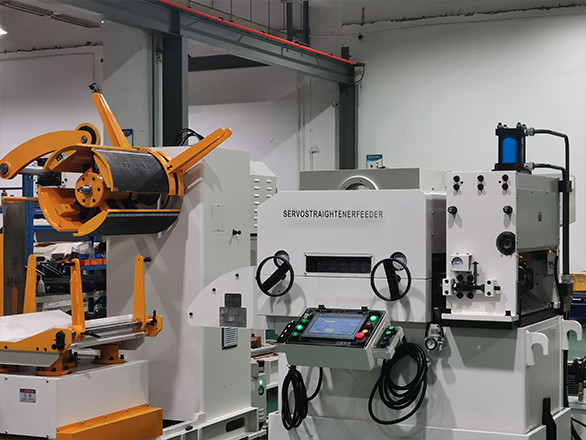
A request for quotation is the first technical document in every machinery purchase, and the quality of the RFQ decides the quality of the quotes that come back. Send a vague RFQ for an NC Straightener Feeder and suppliers will either add generous safety margins to cover the unknowns, or ask you twenty clarifying questions and delay the whole process. Send a complete RFQ and the suppliers can quote accurately, compare fairly, and deliver a machine that fits the day it arrives. This guide lists exactly what a coil-feeding equipment RFQ should contain, explains why each item matters, and gives you a checklist you can reuse for every machine you buy.
The information divides into five groups: the coil and material, the die and press, the performance targets, the site conditions, and the commercial terms. Work through all five and your RFQ will be complete enough for any serious builder to respond with a fixed price and a technical proposal, rather than a list of questions.
One final habit separates professional buyers from the rest: they send the RFQ in a format the supplier can answer directly. A structured document with clear sections, named files for drawings, and numbered questions is faster for the supplier to respond to and easier for you to compare. If you attach a layout sketch, label the press, the coil area, and the available space so the supplier can see the physical constraints at a glance. The effort you put into the RFQ format comes back as the difference between a rushed guess and a considered proposal.
Why a Complete RFQ Saves You Money
Suppliers price risk as well as hardware. When an RFQ omits the material grades or the maximum coil width, the builder does not assume the cheapest case; they assume the widest range they can justify, and the price climbs accordingly. A complete RFQ narrows the machine to what you actually need, so you pay for capacity you will use rather than capacity the supplier had to guess.
A complete RFQ also makes quotes comparable. When every supplier receives the same coil data, die details, and acceptance targets, their offers differ by engineering rather than by assumption, and you can evaluate them honestly. Buyers who send the same disciplined RFQ to three builders consistently report that the spread between the highest and lowest quote narrows, because the suppliers are all pricing the same defined machine.
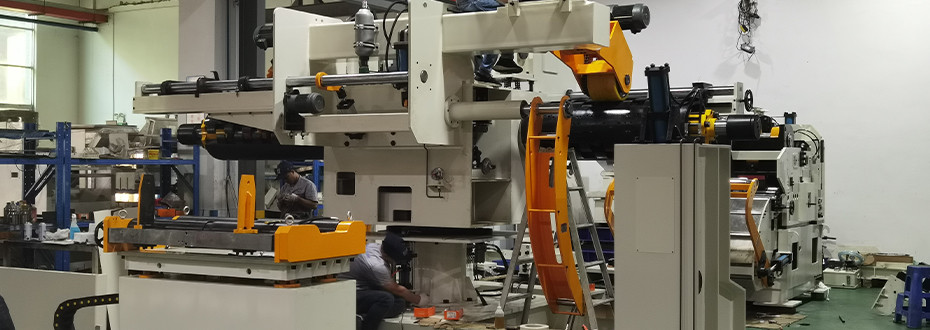 A well-prepared RFQ brings accurate quotes.
Section One: Coil and Material Data
The coil data defines the decoiler and the straightener. Without it, no supplier can size the machine correctly.
| Data point | Why the builder needs it | Example |
|---|---|---|
| Material grades | Yield strength decides straightener power and roll geometry | SPCC, DC01, SUS304, 590 MPa AHSS |
| Thickness range | Sets the straightener roll gap range and motor power | 0.5 - 3.2 mm |
| Strip width range | Sets the decoiler width and straightener roll length | 100 - 400 mm |
| Coil OD and ID | Sets the decoiler expansion range and coil car size | OD 1,200 mm max, ID 508 mm |
| Coil weight | Sets the decoiler load rating and foundation design | Up to 5 tons |
| Surface condition | Oily or dry strip affects feed roll choice | Mill-oiled |
Give the range, not just the nominal value. A machine sized for a 2.0 mm average but occasionally fed 3.2 mm material must be specified for the 3.2 mm case, and the RFQ should say so explicitly.
Section Two: Die and Press Details
The die and the press define the feeder. The most common RFQ mistake is describing the coil in detail and saying nothing about the die, leaving the supplier to guess the feed length and speed.
- Press model and tonnage. Confirms the feeder can be interfaced and the space available.
- Die feed length range. The shortest and longest feed stroke the die requires, in millimeters.
- Press speed. The operating SPM range, including the maximum the line may run.
- Feed height. The distance from the floor to the strip pass line at the die entry.
- Signal interface. The press control voltage and whether it has a cam output for the feeder.
If the die is new and not yet built, state the planned feed length and pitch. If the press is old and its control details are unknown, say so honestly, because the builder can then propose the interface solution rather than quoting a machine that cannot communicate with your press.
Section Three: Performance Targets
State the results you expect, and the suppliers will design to them. Vague targets produce machines that merely run; precise targets produce machines that perform.
- Feed accuracy. The repeatability you need, such as ±0.05 mm at the maximum feed length.
- Strip flatness. The acceptable residual curvature, usually expressed as a bow height over a set length.
- Changeover time. How quickly the line must switch between jobs or coil widths.
- Noise and safety compliance. Any acoustic limit or CE requirement the machine must meet.
- Acceptance test. The test you will run at commissioning to confirm the machine meets the targets.
Agreeing the acceptance test in the RFQ prevents disputes later. If the machine must hold ±0.05 mm feed accuracy measured over a hundred consecutive cycles on your material, write it in the RFQ, and the supplier's quotation becomes a contractual commitment to that test.
Section Four: Site Conditions
The machine must survive your building, so the RFQ should describe the site as well as the product. Include the available floor space and layout sketch, the ceiling height for coil loading, the power supply voltage and phase, the compressed air pressure if the line uses pneumatics, the foundation condition, and the ambient temperature range if the shop is not climate controlled. A supplier that knows the machine will run on a 380-volt three-phase supply in a 40-degree shop can specify the drives and cooling correctly the first time, avoiding a machine that trips or overheats after installation.
Section Five: Commercial Terms
The commercial section of the RFQ defines how the quotes will be compared. Ask every supplier to quote on the same Incoterm and the same destination port, to state the delivery lead time in weeks from order confirmation, to list the warranty period and the response-time commitment, to include the scope of commissioning and training, and to provide a recommended spare parts list with prices. Requiring these items in the RFQ turns the returned quotes into directly comparable offers and eliminates the most common sources of confusion later in the negotiation.
Frequently Asked Questions
How long should an NC Straightener Feeder RFQ be?
Aim for one to three pages of technical data plus a layout sketch and a commercial request. The goal is completeness without padding: every line should either size the machine, define the interface, or set the terms of comparison.
Should I send the same RFQ to every supplier?
Yes, with the same data and the same commercial questions. Identical RFQs make the quotes comparable. Sending different information to different suppliers produces quotes that cannot be compared and wastes everyone's time.
What if I do not know all my coil and die data yet?
Send the RFQ with the data you have and clearly mark the unknowns. A good supplier will ask precisely the questions that fill the gaps, and you avoid the trap of receiving a quote based on assumptions that were never stated.
Can I ask for a sample trial in the RFQ?
Yes, and it is a wise request for a machine of this value. Ask the supplier to confirm whether they can run a sample of your material and die, and include the trial conditions in the commercial comparison.
How many suppliers should I invite to quote?
Three is a practical number for a machine of this type: enough to compare engineering approaches and pricing, few enough that each supplier takes the RFQ seriously. More than five dilutes the responses.
Send Us Your RFQ and Get a Precise Proposal
FANTY responds to complete RFQs with a technical proposal, a fixed price, and a delivery schedule within a few working days. If your RFQ is missing data, our engineers will ask the right questions rather than guess, so the machine you receive fits the day it arrives.
Submit Your RFQ to FANTY