Which Alignment Errors Throw a Decoiler Off the Line?
- Share
- publisher
- David Park - Senior Stamping Engineer, FANTY Machinery
- Issue Time
- Sep 23,2026
Summary
Strip that runs to one edge is usually blamed on the guides or the die, when the cause was set in concrete at commissioning. This covers the four alignment errors that survive installation...
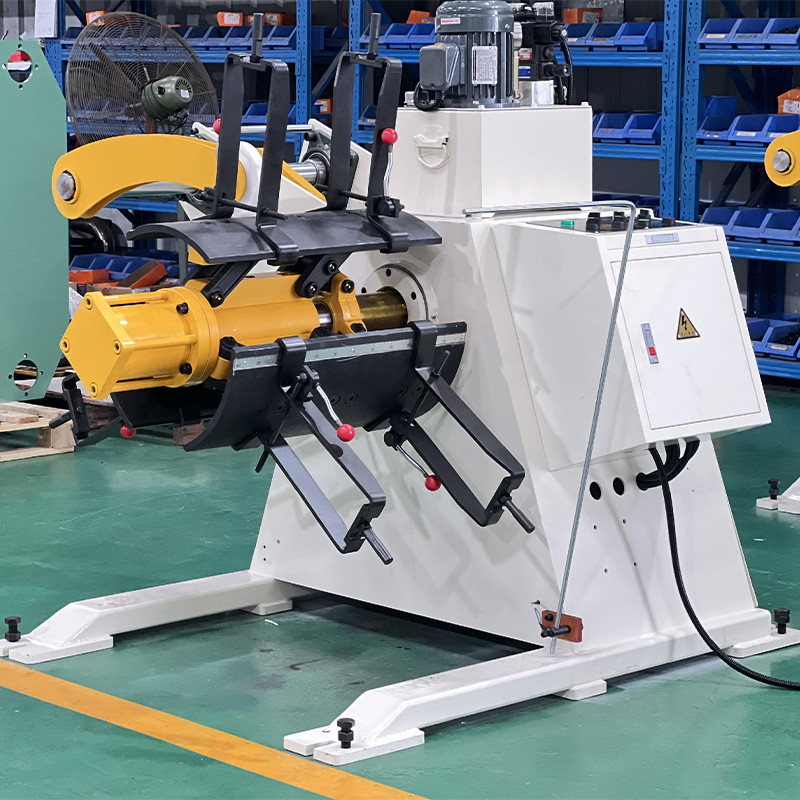
The strip runs to one edge for the whole coil. The guides are blamed, then the die, then the material.
In most cases the cause was set in concrete three years earlier, when the decoiler machine was aligned to the line.
This covers the alignment errors that survive commissioning and quietly tax every coil afterwards, how to choose an alignment reference, and what alignment genuinely cannot fix.
The specification chain that decides what the machine can hold in the first place is in the coil line guide library, and the equipment range is listed under our machines.
Where Tracking Drift Actually Starts
Four alignment errors account for most of the tracking complaints we are called out to look at. They differ in how visible they are and in how much they cost to correct.
Height mismatch at the pass line. The mandrel centre sits 3 to 8 mm above or below the entry height of the equipment downstream.
The strip then enters on a slope, and the first guide it meets pushes it sideways. This is the single most common error, and the cheapest to fix if caught before grouting.
Yaw against the line centreline. The decoiler is rotated a fraction of a degree relative to the line. At 6 metres of distance to the first guide, half a degree is over 50 mm of lateral offset.
Mandrel runout. The mandrel axis is not perpendicular to the machine face, so the coil face wobbles as it turns. The strip pays off in a slow sine wave.
Twist in the base. The base is level side to side but rotated in plan, so the coil sits square to the machine and skewed to the line.
Three of those four are geometric and measurable. Only one of them, runout, can develop after commissioning.
Which Reference You Should Align To
Alignment methods differ mainly in what they measure and what they leave unmeasured.
| Alignment reference | What it gives you | Where it costs you | Where it misleads |
|---|---|---|---|
| String line down the coil centre | Fast, needs no instruments, good to about 2 mm over 6 m | Nothing to record, and it depends entirely on who holds the string | Sag in a long string looks like a decoiler error, and the method says nothing about height |
| Laser line on the mandrel face | Repeatable, visible to the whole crew, easy to photograph | Requires a laser and a flat reference face on the machine | A laser set on a painted or damaged face measures the paint, not the axis |
| Dial indicator on the mandrel | Measures runout directly, in numbers you can trend | Slow, and needs the mandrel rotated under its own power | Catches runout only; a perfectly true mandrel can still be yawed |
| Strip tracking under load | The real proof, because it includes the guides and the first station | Costs a coil, a die set-up and half a shift | A guide set slightly loose will mask a decoiler error and pass the test |
The cost of each method is mostly time, and time is cheap before grouting.
A laser and a dial indicator together cover both yaw and runout for less than the price of one coil ruined by a tracking fault nobody caught.
Record everything in millimetres at the reference points you used. An alignment sheet without a stated reference point is unusable six months later.
Why Squareness Beats Centreline in Practice
Centrelines get all the attention during commissioning and squareness does most of the work afterwards.
A decoiler can be within a millimetre of the line centreline and still skew the strip if its mandrel face is not square to the direction of travel.
The strip leaves the coil perpendicular to the mandrel face. If that face is out by 0.5 degrees, the strip arrives at the first guide 5 mm off centre for every metre of span.
A plumb line dropped from the mandrel face to the floor, plus a feeler gauge at the base, gets you within about 0.5 mm without any instrument that needs calibrating.
It is not the most precise method available, and it is precise enough to catch every error that matters.
Check squareness with the coil mounted. A mandrel that is true when empty can deflect measurably under a 10 tonne coil, particularly on a cantilever design.
Re-check after the first heavy coil. A machine that was square when installed and is not square after a week was not sitting on a sound base.
On an uncoiler machine with a powered mandrel, also check that the mandrel axis stays parallel through the full expansion stroke. A segment set that binds on one side will tilt the coil as it grips.
Height belongs in the same conversation. Squareness in plan is easy to see. Height error is invisible until the strip starts climbing or diving into the first guide.
Where Alignment Cannot Fix Your Problem
Alignment is the cheapest correction available, which is why it gets blamed for faults it cannot cure.
A cambered coil. If the strip was rolled with edge camber, it will curve no matter how true the mandrel is. Measure the coil, not the machine, before adjusting anything.
A guide set that is too far away. Alignment cannot compensate for 8 metres of unsupported span. Move the first guide closer instead.
Insufficient mandrel grip. A coil that turns on the mandrel introduces an error the alignment never had. Check grip before you touch the base.
A base that is moving. If the machine settles seasonally, realignment buys a few months at most. Fix the foundation first.
Strip that is not flat. A decoiler cannot correct shape. Centre buckle, crossbow and twist are properties of the coil and the equipment downstream, not of the pay-off alignment.
Coils outside the mandrel's range. Segments forced onto a bore they were not made for will tilt the coil, and no alignment setting recovers that.
We have commissioned equipment into more than 200 production lines, and the calls that end with a foundation repair rather than an adjustment are the ones worth diagnosing carefully first.
What to Verify Before the Grout Sets
Every check on this list takes minutes before grouting and days after it.
- Mandrel centre height against the pass line. Within 1 mm at the entry of the equipment downstream, measured with the base shimmed, not guessed.
- Mandrel face square to the direction of travel. Within 0.2 mm across the face diameter. Record the reading and the reference face used.
- Mandrel runout through a full revolution. Under 0.15 mm at the mandrel body for a powered unit.
- Base level under load, not empty. Load the heaviest coil you expect and re-read the level. Deflection is normal; uneven deflection is not.
- Bolt torque and shim record. Photograph the shim stack before the grout goes in. It is the only record you will have of how the machine was set.
- Strip tracking run with a full coil. Half a coil at slow speed proves nothing. Run at production speed and check edge position at the first guide over 20 metres.
Sign and date the sheet, and keep it with the machine documentation. When the line starts drifting in two years, that sheet is the baseline everything else is compared against.
Our own machines ship with a CE declaration and a commissioning record precisely because an alignment without a record is an opinion.
How much centreline error can a coil line tolerate, 2 mm or 5 mm?
Keep the decoiler within 2 mm of the line centreline and the mandrel face square within 0.2 mm. Beyond about 5 mm of centreline error, guides start correcting instead of guiding, and edge damage appears.
Does the decoiler need re-aligning after the first 100 running hours?
Check it once after the first coil at full rated weight, and again after roughly 100 hours of running. Most settling happens in that window; after it, annual checks are usually enough.
Can a 1,300 mm coil and a 1,500 mm coil use the same alignment setting?
Yes, the alignment is independent of coil size.
What changes is the tracking behaviour: a wider coil has less margin in the guides, so the same 2 mm error that was invisible at 1,300 mm becomes a visible edge rub at 1,500 mm.
Where to go next
Alignment sets how well a decoiler holds a coil it was specified for. What it can be specified to hold, and the four decisions that fix that, are set out in the guide library.
our coil line knowledge base