Which Uncoiler Drive Suits a One-Press Cell?
- Share
- publisher
- David Park - Senior Stamping Engineer, FANTY Machinery
- Issue Time
- Oct 20,2026
Summary
A one-press cell running 2-tonne coils does not need the same drive as a three-press line running 10-tonne coils. Manual, motorised and hydraulic drives differ in back tension control...
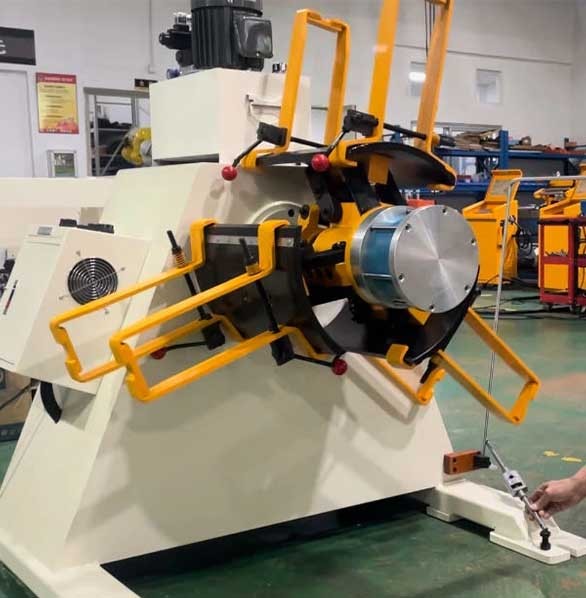
Three drives, one press, one coil at a time. The quotation can be written for any of them, and the price difference between the cheapest and the dearest is larger than the press's annual maintenance budget.
A manual uncoiler relies on the line to pull strip off a braked shaft. A motorised version drives the coil. A hydraulic version adds variable tension control on top.
Which one a single-press cell needs depends on coil weight, line speed and whether the strip is coated, in that order.
Three Drives, One Press, One Coil at a Time
The manual drive is a shaft, bearings and a friction brake. There is no motor and no control, and the payoff speed is set by the line.
The motorised drive adds a motor and a variable speed drive, usually following a loop sensor so the coil pays off as fast as the line consumes.
The hydraulic drive adds proportional tension control, which holds back tension steady as coil diameter falls from 1,500 mm to 508 mm.
Each step up solves a problem the step below cannot. The question is whether that problem exists in your cell.
Manual drive buyers often add a snubber roll later, which is a partial substitute for tension control at a third of the cost.
Motorised drive buyers sometimes add a dancer, which behaves like a light hydraulic system without the hydraulic maintenance.
Comparison for a Single-Press Cell
| Criterion | Manual | Motorised | Hydraulic | Where It Costs You |
|---|---|---|---|---|
| Coil weight ceiling | About 1 tonne by hand | 3 to 5 tonnes | 5 tonnes and beyond | Manual needs a hoist above 1 tonne |
| Back tension through the coil | Rises as diameter falls | Held roughly constant | Held constant and adjustable | Strip stretch late in the coil |
| Coil end handling | Operator judgement | Loop-controlled stop | Programmed deceleration | Whip risk and scrap on manual |
| Capital cost index | 1.0 | 1.8 to 2.2 | 2.6 to 3.4 | You pay for control on every coil |
| Control complexity | None | Loop sensor and drive | Proportional valve and feedback | Hydraulic drive needs a technician |
| Coated strip suitability | Poor | Adequate | Good | Marks appear on manual drives |
The capital index is the least important row for a cell running coated strip at speed, and the most important for a cell running thick hot-rolled material.
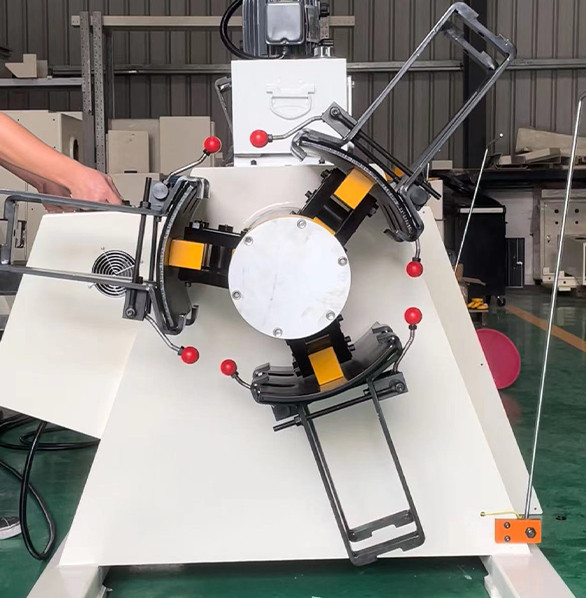
Read the table column by column rather than row by row. The capital column is read once; the tension column is read every shift.
What One Press Actually Demands
A single press at 120 SPM with 300 mm feed consumes 36 metres a minute. That is a modest demand that a motorised drive handles comfortably.
At 250 SPM and 600 mm feed the line consumes 150 metres a minute, and paying off that fast needs a drive that anticipates rather than reacts.
Coil weight is the second demand. Above 3 tonnes, manual loading stops being practical regardless of speed.
Strip condition is the third. Coated, polished or thin material tolerates very little tension variation, which is exactly what a manual brake produces.
Run those three numbers against your own cell before reading the capital index. Two of the three usually decide it.
Feed length matters as much as speed. A short feed at high speed demands more acceleration than a long feed at the same rate.
On a single press the drive is almost never the bottleneck. The press cycle is, and it sets the ceiling for everything upstream.
Where the Manual Drive Still Wins
A cell running one coil an hour on 1-tonne coils at low speed does not need a motor. The manual drive is simpler, cheaper and easier to maintain.
It also wins where there is no maintenance electrician, because there is nothing electrical to fail.
And it wins on very thick material, where tension variation barely affects the finished part and the strip pulls the coil down without complaint.
A plant running 3 mm hot rolled at 60 SPM on a single press is a legitimate manual-drive application, and buying hydraulic there is money spent on nothing.
A manual uncoiler on a 1-tonne coil at 60 SPM is a sound machine, and the strip it produces is indistinguishable from a hydraulic one.
It also takes less floor space, because there is no drive panel to house and no valve to protect from dust.
Where Buyers Pay for Drive They Never Use
Hydraulic drives are frequently bought for a future multi-press line that never arrives. The proportional valve then spends its life at one setting.
Motorised drives are sometimes bought for a coil weight the cell never runs, which adds inertia the line does not need on acceleration.
And both are sometimes bought to solve a marking problem that is actually a guide or a roll surface issue.
Ask what specific fault the extra drive is meant to prevent. If the answer is vague, the drive is being bought on principle.
A hydraulic drive on a line that runs one coil size is buying adjustability that will never be adjusted.
The same logic applies to a motorised drive with a dancer on a line that never changes speed.
Choosing in Four Questions
- What is the heaviest coil in the next five years? Above 3 tonnes, manual loading stops being practical.
- What is the maximum line consumption in metres per minute? Above 100, a reacting drive is not enough.
- Is the strip coated, polished or thinner than 0.8 mm? If yes, tension variation will show as a defect.
- Who maintains it? A hydraulic drive needs a technician, and a manual drive needs nobody.
- How many coils per shift? Above eight, coil end handling alone justifies a driven unit.
The decoiler range lists mandrel size, coil weight and drive type per model, which is the comparison these five answers should be read against.
Two of the five questions usually decide the answer, and they are rarely the ones a quotation emphasises.
Answer the coil weight question first. It eliminates two of the three options more often than any other answer.
Coil car compatibility belongs in the same conversation. A drive that fits the frame may leave no room for a car.
Ask for the drive response time in milliseconds. A motorised drive reacting in 200 ms is following tension, not controlling it.
Hydraulic drives respond in 20 to 40 ms, which is why they hold tension through a coil change better than a motor alone.
That difference only shows on thin coated strip. On 3 mm hot rolled, neither response time is visible in the finished part.
Mandrel design matters as much as the drive and is quoted less often.
A 4-segment mandrel grips a coil with a true 508 mm bore properly and slips on a 610 mm bore unless it has enough expansion travel to close the gap.
Ask for the expansion range in millimetres before the drive specification, because a coil that spins on the mandrel defeats any drive behind it.
This is the single most common cause of surface marking on the inner wraps.
Back tension is the second number worth measuring rather than assuming.
A motorised unit holding 15 percent of coil weight gives a stable loop on 1.5 mm mild steel and almost nothing on 0.5 mm, where the strip needs less absolute tension but more consistency.
Where the cell runs one material and one gauge, a manual decoiler with a friction brake on the spindle will hold tension well enough.
The labour cost is the brake adjustment at each coil, roughly two minutes, and that is the whole difference on a job that changes coil twice a shift.
Where gauges change through the week, the brake has to be re-set each time and the setting is a judgement call.
That judgement is where a motorised uncoiler earns its price, because the tension becomes a stored value instead of a feel.
Where to go next
Drive choice is one of three decisions that set what a decoiler can do, alongside capacity and mandrel range.
The decoiler specification guide treats all three together, which is the only way the trade-offs stay visible.
The Coil Line Guide LibraryWhat coil weight above 3 tonnes needs a driven uncoiler?
Above 3 tonnes for practical loading, and above 1 tonne if one person has to handle the coil without a hoist.
Does a manual uncoiler mark coated strip?
Usually yes, late in the coil. Tension rises as diameter falls, and the strip scratches against its own wraps.
Is a hydraulic drive worth it for a single press?
Only on coated thin strip or at consumption above 150 metres a minute. Otherwise a motorised drive covers the same range.
Is the 80 to 120 percent price step worth it on a 2-tonne coil?
Between 80 and 120 percent of the manual unit price, so roughly double, before any coil car is counted.
Can a manual uncoiler be upgraded later?
Sometimes. If the frame and mandrel are rated for it, a motor and drive can be added. Check the frame rating first.
What consumption rate needs proportional tension control?
Above about 150 metres a minute on strip thinner than 1 mm. Below that, loop control holds tension well enough.