Why Do Punches Break When an NC Servo Feeder Misfeeds?
- Share
- publisher
- David Park - Senior Stamping Engineer, FANTY Machinery
- Issue Time
- Sep 14,2026
Summary
Why a misfeed is a timing event rather than a positioning error, the four mechanisms that turn a short feed into die damage, what happens in the last 30 milliseconds before ram contact, and detection worth fitting this week.
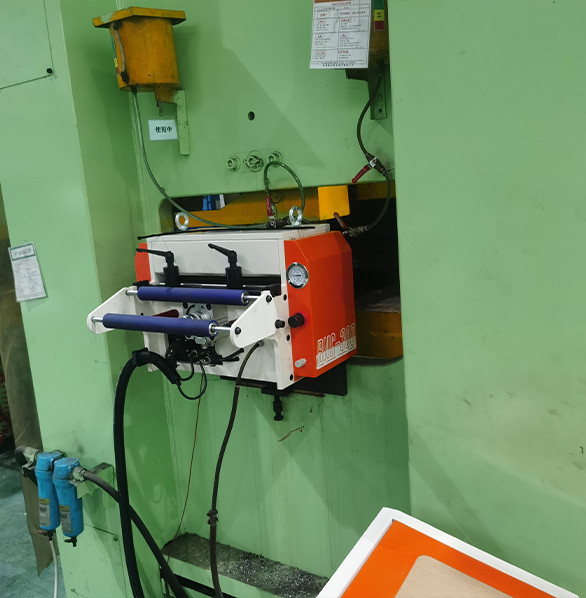
A punch does not fail because it is weak. It fails because it arrived at the wrong place at 180 strokes a minute. On a coil-fed line, a misfeed of half a strip thickness is enough to drive a punch corner into the die shoulder instead of the clearance gap, and the resulting load spike is roughly four to six times the normal cutting force. That spike is what breaks the punch. The misfeed is the cause; the fracture is only the receipt.
This is the failure mode that costs coil-fed shops the most money, because the repair invoice is always smaller than the downtime it caused. A broken punch might cost a few hundred dollars to replace. The press stoppage, the die teardown, the re-qualification of the first fifty parts and the scrapped coil in the line cost far more. Understanding how an NC servo feeder misfeed turns into die damage is the first step toward preventing it. Our coil feeding equipment range is built around this exact problem, and our engineering group of more than 80 R&D engineers spends most of its time on it.
A Misfeed Is a Timing Event
Engineers tend to describe misfeeds in spatial terms: the strip ended up 0.4 mm short. The die sees it in temporal terms: the strip was still settling when the press came down. Those two descriptions lead to different fixes, and only the second one is useful.
Think about the sequence inside a single stroke on a progressive die running at 180 SPM. That is 333 milliseconds per stroke. Of that, the press spends perhaps 120 milliseconds with the ram below the point where material contact matters. The feeder has the rest of the cycle to accelerate the strip, move it the programmed length, decelerate it to a stop and hold position. On a well-tuned NC servo feeder, the move occupies 90 to 140 milliseconds and the remaining time is margin. When anything eats into that margin, the strip is still moving, or still vibrating, when the pilot pins enter.
Pilot pins are the tell. On a die with pilots, the pin pulls the strip into register before the cutting edges engage, which hides small positional errors but transfers them into pilot wear and strip distortion. On a die without pilots, there is no second chance: whatever position the strip held at contact is the position it gets cut at.
Four Ways a Misfeed Reaches the Die
Not every misfeed looks the same, and the remedy differs by mechanism. Here are the four I see most often, with the signature that identifies each.
| Mechanism | What the operator sees | Root cause | First fix |
|---|---|---|---|
| Short feed from roll slip | Random short parts, one or two per thousand | Roll pressure too low for the strip width, or glazed roll coating | Reset roll pressure to the gauge chart, then re-coat or replace rolls |
| Long feed from overrun | Consistent over-length, growing through the shift | Deceleration profile too aggressive, or brake friction falling as the machine warms | Lengthen the deceleration ramp and re-check the holding current |
| Position loss at high speed | Failures cluster above a specific SPM | Move time exceeds the available cycle window; following error exceeds tolerance | Reduce move distance per stroke, or accept a lower stroke rate until the profile is retuned |
| Partial stroke from obstruction | Strip kinked or marked at one edge, punch breaks immediately | Swarf, a burr or a deformed strip edge jamming the feed rolls or the entry guide | Clear the obstruction, then find out why the guide let it through |
Read the failure pattern before you touch a setting. Random failures point at a mechanical contact problem. Consistent failures point at a profile or thermal problem. Speed-dependent failures point at the cycle budget. A punch that breaks on the very first stroke after a tool change points at setup, not at the feeder.
What Happens in the Last 30 Milliseconds
The window that decides whether a punch survives is smaller than most people assume. On a servo feed, the move command ends with a position hold, but the strip does not stop dead. It has mass, it has strip tension on both sides, and it has the elastic behaviour of a long strip span between the feed rolls and the die.
Three things continue to move after the servo reports "in position." The first is the strip span itself, which behaves like a stretched spring and can oscillate at 15 to 40 Hz depending on span length and tension. The second is roll compliance: the polyurethane or composite coating on the feed rolls compresses under clamping force and relaxes over a few milliseconds. The third is the loop on the decoiler side, which changes the effective back tension the strip sees at the rolls.
That is why raising roll pressure fixes some misfeeds and makes others worse. More pressure reduces slip and increases roll compliance simultaneously. There is a window, and finding it is a matter of testing rather than guessing. On a line we commissioned last year running 0.9 mm CRS at 210 SPM, the optimum roll pressure band was 12 percent wide. Below it, slip; above it, visible roll marking and a slight increase in feed scatter as the coating compressed.
Why Short Feed Lengths Hide the Problem
Short feeds are the most dangerous configuration on a coil line, and they are the hardest to diagnose because they look healthy on the gauge.
When the programmed feed length is short, the servo spends less time accelerating and more time settled. Scatter on the finished part looks excellent. But the strip span between the feed rolls and the die is still long, and the loop dynamics have not changed. The result is a line that holds 0.05 mm on the part for months, then breaks a punch the week the shop runs a longer pitch or adds a station.
Two habits catch this before it costs a die. First, verify position at the die entry, not at the feeder exit, by mounting a dial indicator or a laser sensor on the strip just before the entry guide. The difference between feeder exit and die entry is the span error, and on a 900 mm span it can reach 0.25 mm at production speed even when the feeder reports perfect position. Second, run the longest pitch the tool will ever use during setup, not the pitch of the first job. Set the profile against the worst case and the short pitches take care of themselves.
Detection You Can Install This Week
Preventing die damage does not require a new machine. It requires knowing that a misfeed has occurred before the ram reaches the bottom. These measures pay for themselves the first time they fire.
- Enable the servo following-error window and set the trip threshold at twice your normal peak error, not at the drive default
- Add a proximity or laser sensor on the strip at die entry and wire it to the press stop circuit, not just to an alarm
- Log peak current on the feed servo and review the trend weekly; a rising peak current predicts roll slip before parts go short
- Fit a mechanical strip-end and buckle detector, which catches the failure that no electronic sensor can see
- Write the trip thresholds into the setup sheet so a new operator does not disable them to keep the press running
The last point matters more than the hardware. On three separate shop visits I have found the misfeed detector bypassed with a jumper because it was tripping too often. In every case the detector was right and the setup was wrong. A detection system that gets disabled is worse than none, because it creates the illusion of protection. Any line we ship carries CE marking and the interlocks are designed so that bypassing them requires a deliberate, logged action rather than a jumper wire.
Repairing the Die Is the Cheap Part
When a punch breaks, the instinct is to replace it and get running. That is the correct short-term move and the wrong long-term one, because the conditions that broke it are still in the line.
Before restarting, capture four things: the strip position error at the moment of failure if the control logged it, the feed length of the last fifty parts, the loop height on the decoiler side, and the roll pressure setting. Then compare those against the values recorded when the tool last ran clean. Nine times out of ten, one number has drifted, and finding it takes twenty minutes against a die repair that takes a shift.
There is also a structural lesson in the failure itself. Punches break in the same place because the same load path concentrates stress there. If you have replaced the same punch three times, the die is telling you that the clearance is wrong, the stripper pressure is uneven, or the misfeed protection is inadequate. Replacing the punch a fourth time is a decision to keep paying for the same lesson.
Questions from the press line
Can a servo feeder misfeed without any alarm?
Yes, and it is common. Short feeds caused by gradual roll slip stay inside the following-error window until they suddenly do not. That is why logging peak current and measuring position at die entry matter more than relying on drive alarms.
Does higher roll pressure always mean better feed accuracy?
No. Pressure reduces slip and increases roll compliance at the same time. Every strip material has a window, usually narrow, where accuracy peaks. Test at three or four settings and record the scatter rather than assuming more is better.
Why does the problem only appear above a certain stroke rate?
Because the cycle window shrinks. Below a threshold speed the feeder finishes its move and the strip settles before ram contact. Above it, the strip is still oscillating when the pilots enter. Retuning the motion profile buys back time, but there is always a speed where the geometry no longer allows it.
Is it worth adding a strip position sensor on an older line?
Usually yes. A sensor at die entry costs a fraction of one punch and die repair, and it catches the span error that the servo cannot see. Wire it into the stop circuit rather than to a light, or nobody will act on it in time.
How often should feed roll pressure be checked?
At every tool change and after every roll replacement. Roll coating wears gradually, so a setting that was correct in January can be 15 percent low by June without anyone adjusting anything.
Chasing misfeeds on a coil-fed press?
Tell us your strip material, thickness, feed length and press speed. Our engineers will work out whether the cycle window is the limit, or whether a profile and roll-pressure change will hold your tolerance at the speed you need.
Ask an engineer to review your lineFanty · NC Straightener Feeder
Pitch, Pass Line and Roll Pressure, Sorted Before You Order
Tell us your press stroke rate and feed length. Our engineers match servo feed power, straightener roll geometry and loop control to your actual cycle time.
Get a Free QuoteFANTY Machinery · 13 years on stamping automation · 2,000+ coil lines installed · engineers reply within 24 hours