How Much Strip Length Does an NC straightener feeder Need?
- Share
- publisher
- David Park - Senior Stamping Engineer, FANTY Machinery
- Issue Time
- Oct 20,2026
Summary
The distance between the NC straightener feeder and the die is usually whatever the bay allows. It should be a calculation, because too short a span transmits straightener correction into the die.
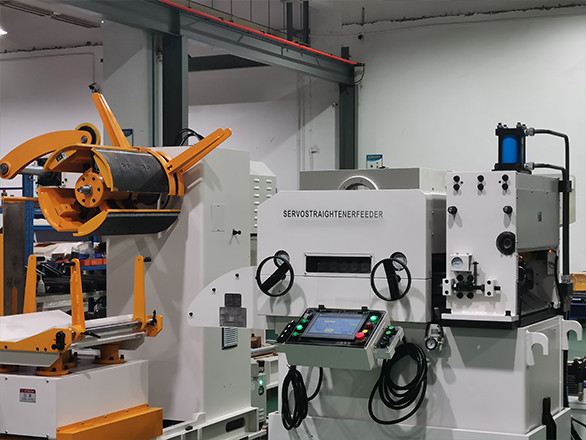
Ask why the straightener sits where it sits and the answer is usually the bay, the crane or the slab joint. Almost never the strip.
An NC straightener feeder straightens strip continuously. Between its exit and the die, that strip is free, and the length of that free span decides how much of the correction reaches the die.
Too short and the die inherits every straightener adjustment. Too long and the loop becomes unstable at speed. There is a range, and it is calculable.
Why the Distance Between Straightener and Die Matters
A straightener works by bending strip through a series of rolls. The strip leaves with a curvature that is not quite zero, and it relaxes over some distance.
Give it too little distance and it enters the die still relaxing, which shows up as a feed length error and a flatness defect at the same time.
Give it too much and the free span starts to behave like a spring, particularly on thin strip, which makes the loop control hunt.
The span also sets how much strip has to be re-threaded after a coil break, which is a small cost that repeats forever.
None of that is speculative. All of it is measurable on a running line with a tape measure and a stopwatch.
The relaxation is not visible on a bench sample, which is why the problem survives inspection and then appears in production.
The Four Inputs: Feed Length, Speed, Roll Count and Loop
Feed length sets the minimum. The free span must hold at least two feed lengths so the loop can absorb a stroke without pulling on the straightener.
Speed sets the dynamic requirement. At 200 SPM the loop moves faster than most people expect, and span length dampens or amplifies that movement.
Roll count sets how much correction is left in the strip. A nine-roll head leaves less residual curvature than a five-roll head, so it needs less free length.
Loop depth sets the working range. A deep loop needs a longer span to avoid the strip touching the pit walls at extremes.
Four inputs, all known before the layout is drawn, and all ignored in most layouts.
Material matters as well, but it is not an input you can change. It decides which end of the band you should aim for.
Worked Example: 350 mm Feed at 200 SPM
Feed length 350 mm, 200 SPM, nine-roll head, loop depth 400 mm. Minimum span by the two-feed-length rule is 700 mm.
The dynamic requirement is larger. At 200 SPM the loop cycles three times a second, and a span under about 1.2 metres transmits that cycling into the straightener exit.
On this line the working span was 1,450 mm, which sits comfortably inside the 1,200 to 1,800 mm band for this combination.
Shortening it to 900 mm to gain floor space produced a feed length variation of 0.06 mm within a shift, which is most of the tolerance budget.
Measure the span on the line you already run. Most plants find it is 30 percent shorter or longer than this calculation suggests.
| Feed length | Minimum span | Working span, 9-roll | Where It Costs You |
|---|---|---|---|
| 150 mm | 300 mm | 800 to 1,100 mm | Short feeds tolerate a shorter span |
| 350 mm | 700 mm | 1,200 to 1,800 mm | The common case on a 1,300 mm line |
| 600 mm | 1,200 mm | 1,800 to 2,400 mm | Long feeds force a long span and a long bay |
| 900 mm | 1,800 mm | 2,400 to 3,000 mm | Bay length becomes the constraint, not the machine |
The table is a starting band, not a specification. Thickness and material move it by 20 to 30 percent in either direction.
What Happens When the Distance Is Too Short
Too short shows up first as feed length variation that grows through a shift, because the strip entering the die is still relaxing.
It shows second as flatness rejection that appears only at speed, since the relaxation is faster relative to the stroke at 200 SPM than at 80.
It shows third as die wear on the pilot pins, because a strip that is still moving slightly when the pilots engage wears them faster.
All three are blamed on the die, the material or the feeder, and none of them is any of those things.
A feed length variation that grows through a shift is the clearest symptom, because relaxation depends on time as well as distance.
What Happens When It Is Too Long
Too long shows up as loop instability. The loop sensor sees a wave it cannot damp, and the drive oscillates instead of holding speed.
It shows second as strip sag on thin material, where the free span bows under its own weight and changes the entry angle to the die.
It shows third as re-threading time after a coil break, which grows linearly with span and is the most annoying of the three.
A span that is 40 percent longer than needed costs a minute of threading at every coil break, forever.
Loop instability at speed is the clearest symptom of an over-long span, and it appears as a drive oscillation rather than a strip defect.
Where the Distance Is Fixed by the Building
Sometimes the bay decides and the calculation cannot win. A column, a wall or a slab joint can fix the span whether the strip likes it or not.
In that case the options are a different roll count, a different loop depth, or accepting the tolerance the building allows.
A nine-roll head tolerates a shorter span than a five-roll head, so roll count is the lever when the bay is tight.
Reducing loop depth also helps, at the cost of more frequent coil changes because the buffer is smaller.
What does not work is shortening the span and expecting the feeder control to compensate. The control adjusts feed length, not relaxation.
Reducing penetration at the exit pair also lowers residual curvature, which effectively buys span you do not physically have.
Measuring What You Have
- Measure from the straightener exit roll to the die entry, not from the machine frame.
- Record the loop depth at the same time, because the two numbers only mean something together.
- Run a strip sample before the die at three speeds and compare flatness. Variation across speeds points at the span.
- Check pilot pin wear against hours run. Faster wear than expected is a span or pass line symptom.
- Note the re-threading time after a coil break. Above two minutes, the span is longer than the job needs.
Adjusting Without Moving the Machine
Three adjustments can change the effective span without moving anything structural, and each has a limit.
Increasing roll count is not an option on a fixed machine, but adjusting penetration changes how much correction remains at exit.
Reducing loop depth shortens the working span and stabilises the loop, at the cost of coil change frequency.
Changing the pass line height changes the entry angle to the die, which can reduce the visible effect of a short span without solving it.
Run the same calculation at 0.8 mm and the answer changes shape. Feed length drops to roughly 26 mm, so the span needed for relaxation falls faster than the span needed for loop stability, and the two curves cross.
That crossing is why thin gauge lines end up with a span sized by loop stability rather than by strip length. Below about 1 mm, the number that decides the layout is the loop, not the relaxation distance.
Threading time is the third pressure and it pulls in the opposite direction.
Every extra 300 mm of span adds a few seconds to each coil change, which on a line changing coil eight times a shift is a real number across a year.
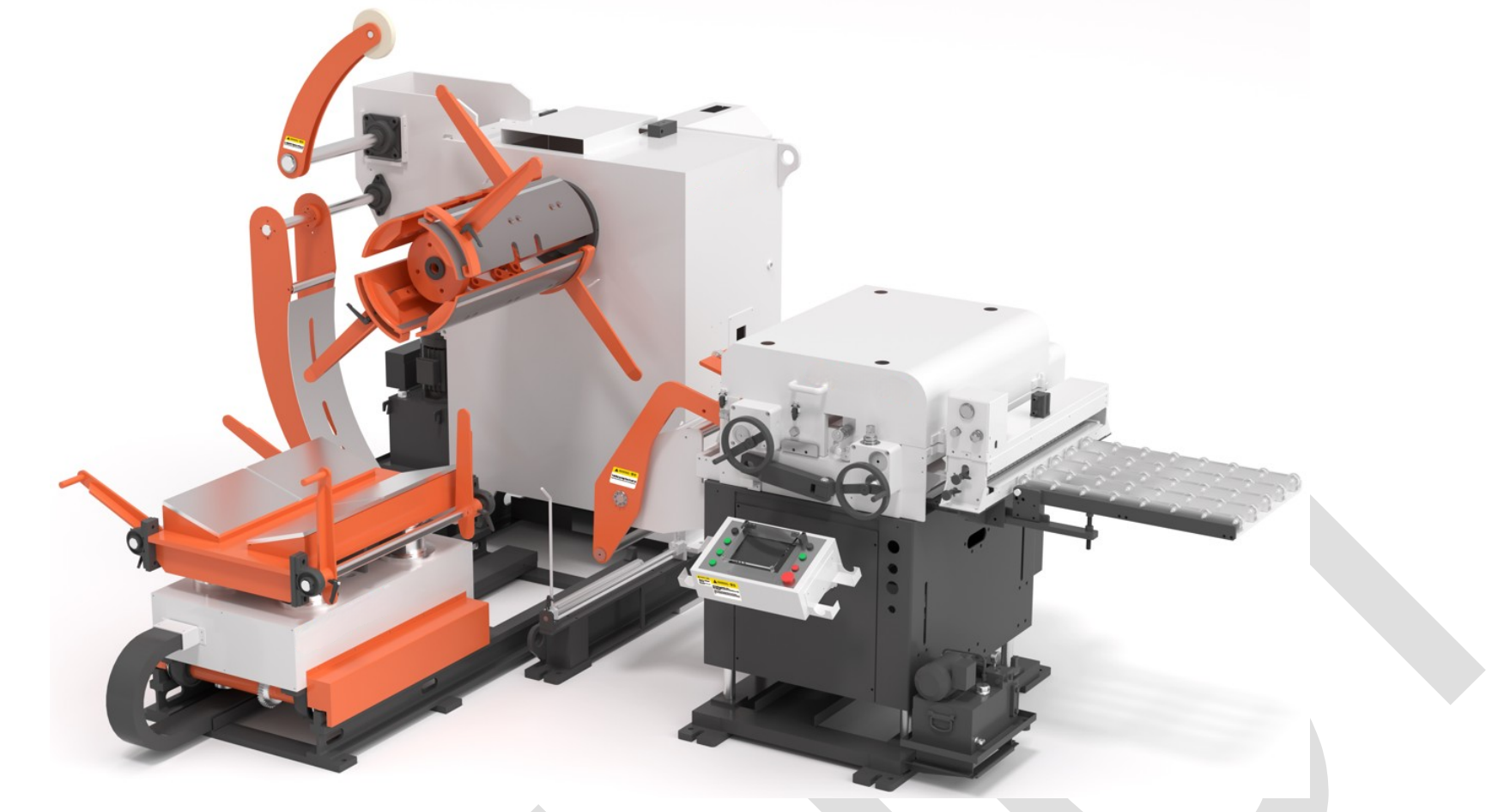
The 3-in-1 feeder range lists overall length and roll count per model, which is how much span a given machine can actually offer.
Where to go next
Span length is one of four settings that decide flatness, and the easiest to get wrong because the building decides it. The flatness guide covers the other three, which are the levers once the span is fixed.
The Coil Line Guide LibraryWhat is the minimum strip span between straightener and die?
Two feed lengths. At a 350 mm feed that is 700 mm, and the practical working span is 1,200 to 1,800 mm on a nine-roll head.
Does a 1,800 mm span improve flatness?
It allows relaxation to complete, which helps up to a point. Beyond that, loop instability and strip sag cost more than the relaxation gains.
How much can a short span cost in feed accuracy?
0.05 to 0.08 mm of variation within a shift on a 1,200 mm line, which is most of a 0.10 mm tolerance budget.
Can 400 mm of loop depth replace span length?
No. Loop depth sets the buffer, span sets the relaxation distance. They are separate numbers and both matter.
Why does flatness fail at 200 SPM but pass at 80 SPM?
Because the strip relaxes more slowly relative to the stroke at higher speed. A short span hides at low speed and shows at production speed.
What is a normal re-threading time after a coil break?
Sixty to ninety seconds on a well-laid-out line. Above two minutes, the free span is longer than the application needs.