How to Set Up a Straightener Feeder for a New Coil Width?
- Share
- publisher
- David Park - Senior Stamping Engineer, FANTY Machinery
- Issue Time
- Oct 17,2026
Summary
Here is the sequence, what to check at each step, and the three mistakes that only appear after the line has been running a while.

Dropping from 1,300 mm to 1,000 mm on a 3-in-1 decoiler straightener feeder looks like a guide adjustment. It is six adjustments, and the order matters more than the settings.
Do them in the wrong sequence and the line will run, produce good parts for two hours, then start tracking to one side as the strip warms and the guides settle.
The sequence below is the one that survives a shift change, because each step leaves the next one measurable.
A Width Change Is Six Adjustments, Not One
Guides, roll crown, roll gap, pass line, decoiler centring and edge sensing all move when the strip narrows. They interact, and the interactions run in one direction.
Guides set before roll gap will be wrong after it, because closing the gap changes where the strip sits vertically and how much it spreads under load.
Pass line set before the decoiler is centred will be wrong too, because a coil offset by 20 mm pulls the strip against one guide continuously.
So the sequence runs from the coil backwards to the die: decoiler, guides, crown, gap, pass line, sensors.
Step 1: Release the Guides Before You Move Anything
Loosen both edge guides and open them 30 mm wider than the new strip. Trying to slide a guide against strip tension scores the guide face and the strip edge together.
Retract the edge sensors as well. A sensor that meets a moving strip edge during setup is a sensor you will be replacing next week.
Withdraw the side guide rolls if the machine has them, and check that the entry and exit guides are both free before the coil starts.
Two minutes confirming both guides are free is cheaper than an hour replacing a scored guide face.
Step 2: Set Roll Crown and Gap for the Narrower Strip
Narrower strip uses less of the roll face, so the same gap produces a different contact pattern. Set the gap first, then verify crown on a strip sample.
The starting point is the same as for the wider material, adjusted for any change in thickness. Width alone does not change the gap.
What width does change is where the strip sits relative to the roll crown. A strip running on the flat centre of a crowned roll straightens evenly; one running near the roll shoulder does not.
On a 1,300 mm machine running 1,000 mm strip, the strip occupies the centre 77 percent of the face, which is comfortable. Below 50 percent the shoulder effect becomes visible.
Roll crown itself is fixed on most machines. What changes with width is how much of that crown the strip actually uses, and that is a setup question.
On machines with adjustable back-up rolls the setting follows strip width rather than strip thickness, which is the opposite of what most operators assume.
Step 3: Recheck the Pass Line, Not Just the Roll Gap
Pass line is the height at which strip leaves the straightener and enters the die. It is set with a gauge, not by eye, and it changes when roll gap changes.
A pass line that is 1 mm high shows up as a strip that lifts off the entry guide and creates a wave at the straightener exit.
A pass line that is 1 mm low shows up as wear on the bottom of the entry guide and a slight upward curl at the die entry.
Both are easy to measure and easy to miss, because the strip still feeds and the parts still look acceptable for the first hour.
Measure pass line at the straightener exit with the strip under tension. A measurement taken with the line stopped changes the moment it runs.
A magnetic base and a dial gauge take two minutes and settle an argument that otherwise runs for a week of email.
Step 4: Centre the Decoiler on the New Width
The coil centreline and the line centreline have to agree within about 2 mm on a 1,000 mm strip. Beyond that, the guides are doing correction work they were not designed for.
Centre the mandrel, load the coil, then check the coil against the guide faces rather than against the frame. Coil winding is not always centred on the bore.
A coil that is 8 mm off centre will pull consistently to one side, and the guide will wear a groove into coated material after a single shift.
Edge sensors left where they were set for 1,300 mm will read the new strip edge as a strip break, and the line will stop for no visible reason.
Check the loop pit at the new width as well. Narrow strip can drop past a loop roller that wide strip has never missed.
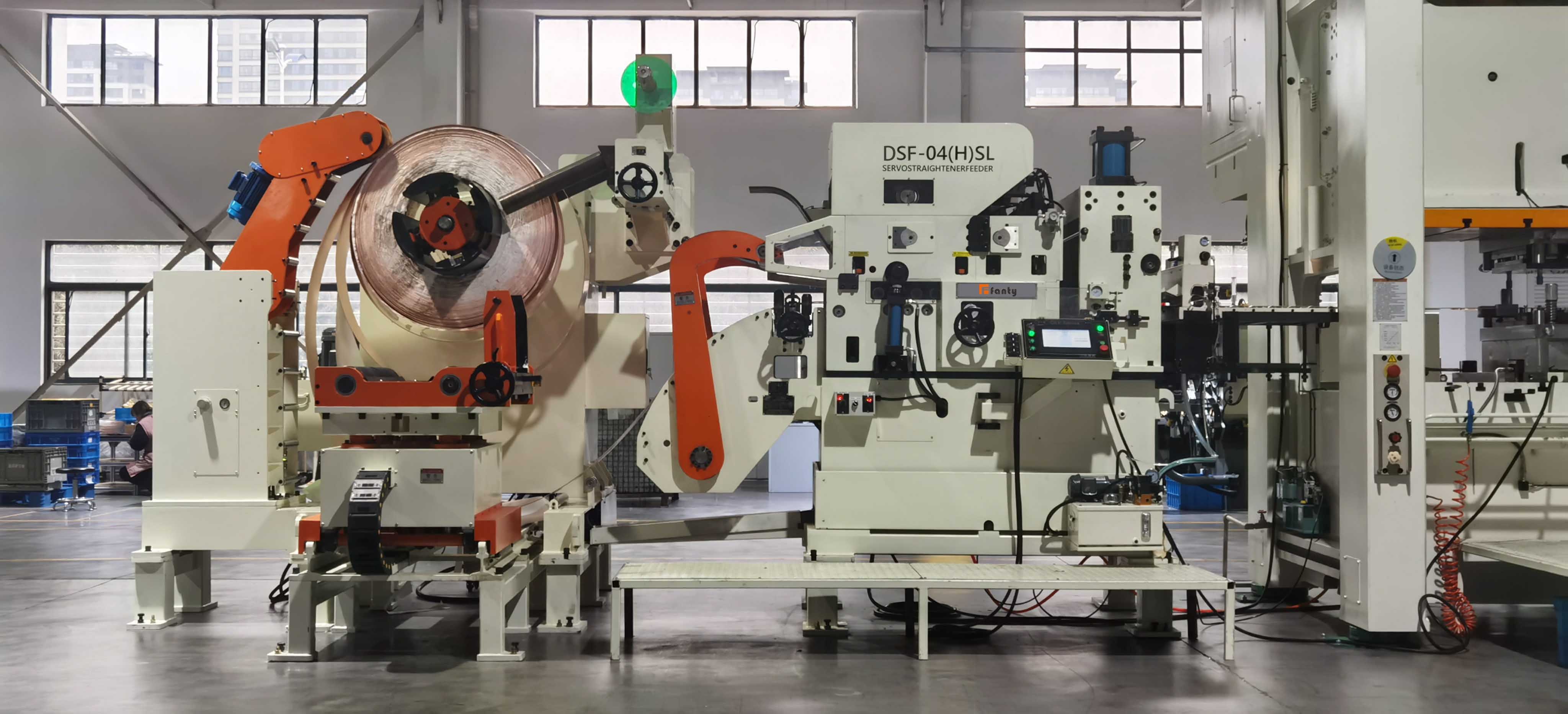
Steps 5 and 6: Sensors, Then a Slow First Coil
- Bring the edge sensors in until they see the strip with 5 mm clearance on each side, then lock them.
- Confirm the loop sensor still reads across the full loop range at the new width, not just at mid-loop.
- Run the first coil at 30 percent speed for ten strokes and watch the strip at the straightener exit, not at the die.
- Check edge condition after the first twenty strokes. A bright line on the strip edge means a guide is too tight.
- Re-torque the guide locks after the first coil, because they settle as the machine comes to temperature.
The Mistakes That Show Up Two Hours Later
What the Same Change Costs on a 1,600 mm Machine
A 1,600 mm machine running 1,000 mm strip performs the same six steps and spends twenty extra minutes on guide travel alone.
Guide travel scales with width change. A 300 mm change on a 1,000 mm machine is not the same task as a 600 mm change on a 1,600 mm machine.
The roll shoulder problem gets worse too, because narrow strip on a wide machine sits further from the roll centre and closer to the crowned edge.
Plants running both widths keep a written recipe card per width rather than re-deriving settings each change. The card carries gap, pass line and guide positions.
That card is worth more than most control features, because it records the numbers that actually produced good parts on that machine.
Recipe cards are also the fastest way to train a new operator, because they show what good looks like on that machine rather than in principle.
Keep them laminated at the machine and update them whenever a setting changes for a reason somebody can explain out loud.
If the width range is still being decided, the 3-in-1 feeder range shows roll face width and guide travel for each model, which is the figure that sets changeover time.
A machine 200 mm wider than the widest job costs twenty minutes on every change. Across a year of weekly changes that is most of a working week.
| Mistake | What you see at setup | What appears two hours later | Where It Costs You |
|---|---|---|---|
| Guides set before roll gap | Straight strip, easy threading | Strip walks to one side as gap settles | Die misalignment and pilot wear |
| Pass line set by eye | Strip runs and feeds | Edge wave at the straightener exit | Flatness rejection on the finished part |
| Decoiler left 10 mm off centre | Nothing, the line runs | Groove worn in one guide face | Guide replacement and edge scrap |
| Coil centre set from the coil OD | Coil looks centred | Constant pull to one side | Continuous guide correction and camber |
Every row in that table passed the first coil. That is what makes width changes deceptive: the setup looks successful for the length of a shift change.
The remedy is not more care at setup. It is a written sequence with a measurement at each step, and a first-coil check that happens after twenty strokes rather than after two.
Where to go next
Width changeover is the most frequent setup on a 3-in-1 line, and part of the wider flatness question. The flatness guide covers roll count, pitch and penetration, which is where a persistent edge wave is solved.
The Coil Line Guide LibraryHow long should a 300 mm width change take on a 3-in-1 feeder?
Thirty-five to fifty minutes for a 300 mm width change, including first-coil verification. Under twenty-five minutes means a step is being skipped.
At what width ratio does roll crown start to matter?
Below about 50 percent of roll face width. A 1,300 mm machine running 600 mm strip will show shoulder effects that a 1,000 mm job never does.
How far off centre can a 1,000 mm coil sit before it causes problems?
About 2 mm on a 1,000 mm strip. Beyond 5 mm the guide does continuous correction work and starts to wear.
Do I need to change roll pressure for a narrower coil?
Only if the thickness changed. Width alone does not change required pressure, but it does change where that pressure is applied across the roll face.
Why does the strip track straight for two hours and then drift?
Because the guides and roll stack settle as the machine reaches operating temperature. Re-torquing guide locks after the first coil removes most of it.
Can an NC straightener feeder store width recipes?
Most current controls store gap, pass line and feed length. Guide positions usually stay manual, which is why the sequence still needs a written checklist.