Why Does an NC Straightener Feeder Mark Coated Strip?
- Share
- publisher
- David Park - Senior Stamping Engineer, FANTY Machinery
- Issue Time
- Sep 20,2026
Summary
Marks on pre-painted strip come from at least four mechanisms and only one is pressure. This diagnostic sequence reads the mark spacing to find the source, shows what each mechanism costs to fix.
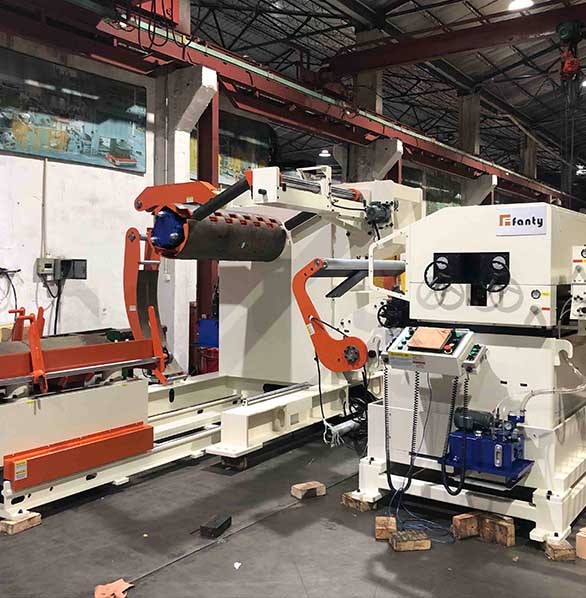
Pre-painted strip arrives with a coating 20–25 µm thick that will show every contact it makes.
The customer sees a mark, the part is rejected, and the first assumption is always the same: the straightener is pressing too hard.
Half the time that is wrong. Marks on coated strip come from at least four different mechanisms, and only one of them is pressure.
Reaching for the pressure adjustment first means you will spend a shift chasing a problem that lives somewhere else in the line.
This is the diagnostic sequence I use on a line running coated or pre-painted material through an NC straightener feeder.
It covers how to locate the source from the mark itself, what each mechanism looks like, and which fixes cost you speed.
The roll geometry behind the contact pattern is covered in the flatness work on the 3-in-1 decoiler straightener feeder, and the machine range sits in our product range.
Start With the Mark, Not the Machine
The mark carries the information you need. Before touching a setting, measure two things: the spacing between marks along the strip, and whether the mark is on one face or both.
Mark spacing equal to the work roll circumference. If marks repeat every 200–250 mm on a machine with 70 mm work rolls, the spacing matches one roll revolution.
That points to a defect on the roll surface — a raised spot, embedded debris or a work-hardened patch.
Mark spacing equal to the feed pitch. If marks repeat every 180 mm and your feed is 180 mm, the source is downstream of the straightener: the die, the feed rolls or the entry to the die.
Continuous marking along the whole strip. No periodicity means the strip is being scrubbed continuously. That is pressure, tension, or a speed mismatch between rolls.
Mark on one face only. A mark on the top face implicates the top rolls and anything touching the top surface. Marks on both faces point to pressure or tension rather than a single damaged roll.
This takes five minutes with a tape measure and a marker, and it eliminates three of the four mechanisms before you change anything.
Four Mechanisms and What Each One Costs to Fix
| What the mark looks like | Mechanism behind it | How to confirm it | Where the fix costs you |
|---|---|---|---|
| Discrete marks repeating at roll circumference spacing, one face only | Roll surface defect: embedded debris, a raised spot or a polished patch | Inspect the suspect roll under a light with the strip out; a defect prints at exactly one point per revolution | Roll change or re-grinding. On a 9-roll machine that is a set of rolls, not one |
| Continuous faint banding along the whole strip, both faces | Penetration or roll gap set too tight for the coating hardness | Reduce penetration in 0.05 mm steps and re-run 2 m. If the mark fades before flatness fails, this is the cause | Flatness margin. Backing off penetration trades flatness for surface |
| Smear or drag marks, worse at higher line speed | Surface speed mismatch between rolls, or back tension too high for the coating | Check roll drive synchronisation and log back tension; drag marks scale with speed, pressure marks do not | Speed. Reducing tension or speed costs throughput, and re-synchronising rolls is a maintenance job |
| Marks concentrated on one edge, often intermittent | Strip tracking off-centre, so the edge of the roll or a guide contacts the strip | Measure the gap from each roll edge to the strip edge; unequal gaps confirm tracking | Setup time per coil, plus guide wear. The root cause may be camber in the coil, which no setup fixes |
The second row is the one everybody assumes. It is also the one where the fix has a real cost, because penetration and flatness are directly linked.
On a 1.0 mm pre-painted panel, a typical working penetration might be 0.6–0.9 mm to achieve the required flatness.
If marking starts at 0.7 mm, you have a narrow window and a genuine conflict between two specifications.
Resolving that conflict is a machine specification question, not a setup question: roll diameter, roll count and surface finish all shift the window.
That is why the answer is sometimes a different machine rather than a better setting.
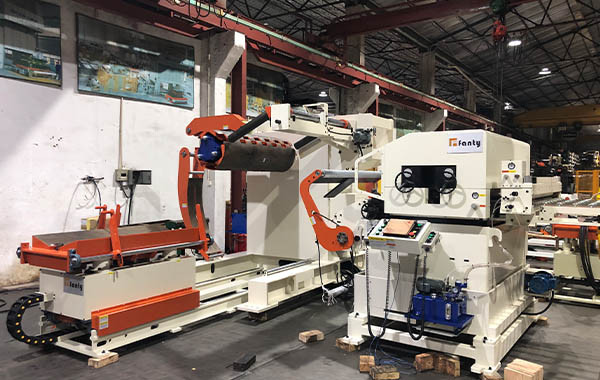
Machine Choices That Move the Marking Threshold
Four machine characteristics decide whether coated strip marks at all, and three of them are fixed at purchase.
Roll count. A nine-roll straightener puts roughly 80% more contact length on the strip than a five-roll machine. More contact means better flatness and more marking risk, and the trade is not adjustable afterwards.
Roll diameter. Larger rolls need less penetration to achieve the same flatness because they bend the strip over a longer arc. They also spread the contact pressure.
Small rolls on thick strip are the worst combination for surface.
Surface finish. Work rolls finished to Ra 0.2–0.4 µm hold a mirror-like surface that shows up on coated strip.
A slightly coarser, directionally finished roll face carries debris away from the contact rather than trapping it.
Roll drive arrangement. Driven rolls with synchronised surface speed avoid the scrubbing that idle rolls can produce.
This is the one item that can sometimes be retrofitted, and it is usually the cheapest fix when drag marks are the problem.
If you are buying for coated material, specify the surface finish and the roll count for it.
A machine selected for heavy-gauge flatness will achieve that specification and mark your coating, and no amount of commissioning time will change the geometry.
What Straightening Cannot Fix
Five cases where the mark will not respond to anything done at the straightener, and where chasing it wastes a shift.
Marks made upstream. A pinch roll, a peeler arm or an entry guide that touches the coated face will mark it before the strip reaches the work rolls. The straightener then gets blamed for a mark it received.
Coating already damaged in the coil. Handling damage, mill scratches and transit abrasion are in the material. Straightening can only add to them.
Coating too soft for any contact. Some PVC-laminated and low-bake coatings mark under finger pressure. If the coating cannot survive a rubber roller, it will not survive a hardened steel work roll.
Mill surface defects. Rolled-in scale, slivers and edge cracks are in the substrate. They can look like marks after straightening because the straightener has flattened the strip around them.
Where the specification misleads. Two machines can carry identical flatness specifications and behave completely differently on coated strip.
Flatness is measured on the strip. Surface damage is not measured at all, which is why the two datasheets are not comparable.
If coated material is your product, ask for a sample trial rather than comparing specification sheets.
The last point is worth acting on before you buy. A supplier who will straighten your actual coated strip and return the sample is telling you they understand the difference between the two specifications.
Verifying a Fix Without Scrapping a Coil
- Run a 2 m sample, not a coil. Two metres is enough to see periodicity and enough to measure flatness on a surface plate. Threading a full coil to test a setting wastes material every time the setting is wrong.
- Change one variable per run. Penetration, tension and roll speed all affect marking. Changing two at once means you cannot attribute the improvement, and you will not know which setting to record.
- Measure flatness at the same time as surface. The point of the exercise is to find the setting where marking stops while flatness still passes. Record both numbers on every run, or you will optimise one and lose the other.
- Mark the roll you suspect. Put a witness mark on the roll end so the next run tells you whether the mark moved with the roll or stayed with the strip. Rotating the roll set can move a defect out of the contact zone temporarily.
- Photograph the mark at 10× before and after. Coating marks are often borderline and judged by eye differently on different shifts. A photo with a scale bar settles whether a change helped.
Does a 220 mm mark spacing point to the roll or to the die?
Measure the spacing. Marks repeating at the work roll circumference — roughly 200–250 mm on a machine with 70 mm rolls — come from the roll surface.
Marks repeating at your feed pitch, say every 180 mm, come from the feed rolls or the die, not from the straightener.
Does a 9-roll machine mark more than a 5-roll machine?
It increases exposure. A nine-roll machine presents roughly 80% more roll contact length than a five-roll machine.
That is why a nine-roll machine that achieves excellent flatness on bare steel can mark pre-painted strip where a five-roll machine would not.
What roll surface finish suits a 25 µm coating?
Ra 0.2–0.4 µm is the normal range for work rolls, but for coated material a slightly coarser directional finish carries debris away from the contact rather than trapping it.
Discuss the finish with the machine builder if coated strip is a routine product, because it is set at manufacture.
How much penetration can a 1.0 mm pre-painted panel take?
On a 1.0 mm pre-painted panel, marking typically starts somewhere between 0.6 mm and 0.9 mm of working penetration, depending on coating hardness.
If your flatness requirement needs more penetration than the coating tolerates, you have a machine specification conflict rather than a setup problem.
Can I straighten pre-painted strip at all?
Yes, and it is done routinely — but the machine has to be specified for it. Larger roll diameter, fewer rolls, a suitable surface finish and driven rolls together create a working window.
Buying a general-purpose machine and hoping to tune the marking out of it rarely works.
The pattern across all of this is that coated strip punishes assumptions.
Pressure is the obvious suspect and usually the wrong one, and the two specifications you are trying to satisfy — flatness and surface — pull against each other.
FANTY has been building straightening equipment for 12 years, with a team of 80 engineers in development.
Coated and pre-painted material is one of the duties we ask about at the quotation stage rather than at commissioning.
It changes the roll specification, and it is much cheaper to decide early.
Where to go next
Roll marking is one failure mode of the roll geometry. The roll count, pitch, gap and penetration settings behind it are set out in the guide library.
the complete 3-in-1 decoiler straightener feeder guide